
It's the question pilots hear at every barbecue and family dinner: "So how often do you actually work?" The honest answer is that an airline pilot schedule doesn't look like a normal job. Some months a pilot is home more than friends with office jobs. Other months they're gone most weekends and every holiday. It all depends on seniority, whether they hold a line or sit reserve, and how the trips were built.
Here's what a typical line pilot's month really looks like, from the inside.
The Short Answer: How Many Days Do Pilots Work a Month?
Most airline pilots work somewhere around 12 to 18 days a month. That's the commonly cited range, and it holds up across most airlines. A lineholder with decent seniority often lands in the low-to-mid teens. A junior pilot on reserve may be on call for considerably more days, even if they don't fly all of them.
The catch is that a "day worked" isn't eight hours. A duty day can start before sunrise and end after midnight in a different time zone.
Lineholder vs. Reserve: Two Very Different Lives
Every month, pilots end up with one of two kinds of schedule.
Holding a line
A lineholder gets a fixed schedule for the month, published in advance. You know which days you're flying, where you're going, and when you'll be home. You can plan a dentist appointment, a kid's recital or a weekend away. For most pilots, holding a line is the goal.
The pilot reserve schedule
A reserve pilot is on call. Instead of trips, you're given blocks of reserve days, and crew scheduling assigns you flying as needed: sick calls, delays, cancellations, new trips. Depending on the airline and contract, reserve can be "short call" (be at the airport within a set time, often a couple of hours) or "long call" (more notice, typically the evening before).
A typical call-out goes like this: the phone rings at 5 a.m., a captain has called in sick, and you're on a three-day trip leaving in a few hours, to cities you didn't know you'd see that week. Some reserve months are quiet and you barely fly. Others, you fly almost every day you're available. The hardest part isn't the flying; it's not knowing. Reserve pilots keep a bag packed, the phone loud and plans flexible.
“The hardest part isn’t the flying; it’s not knowing.”
Trips and Pairings: How the Work Is Packaged
Pilots don't work individual flights; we work trips, also called pairings or rotations. A trip is a sequence of flights that starts and ends at your base.
- Day trips: out and back the same day. You sleep in your own bed, but you often have long duty days and early starts.
- Two- to four-day trips: the bread and butter of domestic and regional flying. Several legs a day, overnights in hotels.
- Long-haul trips: fewer legs, longer flights, longer layovers, and bigger time-zone changes.
Trip length shapes your month. Four four-day trips is 16 days away. Eight day trips is eight days of work, but eight early alarms and eight drives to the airport.
Bidding and Seniority: Who Gets What
Schedules are awarded by seniority, meaning your date of hire at your airline. Your hours, skill and previous job don't matter.
There are two main systems:
- Line bidding: the company builds complete monthly lines, and pilots bid on them in seniority order.
- PBS (Preferential Bidding System): you rank preferences, such as days off, trip length, layovers and report times, and software builds your schedule in seniority order.
Many large North American airlines now use PBS. Bids typically close well before the month starts, and awards come out shortly after. In practice, the most senior pilots get close to exactly what they want, and the junior pilots get what's left. Bidding well is a skill: junior pilots learn to bid for what they can realistically hold, not what they'd love to have.
Credit Hours vs. Days Worked
Pilots are mainly paid by credit hours, not by days. Credit is roughly the scheduled block time (gate to gate), plus extra pay protections the contract may add for things like long duty days, short-turn trips or deadheading.
Monthly lines at many North American airlines are commonly built in the 70-to-90 credit-hour range, and contracts include a minimum monthly guarantee. The exact numbers vary by contract.
This is why days worked and hours paid don't line up neatly. A month of efficient long-haul trips might pay well in fewer days. A month of short legs and long sits might keep you away more days for the same credit.
An Airline Pilot Schedule Example
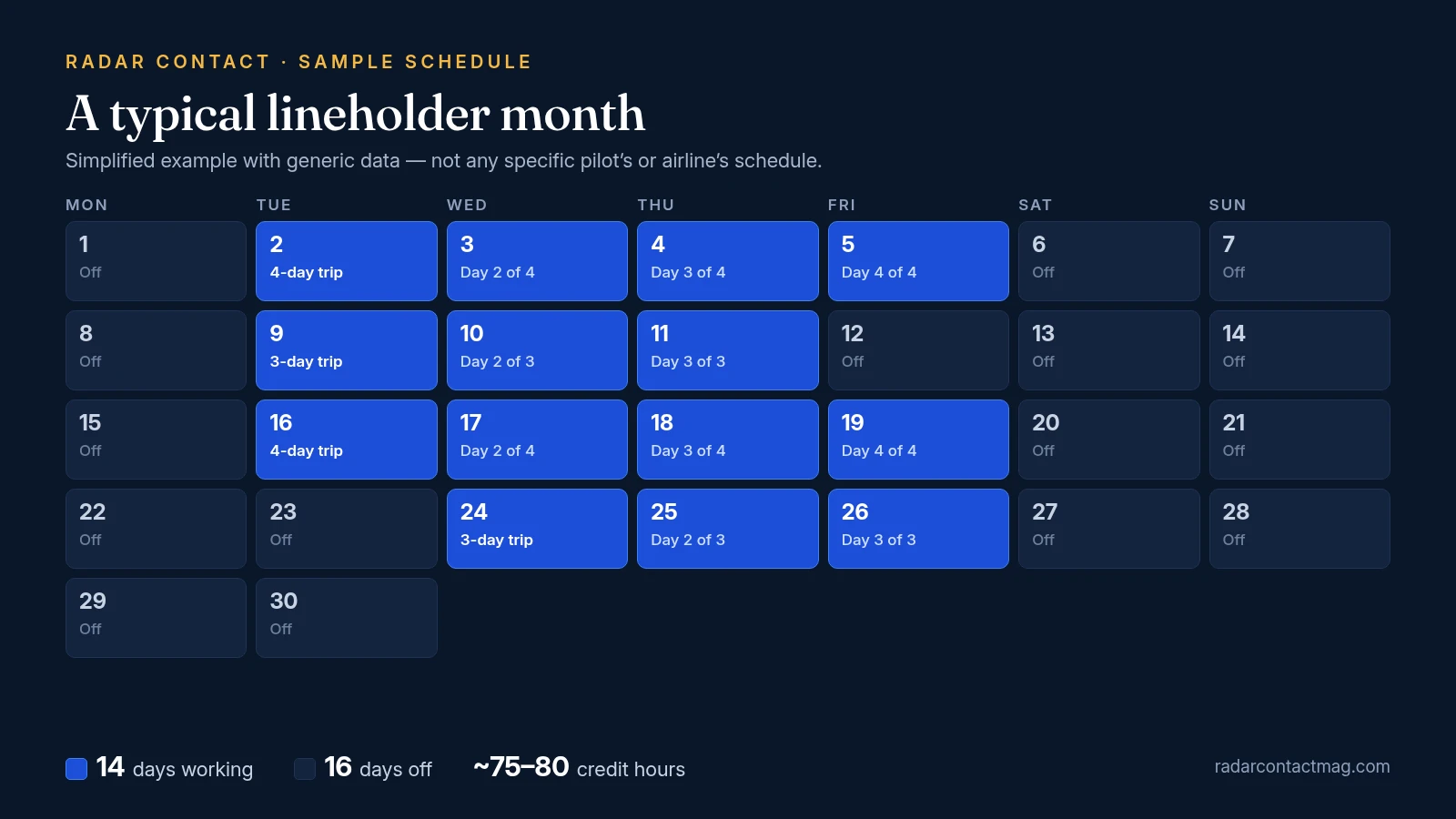
This is a simplified example of a typical lineholder month, not any specific pilot's schedule.
- Days 2–5: four-day trip
- Days 9–11: three-day trip
- Days 16–19: four-day trip
- Days 24–26: three-day trip
- Everything else: off
That's 14 days of work and 16 days off, with roughly 75–80 credit hours depending on how the trips are built. A reserve month in the same category might look like 17 or 18 reserve days and the rest off, with no idea in advance which of those reserve days you'll actually fly.
Airline Pilot Days Off: Minimums and Rest Rules
Days off are protected in two ways: by regulation and by contract. Each region writes its own fatigue rules, and they differ in the details.
Canada (Canadian Aviation Regulations)
- Flight time capped at 112 hours in 28 days, 300 in 90 days and 1,000 in 365 days.
- At least 10 hours' rest in suitable accommodation away from base, and generally 12 hours at home base.
- Time free from duty: at least one day off in any 7 days and four in any 28.
United States (FAA Part 117)
- At least 10 consecutive hours of rest before duty, including 8 uninterrupted hours of sleep opportunity.
- At least 30 consecutive hours free from all duty in any 168 hours (7 days).
- Flight time capped at 100 hours in any 672 consecutive hours (28 days) and 1,000 in 365 days.
Europe (EASA ORO.FTL)
- Flight time capped at 100 hours in 28 days, 900 in a calendar year and 1,000 in 12 months.
- Duty capped at 60 hours in 7 days and 190 in 28.
- Rest of at least 12 hours at home base and 10 away (or the length of the previous duty, if longer), plus a recurring 36-hour rest including two local nights.
What the contract adds
Regulations are the floor. Pilot contracts usually go further, with a minimum number of days off per month for lineholders and reservists, often somewhere in the 10-to-16-day range depending on the airline and the month.
How Commuting Eats Your Days Off
Here's what the schedule doesn't show. Many pilots don't live where they're based. They commute by air, usually on standby, to start their trips.
A commuter often has to fly in the day before a trip and may not get home until the day after. Two "days off" can disappear on each end of a trip. Fourteen days off on paper can feel like ten at home. That's why commuters often bid for longer trips stacked back to back, and some keep a "crash pad" near base.
Junior vs. Senior: How the Schedule Changes
When you're junior, expect reserve, weekends, holidays, red-eyes and the trips nobody else wanted. You may be junior again after every upgrade or move to a new aircraft or base, because your bidding position depends on where you rank within that seat, aircraft and base, not just your overall hire date.
As you move up, the picture changes: lines instead of reserve, weekends at home, better layovers, and the option to build a month that fits your life. Senior pilots often trade money for time, or time for money, by picking up or dropping trips.
Holidays and Weekends
Airlines fly 365 days a year, and the busiest days are exactly when everyone else is off. Junior pilots work most holidays. Christmas, Thanksgiving, March Break and summer weekends go senior fast. Pilot families learn to celebrate on the 23rd or the 27th, or to meet up on a layover.
FAQ
How many days a month do pilots work?
Most airline pilots work roughly 12 to 18 days a month. Senior lineholders tend to work fewer days; junior pilots on reserve are often available for more.
Do airline pilots get weekends off?
Not automatically. Weekends off depend on seniority. Junior pilots often work weekends; senior pilots can usually bid for them off.
What is a pilot reserve schedule?
It's an on-call schedule. Reserve pilots are assigned blocks of availability, and crew scheduling calls them to cover open trips, sometimes with only a couple of hours' notice.
How many hours a month do airline pilots fly?
Many airline pilots are scheduled for roughly 70 to 90 credit hours a month, depending on the contract. Regulations cap flight time, for example at 100 hours in 28 days under FAA and EASA rules, and 112 hours in 28 days in Canada.
The Bottom Line
An airline pilot schedule means fewer days at work than most jobs, but longer, less predictable days, and a lifestyle that depends almost entirely on seniority. If you understand reserve, bidding and commuting before you start, the reality won't surprise you.
Regulatory limits are summarized for general information and can change; contracts vary by airline. Always check the current rules and your own collective agreement.