That's the official picture. From the cockpit, the part that sticks is the instruction. "Give way" is not a suggestion. And a missing wingtip is not a fender-bender you shrug off, even when everyone walks away.
What happened
Miami-Dade Aviation says it happened at about 9:15 PM. The airport's communications director, Greg Chin, told CBS Miami that an arriving airplane and a departing airplane made contact at the intersection of two taxiways. The FAA's statement is a little broader, "around 9 p.m. local time." Same evening, same airport.
The FAA put it plainly: "The wingtip of a Copa Airlines Boeing 737 struck the nose of a UPS Boeing 767 while the airplanes were taxiing at Miami International Airport. Air traffic controllers had told the UPS crew to give way to the Copa flight." The Copa flight was taxiing to the gate. The UPS flight was taxiing for departure to Bogotá, Colombia. The FAA is investigating.
CBS Miami identified the flights as Copa 427, arriving from Panama City, and UPS 358, headed for Bogotá. Chin said flights were being sent to other taxiways, and that there was no impact to airport operations.
On the radio, as reported by Simple Flying, a Copa pilot said, "Somebody hit us." The controller asked, "UPS 358, did you hit that aircraft?" The UPS pilot answered, "Yeah, we went too far and then he... he clipped us with the wing." The Copa crew later told the tower, "It seems that we are missing the left wingtip." Photos published by ABC News showed damage to the nose of one of the airplanes. The NTSB said Sunday that preliminary information showed "substantial damage" to the UPS plane, while an assessment of the Copa aircraft had not yet been completed, according to CNN.
UPS said in a statement, as quoted by ABC News: "We are aware of an incident involving one of our aircraft on the ground in Miami. Our crew is safe, and we are committed to working with authorities to determine what happened. The safety of our employees and the public is our highest priority."
Copa said its airplane was carrying 166 passengers and six crew, that paramedics evaluated two passengers for apparent minor injuries, and that it will work with authorities in the investigation, as reported by Bloomberg via Moneycontrol. Aviacionline, also citing the airline, reported the Copa jet as a Boeing 737-800 and said the rest of the passengers and the crew have disembarked and are well. CNN, citing Copa, later said all 166 passengers and six crew have since disembarked and the plane was returned to the terminal after a tug moved the jet.
What "give way" means
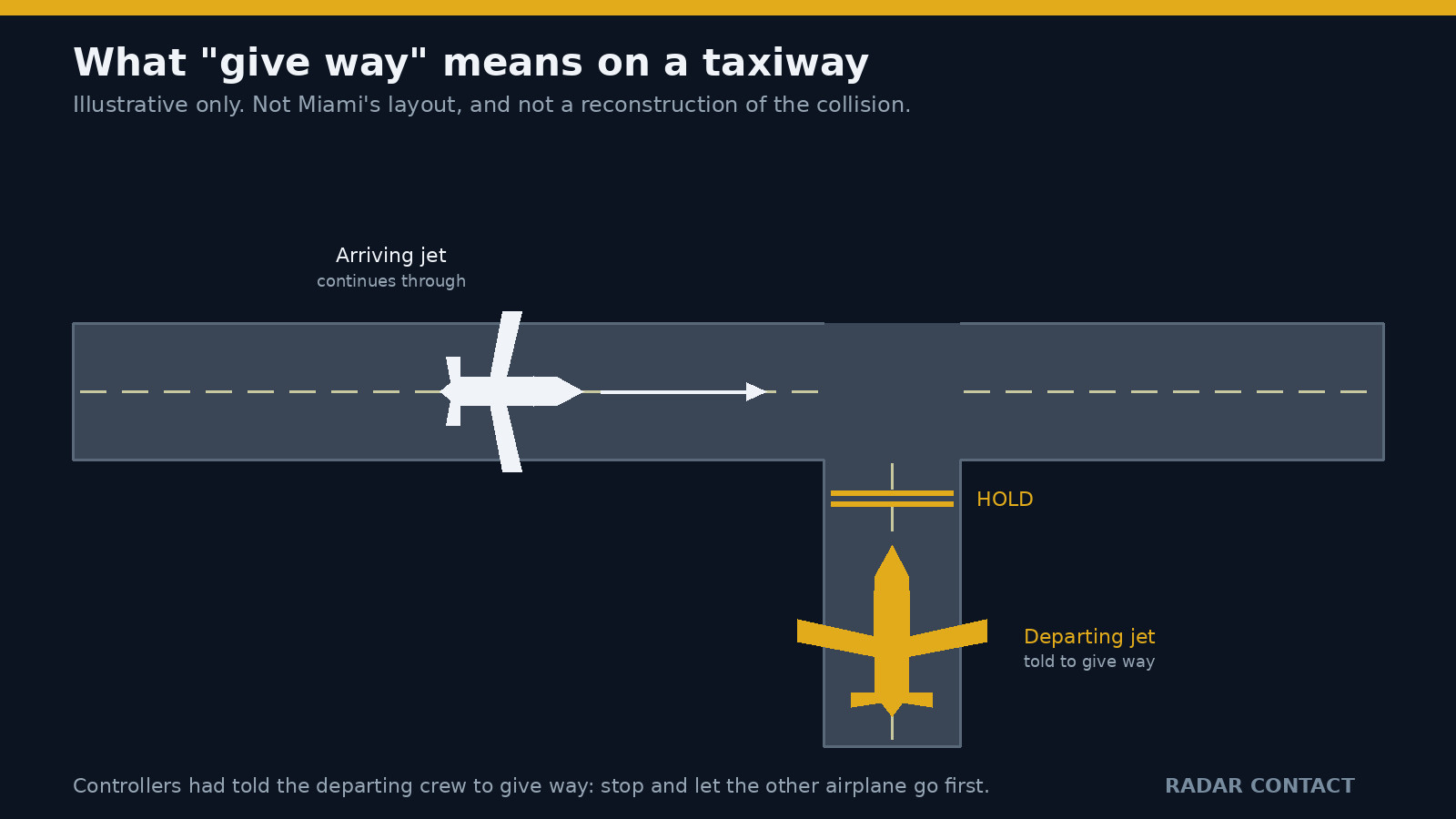
If a controller tells you to give way to another airplane, you stop and let that airplane go first. You don't keep rolling and hope the geometry works out. On a taxiway the jets are close, the wings stick out farther than people think, and the person in the other cockpit can't always see your nose.
It's a simple call. The hard part is actually stopping in the right place, especially at night at a busy hub, when you're looking at a moving map, a taxi clearance, and a checklist at the same time.
I'm not going to walk you through how we taxi. The only point that matters here is the instruction the FAA says went out. UPS was supposed to hold and let Copa pass.
The UPS pilot's line, "we went too far," is an acknowledgment of where the airplane ended up, not a finished investigation. The FAA and the NTSB will take it from here.
A late runway change is a busy moment, not a cause
There's one more line on the tape that pilots will notice. As reported by The Mirror, a UPS pilot can be heard telling the controller, "we're running checklist, runway change." Simple Flying also reported that one of the pilots said they were in the middle of a checklist for a runway change.
A late runway change is a known high-workload moment. You're updating the flight computer, running a checklist, and still supposed to be looking outside. Night doesn't help. A busy airport doesn't help either.
I'm not saying that's why this happened. Workload is not a cause until investigators say it is. It's just the kind of moment we already treat as a risk, which is why that line is worth mentioning and not worth turning into a verdict.
Why a wingtip strike is still a big deal
Two passengers were treated for minor injuries and didn't need an ambulance. That's the part everyone wants first, and it's good news.
It does not make this a small event.
A wingtip is not a bumper. It's structure, lights, and sometimes more than what you can see from the ramp. A nose strike on a 767 isn't cosmetic until somebody signs for that. Both airplanes stay on the ground until they're inspected, and often longer than that. The FAA and the NTSB have both opened investigations. Passengers get rebooked. The UPS flight to Bogotá isn't leaving on that airplane.
You can have a collision with no one in the hospital and still have two jets out of service, a taxiway blocked, and a long paper trail. That's where we are.
The timing in Miami
This happened a day after the FAA's nationwide ground stop, the longest one since September 11, 2001. Miami, like a lot of airports, was still dealing with delays and cancellations on Saturday. Nobody has tied Saturday night's collision to Friday's outage, and I'm not going to either.
It also comes weeks after an Amazon cargo plane overran a runway at Miami in September and killed five people on the ground, as reported by Bloomberg via Moneycontrol. That's a different accident, and investigators are already on that one. I'm only mentioning it because it's the same airport and it's still recent. Two events in one place will get people talking. They are not the same story.
What's next
The FAA is investigating, and the NTSB has also opened an investigation. Preliminary information showed "substantial damage" to the UPS plane, while an assessment of the Copa aircraft had not yet been completed, the NTSB said Sunday, according to CNN.
If you were on Copa 427, the useful part is simpler than the radio tape. The airplane isn't flying onward. Copa said passengers and crew have deplaned, and the people who were treated didn't need a hospital. If you weren't on it, Miami kept moving traffic on other taxiways.
We'll come back if officials name a cause. Until then, the facts are the ones above, and the rest is the investigation.
FAQ
What happened in the Miami airport plane collision?
Around 9:15 PM ET on Saturday, November 14, 2026, the left wingtip of a Copa Airlines Boeing 737-800 struck the nose of a UPS Boeing 767 freighter while both were taxiing at Miami International Airport. The FAA says controllers had told the UPS crew to give way to the Copa flight. The FAA is investigating, and the NTSB has also opened an investigation.
Did anyone get hurt in the Miami airport collision?
Two passengers were treated on the scene for minor injuries and were not taken to the hospital. Copa said paramedics evaluated two passengers for apparent minor injuries. UPS said its crew is safe.
Which flights were involved in the Miami airport collision?
Copa flight 427, a Boeing 737-800 arriving from Panama City with 166 passengers and six crew, was taxiing to the gate. UPS flight 358, a Boeing 767 freighter, was taxiing out for Bogotá.
What does "give way" mean on a taxiway?
If a controller tells you to give way to another airplane, you stop and let that airplane go first. The FAA says that was the instruction given to the UPS crew before the collision. The FAA is still investigating what happened.
Why is a wingtip strike a big deal if nobody was badly hurt?
A wingtip is structure, not a bumper, and a nose strike has to be inspected before anyone calls it cosmetic. Both airplanes stay on the ground until that work is done. The NTSB said Sunday that preliminary information showed "substantial damage" to the UPS plane, while an assessment of the Copa aircraft had not yet been completed. The two people who were treated did not need a hospital, and the airport stayed open.
Did the Miami collision shut down the airport?
No. The airport said flights were being directed to other taxiways, and that there was no impact to airport operations.
Was the Miami collision related to Friday's nationwide ground stop?
It happened a day later, and Miami was still dealing with delays and cancellations from Friday's stop. Nobody has tied the two events together. The FAA's statement on the collision does not mention the ground stop.
Is the NTSB investigating the Miami airport collision?
Yes. The NTSB opened an investigation. Preliminary information showed "substantial damage" to the UPS plane, while an assessment of the Copa aircraft had not yet been completed, the agency said Sunday, according to CNN.
Sources
- FAA Statements on Aviation Accidents and Incidents, November 14, 2026
- ABC News, November 14, 2026
- CBS Miami, November 14, 2026
- Simple Flying, November 15, 2026
- The Mirror, November 15, 2026
- Aviacionline, November 15, 2026
- Bloomberg, via Moneycontrol, November 15, 2026
- NTSB 2026 newsroom, checked November 15, 2026 (no release on this incident)
- CNN, via AccuWeather, November 16, 2026
- Copa Airlines, official statement on CM427 (X, Nov. 15, 2026)