Every passenger has wondered about it at some point, usually somewhere over the clouds with nothing else to do. Why not big square windows like at home? Short answer: your house doesn't get inflated a few thousand times a year.
Your Airplane Gets Blown Up Like a Balloon Every Flight
At cruise, the air outside is way too thin to breathe comfortably. So we pressurize the cabin. US certification rules say an airliner has to be able to keep the cabin at a pressure altitude of no more than 8,000 feet in normal operation, even when we're cruising far higher than that.
That means the inside of the airplane is pushing out on the skin the whole time we're up there. Then we land, the pressure comes off, and the next flight does it all again. Each flight is one pressurization cycle. For the early jets, that number was a big deal. The world's first jet airliner, the de Havilland Comet, flew with a working pressure difference of about 8.25 pounds per square inch.
Metal handles one big push just fine. What wears it out is the same push, over and over. That's metal fatigue, and it's why an airliner's structural life gets counted in flight cycles, not just hours.
Why Sharp Corners Are the Problem
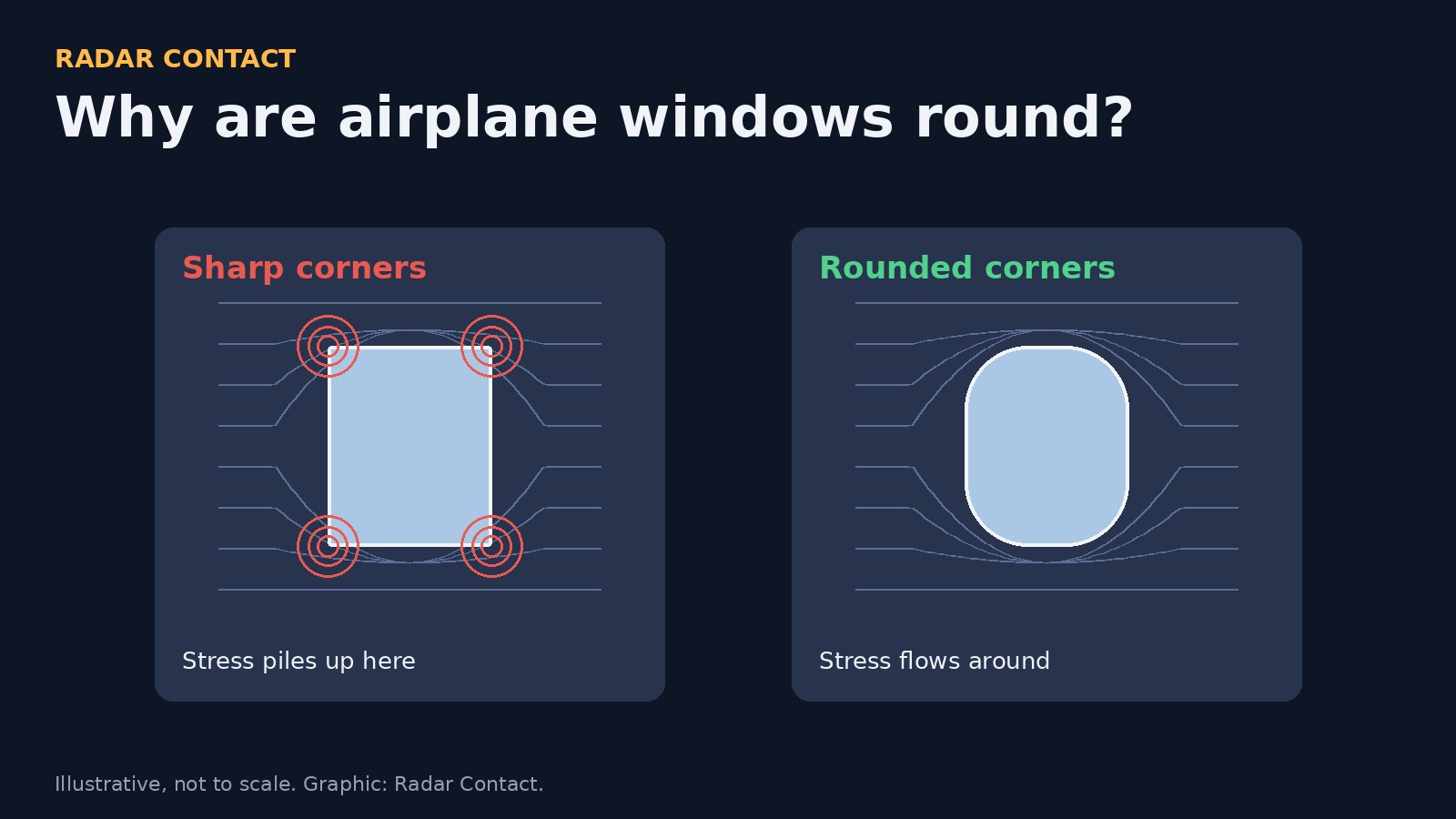
Cut any hole in a stretched sheet and the stress has to detour around it. It bunches up at the edge of the hole. Engineers call that a stress concentration.
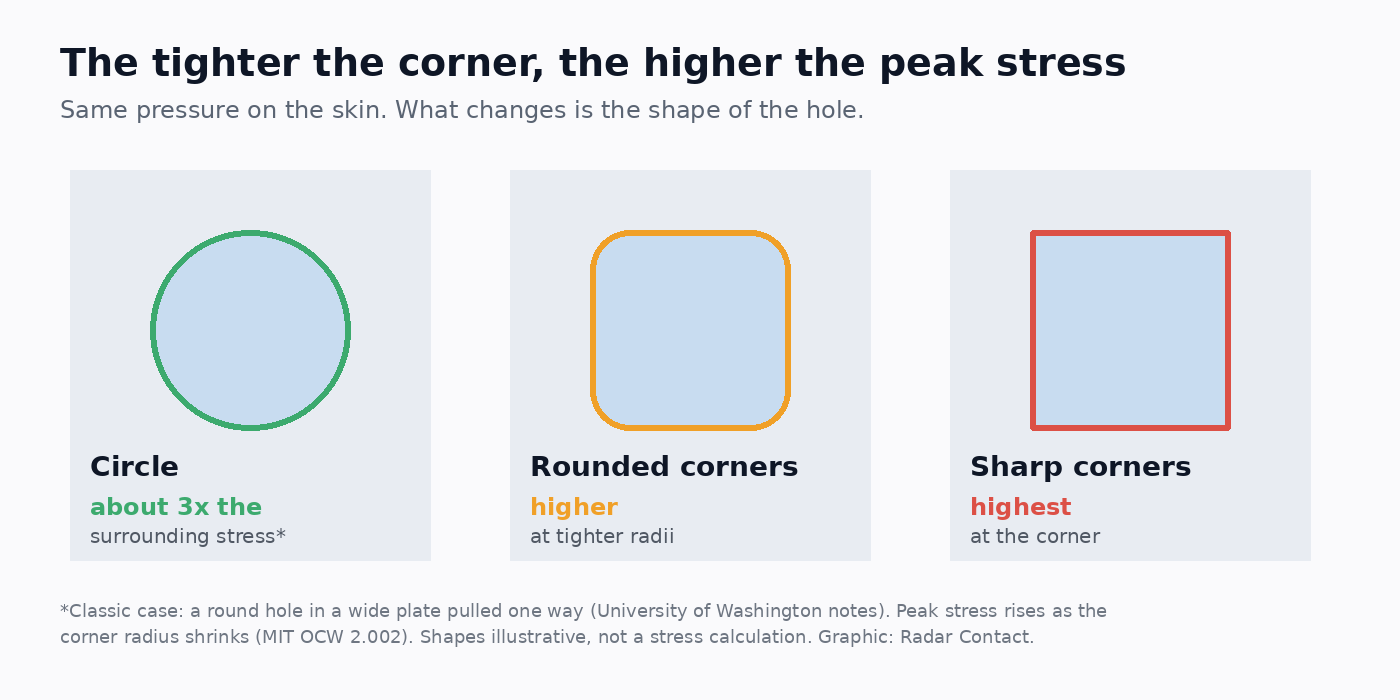
Even a perfectly round hole raises the local stress. University of Washington engineering notes show the classic case: in a wide plate pulled in one direction, the stress at the edge of a circular hole hits three times the stress in the rest of the plate. Make the corner tighter and it gets worse. MIT's mechanics course material shows the peak stress climbing as the radius at the tip of the opening shrinks. A truly sharp corner is the worst case of all.
So a window with generous curves lets the load flow around it. A window with tight corners gives fatigue a perfect place to start, a few thousand flights from now.
The Comet: What Really Happened
This is where the story gets told wrong a lot. The popular version goes, "The Comet had square windows, so it fell apart." The real investigation is more interesting than that.
In 1954, two Comets broke up in flight over the Mediterranean, one near Elba in January and one near Naples in April. The fleet was grounded. Britain's Royal Aircraft Establishment then put a whole Comet fuselage in a water tank and pressurized it again and again to simulate flights. According to the Court of Inquiry report, that airplane had flown 1,230 pressurized flights. It took another 1,830 in the tank, about 3,060 in total, before the cabin split. The failure started at the corner of one of the cabin windows. The FAA's account says it was the window in the forward escape hatch.
Then came the Elba wreckage. A piece of the cabin roof, later hauled up by an Italian fishing boat, held the two small windows for the ADF antennas. That's the automatic direction finder, a radio navigation receiver, with its antennas under windows on top of the fuselage. The Court accepted that the first fracture of the cabin happened there. It said the crack probably started near the rear corner of the rear ADF window, at the edge of a countersunk hole for a bolt, and that it couldn't be certain.
So it wasn't a passenger window, and it wasn't a sharp square. The Comet's passenger windows were rectangles with 3-inch corner radii, according to a 1960 government research report on another Comet fuselage. In that later test, cracks started at the rivet holes at the window corners, not at the window edges themselves.
What the Court did find is the real lesson. Its "fundamental cause" was a level of stress around the corners of the windows and other cut-outs that was higher than a long cabin life could handle, made worse by small local stress raisers like that bolt hole. The designers had estimated the stress near the window corners as an average over a couple of inches of skin, not the peak right at the corner. And the FAA's lessons-learned review notes de Havilland's fatigue test had been run on a section already loaded to twice working pressure, which made it look far tougher than a production airplane.
De Havilland told the inquiry it would use thicker skin and "strengthen and re-design windows and cut-outs." The FAA says later Comets switched to oval windows. So, square windows caused the crash? Not quite. Corners and cut-outs, under repeated pressure, with fatigue nobody had measured properly? Yes.
So Why Are Today's Windows Oval?
Curves are the cheap, light way to keep stress around a cut-out low. The FAA puts it simply: on today's rounded and oval windows, the stress flows around the curved edges instead of building up at a corner.
Could you build a square window that lasts? In principle, with enough metal around it. But every pound of reinforcement is a pound we haul around on every flight. Rounded corners get you there lighter, which is why modern airliner windows are rounded.
What's That Little Hole in the Window?
Look closely and there are actually three panes. The one you can touch is the scratch pane, there mostly to protect the others. Behind it are the middle pane and the outer pane, and those two are the structural ones.
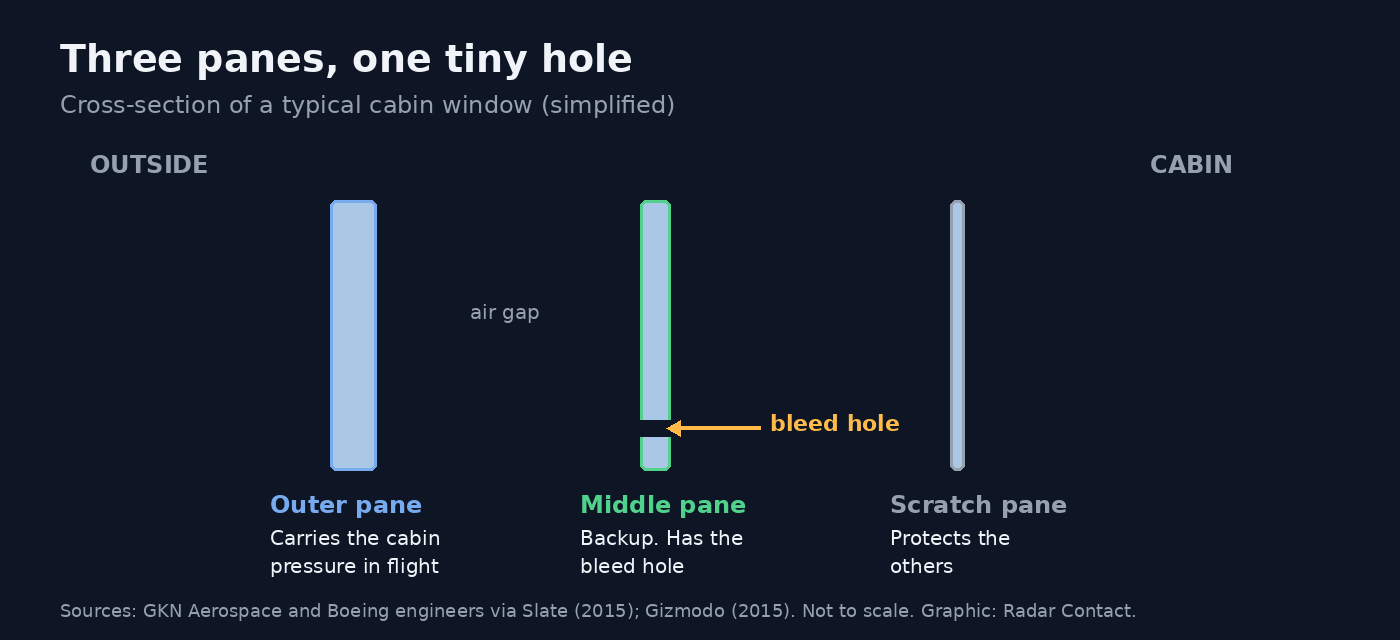
The tiny hole near the bottom of the middle pane is the bleed hole, or breather hole. A window engineer at GKN Aerospace, a major cabin window maker, explained it to Slate: it lets the pressure between the cabin and the air gap between the panes even out, so the cabin pressure in flight lands on the outer pane only. The middle pane stays unloaded, as a backup. In the extremely unlikely event the outer pane cracks, the middle one takes over.
A Boeing engineer added a second job. The hole lets moisture out of the gap, which cuts down on fog and frost between the panes. That little snowflake of frost you sometimes see around the hole on a long flight? That's cabin moisture meeting a very cold window.
So no, it's not a defect, and no, nobody drilled it to give you fresh air.
FAQ
Why don't airplanes have square windows?
Sharp corners concentrate stress, and an airliner's cabin is pressurized and let down on every flight. Repeated stress at a tight corner is where fatigue cracks like to start. Rounded corners spread the load and save the weight you'd need to reinforce a square one.
Did square windows cause the Comet crashes?
Not the way the story usually goes. The 1955 Court of Inquiry found the Elba breakup was caused by fatigue of the pressure cabin, starting at the ADF antenna window in the roof, probably at a bolt hole near its corner. The passenger windows were rectangles with rounded corners. Stress at the corners of windows and cut-outs was the underlying problem.
What is the little hole in an airplane window for?
It's a bleed hole in the middle pane. It lets cabin pressure reach the gap between the panes, so in flight the outer pane carries the load and the middle pane stays in reserve as a backup. It also helps let moisture out, which reduces fogging and frost.
What happens if an airplane window cracks?
The window is built with a backup. The outer and middle panes are both structural, and Slate reports each is strong enough to hold the pressure difference on its own. If the outer pane fails, the middle pane takes over. GKN's engineer called that an extremely rare event.
Are airplane windows made of glass?
Passenger cabin windows usually aren't. Slate and Gizmodo, reporting with GKN Aerospace, describe the panes as acrylic, a tough, clear plastic.
Why are airplane windows so small?
Every window is a hole in the pressure cabin, and holes need reinforcing around them. An aviation expert quoted by AFAR says the best design from an engineering standpoint would have no windows at all, because windows and frames are heavy, and rounded windows are the compromise between safety, weight and passenger comfort.
Why does frost form around the hole in the window?
GKN Aerospace says it's condensation when cabin air meets the cold window surface. At cruise, the outside air can be around minus 70 degrees Fahrenheit, so the outer layers get very cold.
Sources
- Ministry of Transport and Civil Aviation, Report of the Court of Inquiry into the Accidents to Comet G-ALYP and G-ALYY (HMSO, 1955; copy hosted by the FAA). Originals held at the UK National Archives.
- Aeronautical Research Council, R. & M. No. 3248, Behaviour of Skin Fatigue Cracks at the Corners of Windows in a Comet I Fuselage (HMSO, 1962)
- FAA Lessons Learned, de Havilland DH-106 Comet 1
- FAA, 14 CFR 25.841, Pressurized cabins (eCFR)
- University of Washington, stress concentration lecture notes; MIT OpenCourseWare 2.002, stress concentration lab
- Slate, "Why are there holes in airplane windows?" (May 29, 2015), with GKN Aerospace and Boeing engineers; Gizmodo (2015)
- Smithsonian National Air and Space Museum, How Things Fly; AFAR (October 22, 2024)