Every pilot has heard it at a dinner party. "Doesn't the plane basically fly itself?" Sort of. The autopilot does a lot of the flying. But "the plane landed itself" usually means the crew did a ton of work so it could.
Here's how it actually works, when we use it, and why most of the time we'd rather land it ourselves.
Autopilot vs. Autoland: Not the Same Button
A normal autopilot holds a heading, an altitude, a speed and a route. It can fly an instrument approach most of the way down. It doesn't, by default, put the wheels on the runway.
Autoland is a step beyond that. It's the autopilot, plus extra computers, sensors and backups, certified to fly the approach, the flare (that last nose-up moment that softens the touchdown) and in many airplanes the rollout down the centerline. Europe's safety agency, EASA, puts it simply: automatic landing means "use of autopilot until touchdown." It also notes that the autopilots in typical general aviation airplanes don't have that capability.
Airbus describes its autoland as landing the airplane automatically on an ILS or GLS signal, the ground-based or satellite-based guidance that points us at the runway. And it's certified within limits: the environment, weather minimums, airplane configuration and failure cases. Step outside the limits, and it's a hand-flown landing or a go-around.
When Pilots Actually Use Autoland
Mostly fog. Approaches come in categories, based on how low we can go before we have to see the runway:
- CAT I: decide at no lower than 200 feet above the runway. No runway in sight, we go around.
- CAT II: decide as low as 100 feet.
- CAT III: decide below 100 feet, or with no decision height at all.
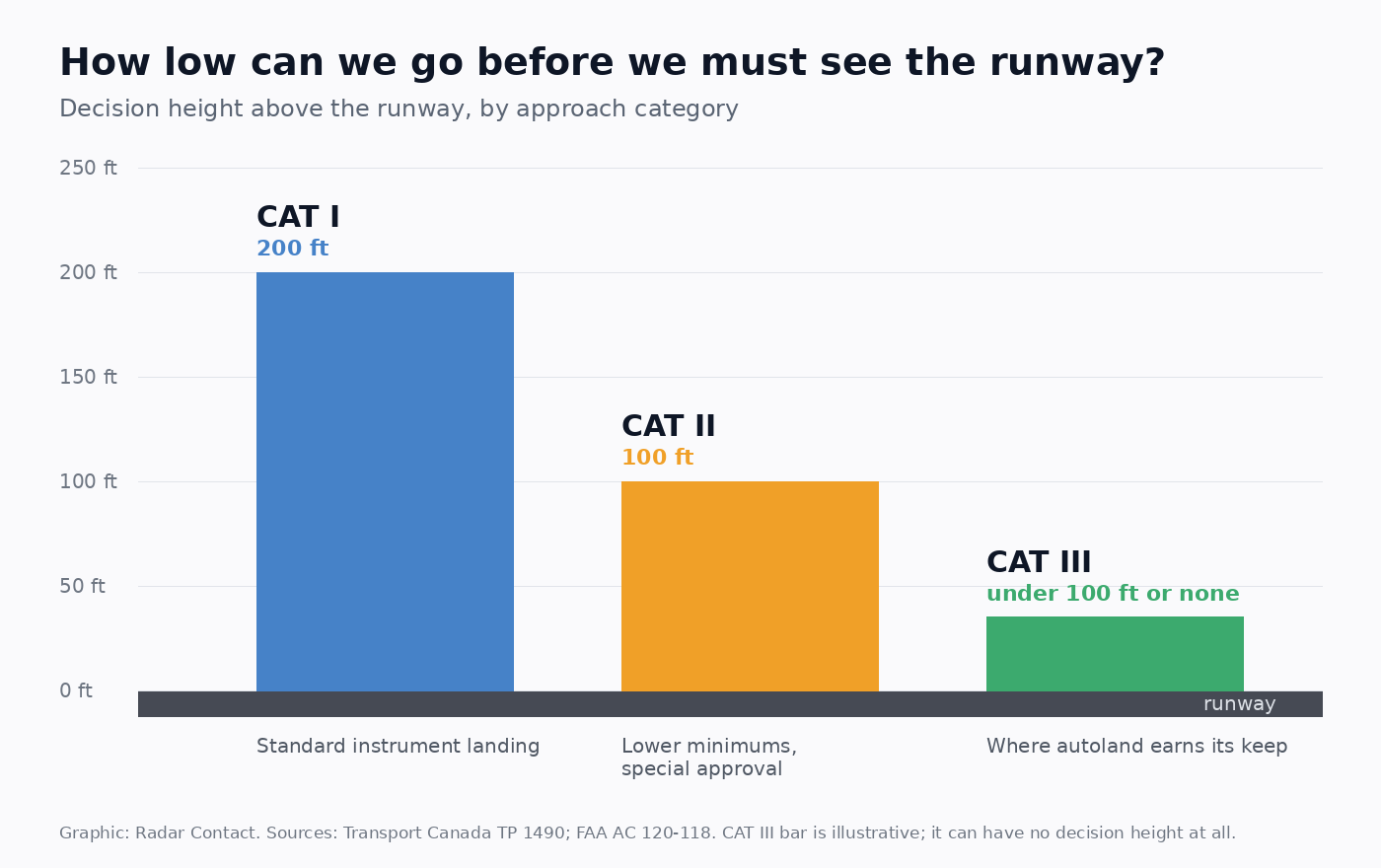
Down at CAT III, you may only see the runway in the last seconds, or barely at all before you're rolling on it. That's the job autoland was built for. The FAA's all weather operations guidance says US operators can be authorized as low as 300 feet of runway visual range. That's roughly a football field of visibility along the runway. In those conditions, CAT III can be flown by autoland, by hand with an approved head-up display, or a mix of both, depending on the airplane.
It takes three things lining up. The airplane has to be certified for it. The runway has to be equipped and protected for it. And the crew has to be trained and current. The FAA describes CAT III minimums as a three-legged stool: the lowest you can go is set by whichever leg is weakest.
Do Pilots Just Sit There?
No. If anything, an autoland is busier.
The UK pilots' union, BALPA, says setting up an autoland "is not simple," that there are pages and pages of manuals on it, and that in a lot of respects automatic landings are more work than doing it by hand. We brief it, check the weather and the winds against the limits, set up the approach and then watch the flight mode annunciations (the little status words that tell us what the autopilot is really doing) like hawks.
Transport Canada's manual says the quiet part out loud. The more we lean on automation, the more the pilot's role becomes "supervisor of the operation," with decisions still on us. If something breaks, the design decides what happens next:
- Fail-passive: a failure doesn't throw the airplane off its path, but we might lose the ability to finish the autoland and have to go around.
- Fail-operational: after a single failure, the remaining systems can still complete the approach, flare and touchdown. One way to get there is two or more monitored autopilots working together.
Either way, a go-around plan is always part of the deal. Here's why planes go around, if you've ever felt one.
Why Most Landings Are Still Hand-Flown
Because most days don't need it. BALPA says fewer than 1% of landings are flown automatically. That's the union's figure from 2019, not an official worldwide statistic, but it matches what you'll hear in any crew room.
The other reasons are practical:
- Wind. Fog usually comes with light wind, and autoland has tight wind limits. Transport Canada's default for CAT II and III is a 15-knot crosswind and 10-knot tailwind unless the airplane's manual says otherwise.
- The airport. BALPA points out that most airports either don't have the equipment or don't need it. When low-visibility operations are on, air traffic control spaces airplanes further apart so nothing disturbs the landing signal, and that slows the whole flow down.
- Our skills. We want to stay sharp at the most hands-on part of the job. And honestly, it's the fun part.
So if you've ever had a firm arrival on a clear day and blamed the autopilot, it was probably us. Sorry.
There's one exception. Sometimes you'll get an autoland on a nice day. Operators have to keep their airplanes and crews qualified, and Transport Canada notes practice autolands are allowed outside low-visibility conditions, with the crew ready to take over if the guidance gets weird.
Can Autopilot Take Off?
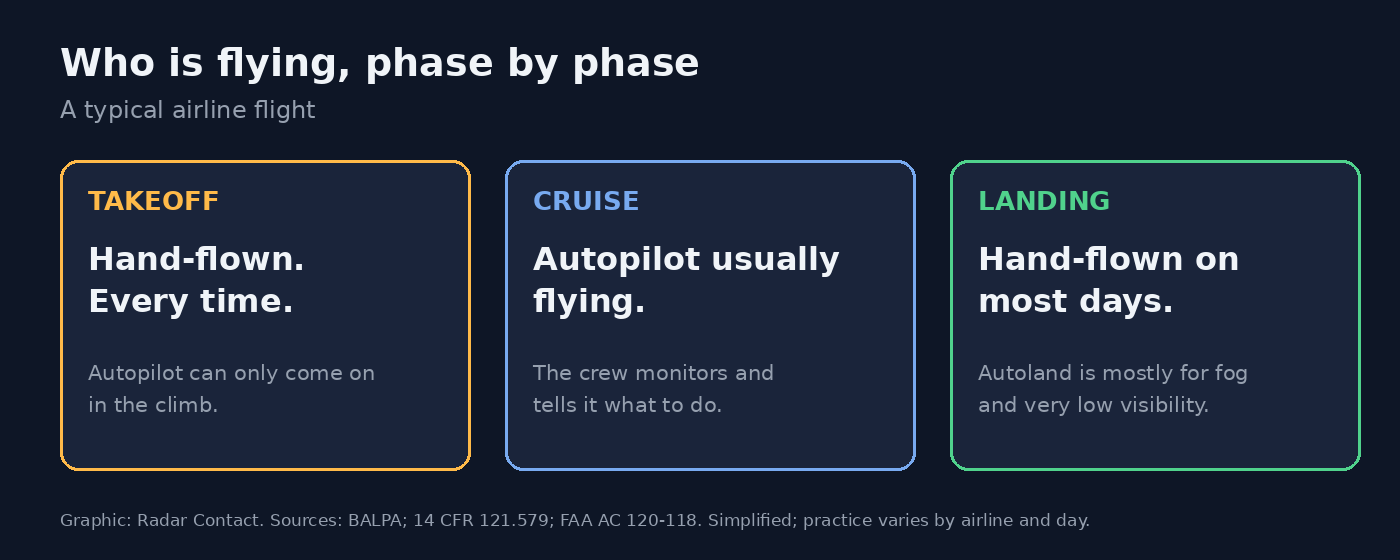
Not on your airline flight. BALPA puts it bluntly: there's no such thing as an auto takeoff in commercial aviation.
US airline rules back that up. They don't allow the autopilot for takeoff. It can only come on in the climb, above a minimum height set by the rule and the airplane's manual. So we fly the takeoff, then we can engage it.
Airbus did test fully automatic taxi, takeoff and landing on a test airliner in its ATTOL research program, which wrapped up in 2020 after more than 500 test flights. That's research, not your Tuesday morning departure.
Garmin Autoland: The Emergency Version for Small Planes
This is a different animal. Garmin Autoland is built for the worst day in a small airplane: the pilot can't fly.
A passenger presses one dedicated button, or the system kicks in on its own if it detects no pilot interaction. Then it picks the most suitable airport, factoring in weather, fuel, terrain and runway length, and talks to air traffic control on its own. It flies the approach, lands, brakes to a stop and shuts down the engine so everyone can get out. A pilot can cancel it with the autopilot disconnect.
Garmin says more than 2,500 aircraft now have it, across more than 15 models from single-engine planes to twin-engine business jets (Garmin, October 2026). Its first real emergency use came on December 20, 2025, when a twin-turboprop King Air lost cabin pressure after leaving Aspen, Colorado. The system engaged as designed and landed near Denver. Nobody was hurt. The operator said the two pilots were fine and chose to let it fly, as a conservative call. It also set the transponder to squawk 7700, the general emergency code.
It has limits. ABC News, citing Garmin's own site, reported it won't work with mechanical problems, fuel exhaustion or flight controls that can't move freely. And it's not on your airliner. Big jets have two trained pilots for that.
FAQ
Can autopilot land a plane by itself?
Only with autoland, and only within its limits. The airplane, the runway and the crew all have to be approved for it, and the pilots set it up and monitor it the whole way. A regular autopilot can fly most of an approach but doesn't do the touchdown.
Do pilots land the plane manually?
Most of the time, yes. BALPA, the UK pilots' union, says fewer than 1% of landings are automatic. Autoland is mainly for fog and very low visibility.
Can autopilot take off?
Not in airline service. BALPA says there's no auto takeoff in commercial aviation, and US airline rules only allow the autopilot to come on in the climb, above a minimum height. Airbus tested automatic takeoffs in research flights that ended in 2020.
Can a plane land itself in fog?
Yes, that's what autoland is for. On a CAT III approach, the decision height is below 100 feet or there isn't one. The FAA says US operators can be authorized down to 300 feet of runway visual range. Airplane, runway and crew all have to be approved.
Why don't pilots use autoland all the time?
It's more work to set up, it has tight wind limits, and most airports either don't have the equipment or don't need it. When low-visibility operations are running, controllers space airplanes further apart. Pilots also want to keep their hand-flying sharp.
Can a commercial plane land itself without a pilot?
No. Autoland on an airliner is a tool the crew uses, not a replacement for them. Transport Canada describes the pilot's role as the supervisor of the operation, and the crew has to be trained and qualified to fly those approaches.
Can a plane land itself in an emergency?
Some small planes can. Garmin Autoland lets a passenger press one button, or engages on its own if the pilot stops responding. It picks an airport, talks to air traffic control and lands. Garmin says more than 2,500 aircraft have it.
Has Garmin Autoland ever been used in a real emergency?
Yes. On December 20, 2025, it engaged after a King Air lost cabin pressure departing Aspen, Colorado, and landed near Denver with no injuries. The operator said the pilots weren't incapacitated and chose to let the system fly.
Sources
- FAA, AC 120-118, All Weather Operations and 14 CFR 121.579 (eCFR)
- Transport Canada, Manual of All Weather Operations (TP 1490)
- EASA, CS-AWO FAQ
- Airbus, Flight test autoland explainer and ATTOL press release (June 29, 2020)
- BALPA, Autopilot: do planes fly themselves?
- Garmin, Autoland press releases (2019, 2020 and October 14, 2026)
- AOPA, AVweb, ABC News and Flightradar24 coverage of the December 20, 2025 King Air Autoland landing