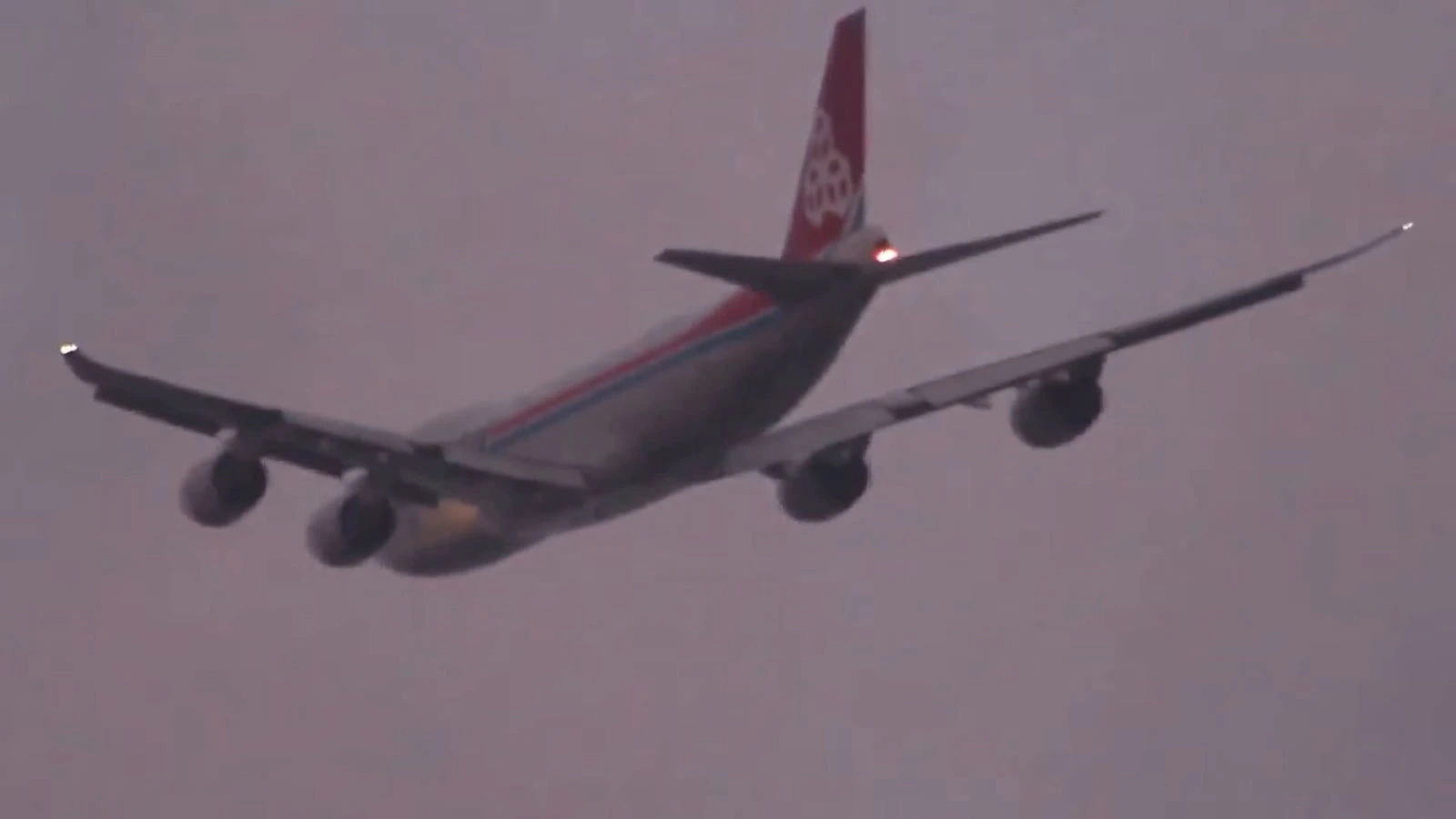
You are expecting the wheels to touch down. Instead, the engines get loud and the airplane climbs away.
The FAA describes a go-around as a routine maneuver that can be initiated by a pilot or requested by air traffic control. Routine does not mean passengers experience one every week. It means there is a trained response to not landing this time. Source: FAA, Go-Arounds Explained.
From the flight deck, the important question is not whether we can persuade the airplane onto the runway. It is whether continuing is the right decision.
The runway does not give marks for persistence.
Why Do Planes Go Around?
Because the conditions for continuing the landing are not right, or something has changed. The crew does not have to wait for an emergency to stop an approach.
Several broad reasons explain the decision:
Runway availability and traffic spacing. Another aircraft may still be on it, or a vehicle or other obstruction may make landing inappropriate. Controllers can request a go-around, including for traffic-spacing reasons. The FAA handbook lists ATC requirements and overtaking another aircraft among the reasons to discontinue an approach. The pilots can decide to go around too. Source: FAA handbook, chapter 9. Sources: FAA, AOPA, Decisions and Revisions.
The approach is not stable. That is pilot shorthand for an airplane that is not sufficiently settled on the required flight path, speed and landing setup. Being too high or too fast is not something to fix with optimism. Airbus says operators should define clear stabilization criteria and encourage crews to go around when those criteria cannot be met. Source: Airbus, Prevention of Unstable Approaches.
Weather and visibility. Fog, low cloud or poor visibility can prevent the crew from obtaining the required visual references at the applicable minimum. That minimum depends on the approach, aircraft and authorization; there is no single decision height for every landing. Source: U.S. 14 CFR 91.175.
Wind changes. An approach can be stable earlier and become unsettled later. Airbus specifically discusses late destabilization, including changes in the wind. Reaching an earlier checkpoint is not permission to ignore what happens afterward. Source: Airbus.
Crosswinds, tailwinds and windshear are not interchangeable terms or one universal wind limit. What matters is whether the actual conditions allow the landing to continue safely within the applicable requirements. Windshear is explicitly among the FAA’s reasons to discontinue an approach. For the broader distinction between atmospheric turbulence and aircraft wake, see our turbulence explainer; that is background, not a cause finding for your flight. Sources: FAA Airplane Flying Handbook, chapter 9, FAA crosswind safety discussion.
A technical problem. The FAA also lists mechanical failure as a possible reason to discontinue an approach. That does not mean every go-around involves a broken airplane. Source: FAA handbook.
Those are possible reasons, not a diagnosis of your flight. A window-seat video rarely tells you which one applied. Neither does the fact that the weather looked lovely from row 18.
How Often Do Planes Abort Landings?
Go-arounds are uncommon on an individual passenger’s trips, but they are a standard, trained part of flying.
For perspective, the Flight Safety Foundation’s March 2017 report described an analysis of almost 500,000 flights involving jets from a range of airlines worldwide. In that sample, the reported go-around rate was 0.29 percent, or about one in 340 approaches. Single-aisle jets accounted for 86 percent of the sample; twin-aisle jets made up the remaining 14 percent. That is a historical observation, not the odds for your next flight. Source: Flight Safety Foundation, Go-Around Decision-Making and Execution Project, section 6.2, pp. 35–36.
How often they happen varies with the airport, weather, traffic and operation. You can make plenty of trips without experiencing one. The first one may still feel startling. Unfamiliar to you does not mean unfamiliar to the crew.
Aborted Landing vs. Go-Around: What Is the Difference?
In everyday passenger language, they usually describe the same event. “Aborted landing” describes the attempt being stopped. “Go-around” is the aviation term you are likely to hear from the crew.
AOPA describes a go-around as essentially an aborted landing. It is not the same thing as an aborted takeoff, which involves stopping a departure rather than discontinuing an arrival. Source: AOPA.
You may also hear missed approach. The FAA uses that term for the maneuver when an instrument approach cannot be completed to a landing, and for the associated published procedure. The terms overlap in conversation, but they are not a promise that every flight will follow an identical path afterward. Source: FAA Pilot/Controller Glossary, Missed Approach.
Can a Plane Go Around After Touching Down?
Yes, in some circumstances. Brief contact with the runway does not always mean the landing must continue. But there are aircraft-specific limits. This is not an option that remains available throughout the landing roll.
Airbus discusses a go-around near the ground, sometimes called a rejected landing, and explains that the landing gear may briefly contact the runway during the maneuver. It also describes restrictions once the aircraft has committed to stopping. A passenger should not infer from those examples that any aircraft can simply take off again at any point. Source: Airbus, Preventing Tailstrike During Go-around Near the Ground.
You may encounter the label “balked landing” in discussions of a late discontinued landing too. The terminology is less useful than the limitation: what is possible depends on the aircraft and the situation, not on whether someone in the cabin felt a bump.
What Does a Go-Around Feel and Sound Like?
You may hear a marked increase in engine noise and feel the aircraft change from descending to climbing. There may be further mechanical sounds as the aircraft's configuration changes. The exact sensations depend on the airplane and where you are sitting.
The basic reason is straightforward: the crew is changing from an approach intended to end on the runway to flight away from it. The FAA describes the maneuver as discontinuing the approach and returning the aircraft to an altitude and configuration suitable for another approach. Source: FAA.
That change can feel abrupt when you were expecting the next sound to be the wheels landing. Loud is not, on its own, a diagnosis of trouble.
If an announcement is not immediate, do not use the silence to fill in the worst possible explanation. Flying and coordinating with air traffic control come before a polished cabin announcement. You want a controlled climb first. The commentary can wait.
Is a Go-Around Dangerous?
It is a safety maneuver, not a guarantee that there is no risk. Its purpose is to avoid continuing a landing when stopping the approach is the better choice.
The FAA describes it as safe and routine. Airbus also documents hazards close to the ground, including tailstrike risk. A trained maneuver still has to be flown properly. Sources: FAA, Airbus.
What I would not do is judge the crew by whether it landed on the first attempt. Airbus advocates a non-punitive approach to go-around decisions. The aim is to make the right decision, not to protect a first-attempt success rate. Source: Airbus.
When news coverage says a flight “aborted its landing,” the phrase describes what stopped. It does not establish a near collision, a mechanical failure or a pilot error. Those claims need evidence of their own.
How Long Does a Go-Around Add?
San Francisco International Airport’s explainer says a go-around “usually only involves a delay of no more than 10 to 15 minutes.” Treat that as SFO’s guidance, not a worldwide promise or a timer starting when the engines get louder. Source: SFO, Information About Go-Arounds.
Weather, traffic and the next plan can make the wait longer. A diversion changes the calculation altogether.
What Happens Next, and What Should Passengers Do?
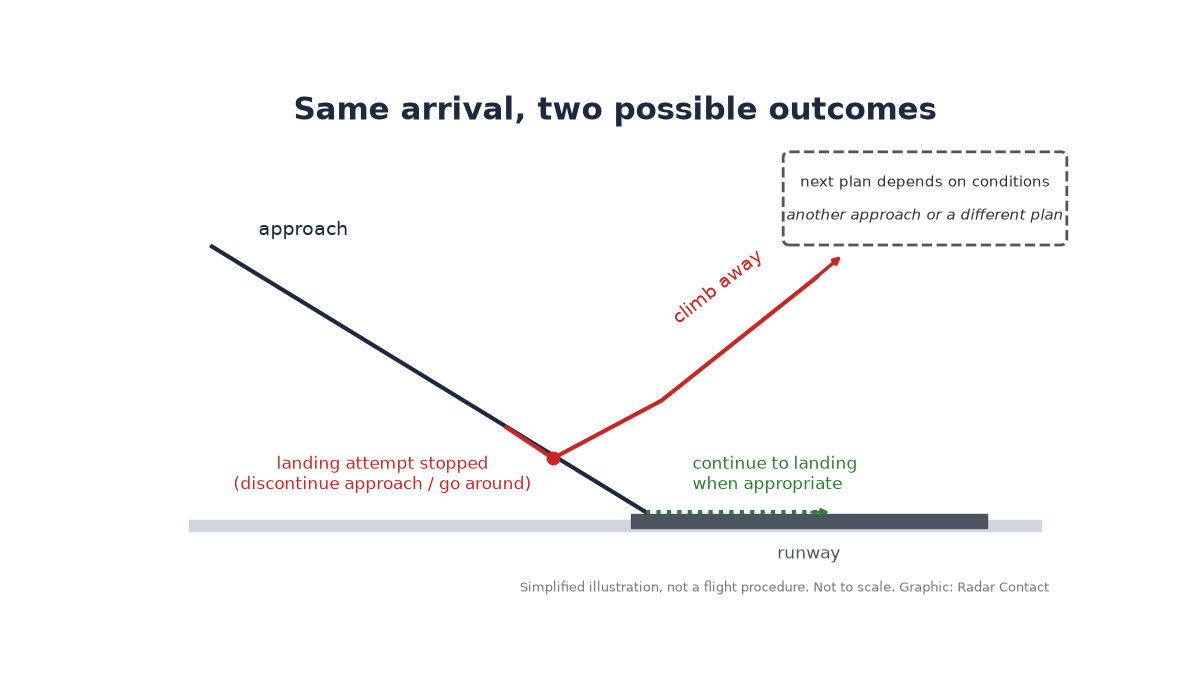
The crew may make another approach. Depending on conditions and the remaining options, the plan may change, including a diversion. A second attempt is an option, not an obligation. As AOPA notes, decisions about when and where to land remain constrained by fuel. Sources: FAA, AOPA.
For passengers, the useful actions are unglamorous. Stay seated with your belt fastened. Keep your belongings stowed. Follow the cabin crew's instructions and wait for an update.
The pilot take is simple: I would rather explain a go-around than defend a landing we should not have continued.
You wanted to be at the gate. So did the crew. Getting there safely matters more than getting there on the first try. For a different part of the job, our airline pilot schedule explainer shows how trips and days off fit together.
Go-Around FAQ
Why do planes go around before landing?
The crew may discontinue an approach because the runway is occupied, traffic spacing is insufficient, the approach is unstable, weather is unsuitable or a technical problem needs attention. The maneuver alone does not establish the cause.
How often do planes abort landings?
A historical sample reported by the Flight Safety Foundation in March 2017 found a go-around rate of 0.29 percent, about one in 340 approaches, among almost 500,000 flights. That is not a current universal rate or the odds for your next flight.
Can a plane go around after touchdown?
Sometimes. Brief runway contact can occur during a go-around close to the ground, but aircraft-specific limitations apply. It is not an option that remains available throughout the landing roll.
Is a go-around dangerous?
It is a standard safety maneuver used to avoid continuing an unsuitable landing. It still requires proper execution and is not a guarantee of zero risk.
How much delay does a go-around cause?
SFO’s explainer says it usually adds no more than 10 to 15 minutes. That is airport guidance, not a universal promise. Another approach may take longer, or the crew may divert.