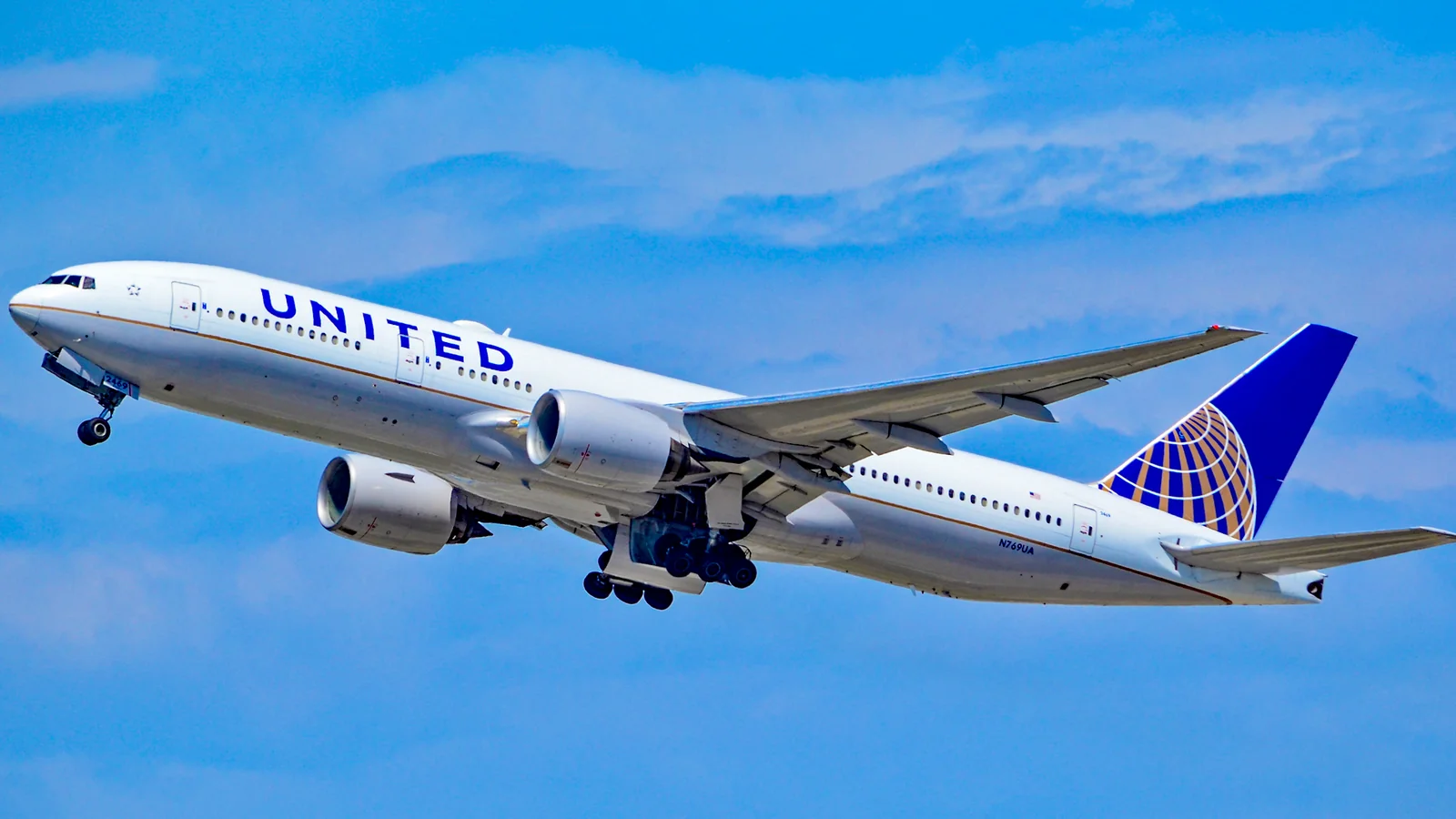

On the evening of October 21, a United Boeing 777 inbound from Honolulu was descending toward Los Angeles when the airplane was hit by a few seconds of violent turbulence. Four flight attendants were hurt. United says no passengers were injured. A pilot's radio call that it "felt like wake turbulence" has put two invisible hazards in the headlines: wake turbulence and clear-air turbulence. Here's what we know about United 1157, what the flight deck can and can't see, and whether turbulence is getting worse.
What happened on United flight 1157
According to The Aviation Herald (via AeroInside), the 777-200, registration N769UA, was descending through about 25,000 feet toward Los Angeles when the crew reported the encounter. It landed on runway 24R about 22 minutes later.
On the radio, a pilot told ATC: "It only lasted a couple of seconds, it felt like wake turbulence, but we're smooth now," as reported by ABC7. Passengers described a sudden drop, shaking and a loud bang, and one said she saw a flight attendant with blood on her head and leg.
United told The Independent that one attendant was hospitalized and no passengers were injured. Flight data cited by the New York Post showed the jet going from 22,800 to 14,000 feet in about two and a half minutes. Treat that number carefully: the airplane was already in a normal descent, and a jolt that lasts seconds doesn't show up clearly in tracking data sampled every 30 seconds or so.
The Aviation Herald says public ADS-B data shows no other aircraft near the 777 at the time. If that holds up, it weakens the wake theory, since wake turbulence needs an airplane ahead of you. On October 27 the NTSB opened a Class 4 investigation. Under the NTSB's classification system, that is its most limited level, usually handled remotely.
It wasn't the only bad ride this month. On October 9, Avianca flight 42 from Medellín to New York JFK diverted to Miami after the crew reported severe turbulence. Avianca said six passengers and three crew were affected, and Miami-Dade Fire Rescue took eight people to hospital, ABC News reported.
Wake turbulence vs clear-air turbulence: what's the difference?
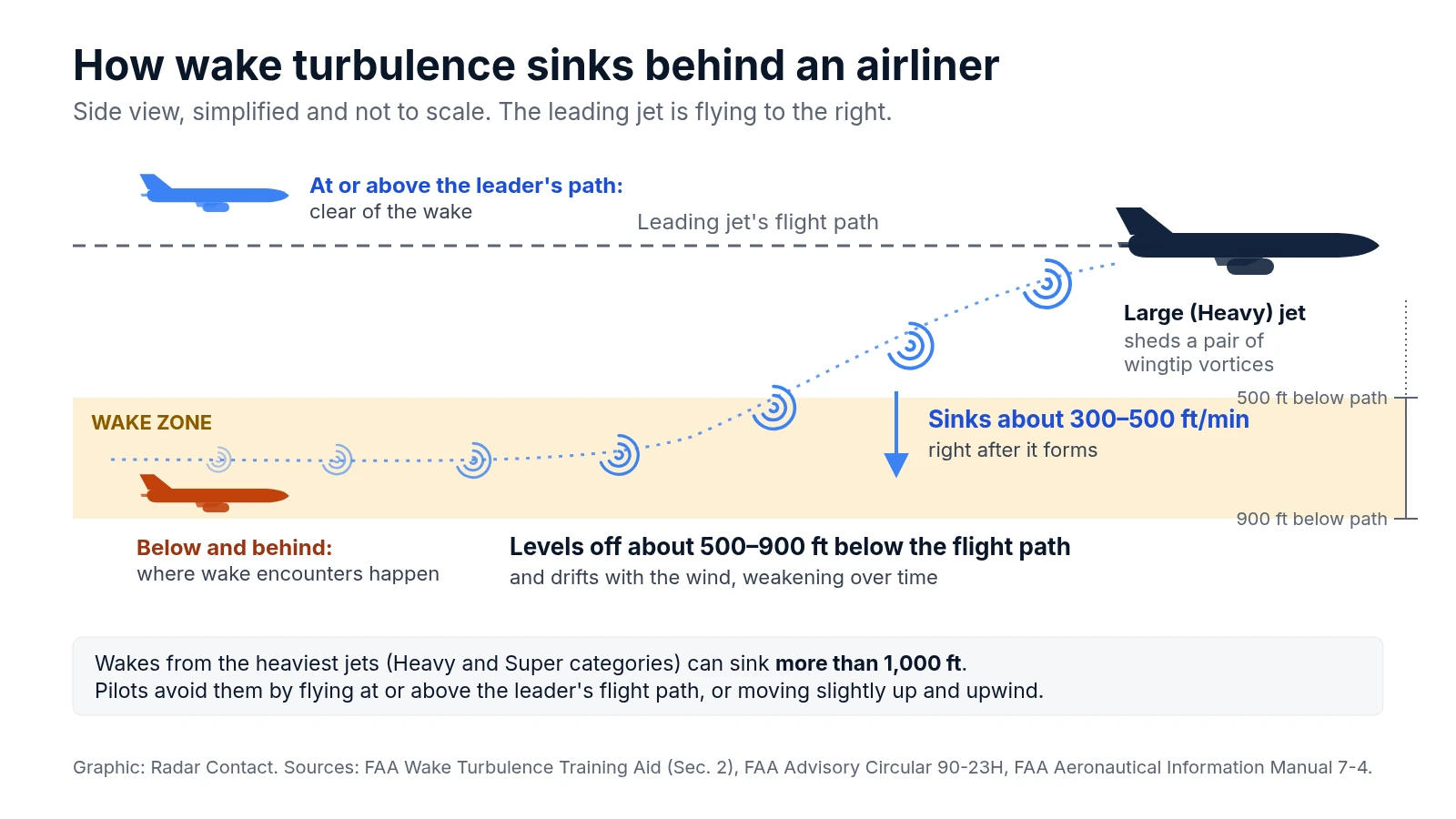
Wake turbulence is made by airplanes. Every wing producing lift sheds a pair of counter-rotating vortices from its tips, like two horizontal tornadoes trailing behind. They're strongest behind an airplane that is heavy, clean and slow. According to the FAA's wake turbulence guide, they sink at roughly 300 to 500 feet per minute at first, then level off about 500 to 900 feet below the generating airplane's flight path. FAA AC 90-23H adds that wakes from Heavy and Super aircraft can descend more than 1,000 feet. That's why ATC spaces airplanes for wake, and why en route encounters usually happen behind and below another jet.
Clear-air turbulence (CAT) is made by the atmosphere. It's mostly found near the jet streams, where wind speed changes sharply with height (wind shear) and the air starts to overturn. The FAA's AC 00-30C covers where it lives: around the jets, over mountains, and near troughs and ridges. There's nothing to see. The sky can be blue and the ride glassy until it isn't.
Why weather radar can't see either one
Airborne weather radar sees water. It paints rain and hail, and modern units can flag turbulence inside precipitation by measuring how fast the droplets are moving. Clear air has no droplets, so CAT gives no return at all. Neither does a wake vortex. The NTSB's 2021 turbulence study notes that laser-based (LIDAR) detection is being researched, but manufacturers told the board it isn't close to being fitted to airliners. For now, the tools are forecasts and reports from other airplanes.
Turbulence injuries: why flight attendants get hurt most
United 1157 fits a pattern pilots know well. The NTSB's study of US airline accidents from 2009 to 2018 found turbulence caused more than a third of them. About half happened in descent or approach, 60% of those below 20,000 feet, and flight attendants were the most commonly injured. More than three quarters of flight attendant injuries happened in the aft section of the cabin.
The FAA's own figures tell the same story: of 207 serious turbulence injuries on US airlines from 2009 to 2024, 166 were crew. In 2024, crew accounted for 20 of 23.
The reason is simple. Descent is when the cabin is busiest. Carts are going back into the galleys, trash is being collected, and the cabin is being secured for landing, all while the airplane is passing through lower, often bumpier air. Passengers have been told to sit down and buckle up. The crew are the ones still standing. The NTSB concluded that keeping flight attendants seated for more of the descent would cut injuries, and in recommendation A-21-38 asked the FAA to spell out when that should happen. As of March 2026 the FAA was still revising its turbulence guidance, AC 120-88A, according to the FAA's public log of its responses to the NTSB.
How pilots handle turbulence
Most turbulence avoidance happens before passengers ever feel a bump. A typical line crew works it like this:
- Before departure: the flight plan and dispatch briefing include turbulence forecasts. Crews look at where the jet streams sit, forecast turbulence charts, and how the ride has been on the route that day.
- PIREPs and ride reports: pilots report what they feel to ATC ("light chop at 37,000" or "moderate turbulence descending through 24,000"), and controllers pass it on. On a busy frequency you'll hear crews asking "how's the ride?" constantly. It's the best tool we have.
- EDR data: many airliners now measure turbulence automatically as an eddy dissipation rate (EDR), the ICAO standard metric, and share it. IATA's Turbulence Aware platform pools those reports from participating airlines, and many crews see them on tablet apps in the flight deck.
- Altitude and route changes: if the ride is bad, we ask ATC for a different altitude or a reroute. A few thousand feet can make the difference between rough and smooth.
- The seatbelt sign and the cabin call: when we expect bumps, the sign goes on and we call the cabin crew. For anything more than light chop, the call is usually to stop service and sit down. The hard part: leave the sign on all flight and people stop listening.
None of this helps when the bump comes out of clear air with no report ahead of you. That's the scenario pilots dread, and it may be what happened on 1157.
Is turbulence getting worse?
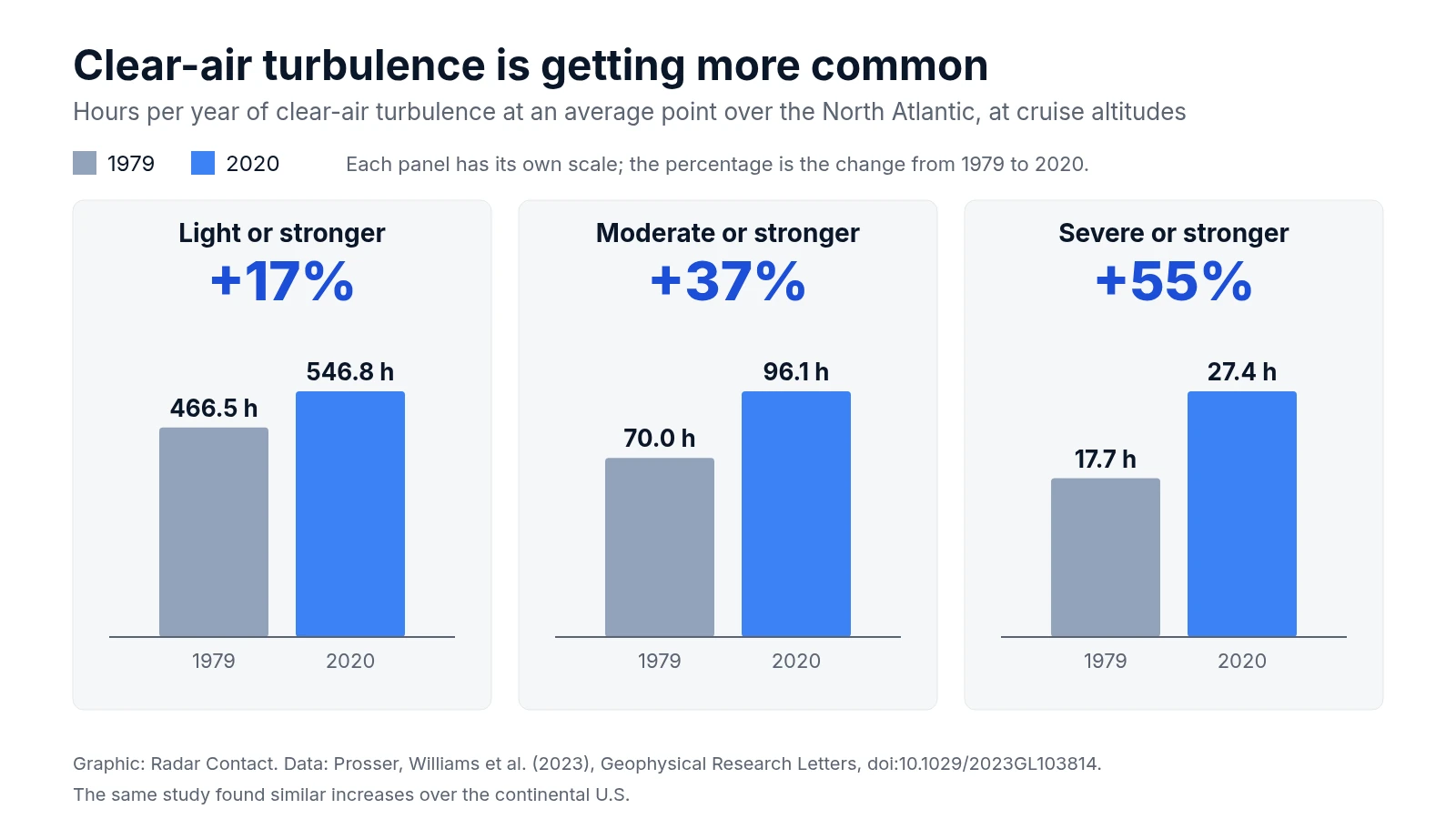
The research says yes, at least for clear-air turbulence in some of the busiest airspace. A 2023 study by Mark Prosser and Paul Williams of the University of Reading, published in Geophysical Research Letters, analysed atmospheric data from 1979 to 2020. At an average point over the North Atlantic, the yearly total of severe-or-greater CAT rose 55%, from 17.7 hours to 27.4 hours. Moderate-or-greater rose 37% and light-or-greater 17%. They found similar increases over the continental US, and smaller but significant ones over Europe, the Middle East and the South Atlantic.
The authors say the trend is consistent with climate change: warmer air is increasing wind shear in the jet streams. Earlier modelling by Williams (2017) projected that severe winter CAT over the North Atlantic could increase by about 149% on average if CO2 doubles from pre-industrial levels.
One caution: those are turbulence hours diagnosed from weather data, not counts of airplanes hitting bumps. The honest summary is that the air at cruise is getting rougher, and better forecasts and shared data matter more every year.
Can turbulence crash a plane?
Realistically, no. Airliners are certified to take a lot more than any passenger would want to feel. Under 14 CFR 25.337, a transport airplane must handle a limit load of at least +2.5 g, and 25.303 adds a 1.5 safety factor on top before the structure is allowed to fail. Gust loads are designed for separately. For comparison, the Singapore Airlines flight 321 encounter in May 2024, one of the most violent in recent memory, swung from about +1.35 g to -1.5 g and back up to +1.5 g within seconds, according to Singapore's preliminary findings. A passenger died, dozens were hurt, and the airplane landed in Bangkok, the BBC reported.
The historical exception is BOAC flight 911, a Boeing 707 that broke up near Mount Fuji in 1966 after hitting extreme mountain-wave turbulence in clear air, according to the accident report. Design standards, weather knowledge and route planning have all moved a long way since. The real danger of turbulence today isn't the wings. It's people and objects that aren't secured.
What passengers should do
- Keep your seatbelt fastened, loosely, whenever you're seated, even with the sign off. The FAA says to keep it buckled at all times, and the NTSB calls it the most effective way to prevent a turbulence injury.
- When the sign comes on, sit down right away. Don't wait for the bathroom line.
- Put children under two in an approved child seat if you can.
- Stow heavy bags properly. Overhead bins can open in a jolt.
FAQ
What is wake turbulence?
The swirling air left behind an airplane's wings. It's strongest behind heavy jets and sinks below their flight path, which is why ATC spaces aircraft apart.
What is clear-air turbulence?
Turbulence in cloud-free air, usually near the jet streams. It's invisible to the eye and to weather radar.
Is turbulence getting worse?
Yes, for clear-air turbulence at least. Research from the University of Reading found severe clear-air turbulence over the North Atlantic increased 55% between 1979 and 2020, consistent with climate change.
Can turbulence crash a plane?
Realistically, no. A modern airliner is built to withstand far more than turbulence normally produces. Injuries come from people who aren't belted in.
Why are flight attendants injured more than passengers?
They're often standing and working, especially during descent, when passengers are already seated and belted.
The bottom line
United 1157 is a reminder that the most dangerous turbulence is the kind nobody sees coming. We still don't know what hit the 777: wake, clear-air turbulence or something else. But the lesson is the same as it always is. The airplane will be fine. Keep your belt on, and let the crew sit down when they need to.