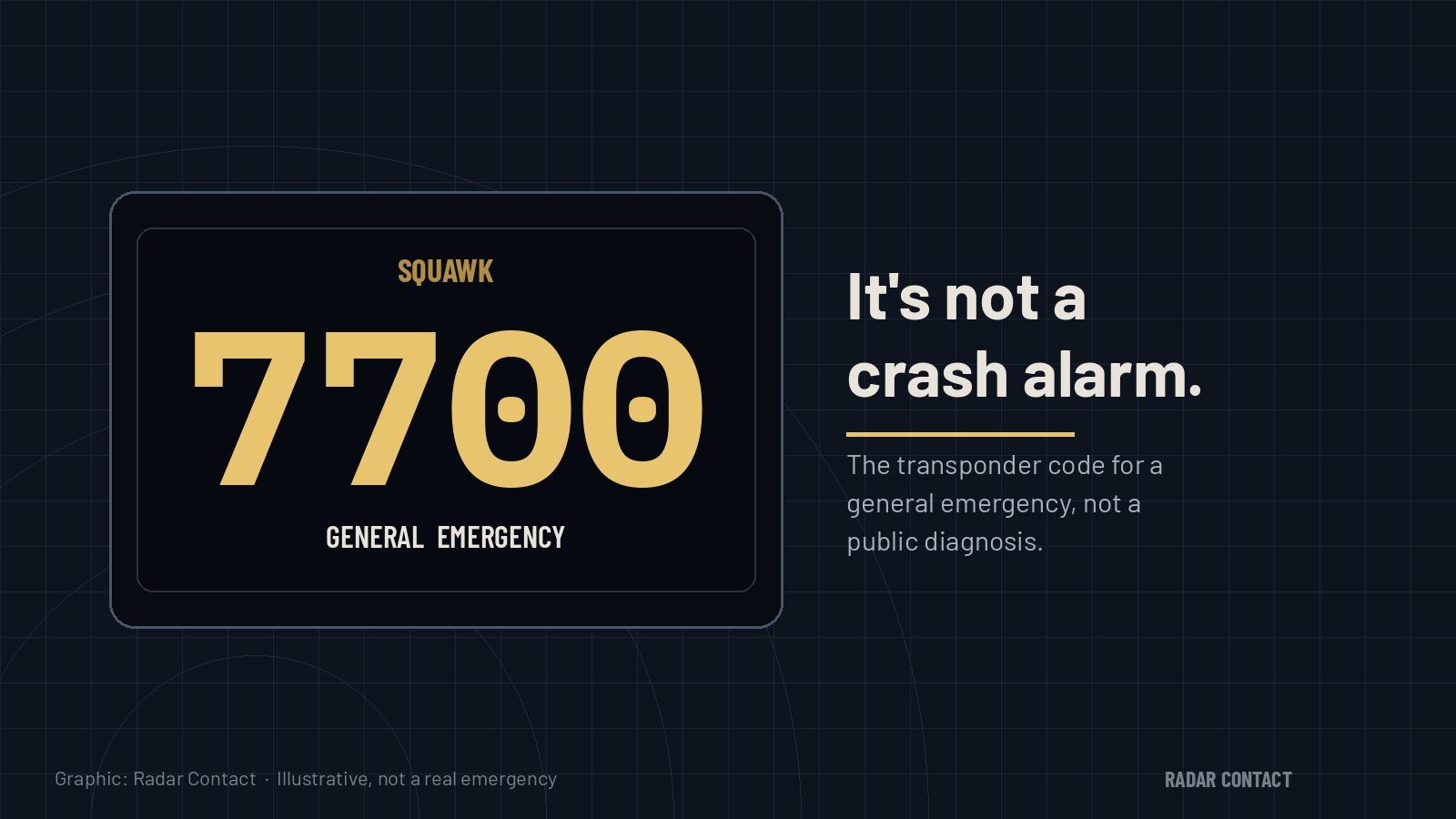
If you just watched a flight go red on a tracker, take a breath. The code is supposed to be loud. The situation usually isn’t.
How a Squawk Code Works
Every airplane with a transponder — that’s the little box that answers the radar — is broadcasting a four-digit code. Only the digits 0 through 7, like an old combination lock. That gives you 4,096 possible combinations, from 0000 to 7777.
On a normal day, air traffic control hands us a code so our blip shows up with the right label. A handful of those codes are reserved for special situations. 7700 is the reserved emergency code.
“Squawk” is just the verb. You’re not hearing the airplane scream. You’re looking at a number the box was already built to send.
What 7700 Actually Means
In the FAA’s own manual, 7700 is the emergency transponder code. If we’re in a distress or urgency situation and we want a radar facility to notice, we set 7700, leave the altitude reporting on, and get on the radio. Those radar rooms are wired so 7700 usually trips an alarm or a special flag on the scope. We might not even be in radar coverage, so the advice is simple: leave 7700 in the window and keep trying the radio.
Canada’s AIM says pretty much the same thing. If you can’t get ATC on the radio right away and you need them to notice, set 7700, then get them on frequency and do what they tell you with the transponder. Europe’s rules tell us to select 7700 to show we’re in an emergency, unless they’ve already given us a specific code. Even then, we can still set 7700 if there’s a real reason that’s the better move.
Notice the language. Distress or urgency. Not “the wings have departed.” The FAA’s own glossary spells it out. Distress is being threatened by serious and/or imminent danger and needing immediate help. Urgency is being concerned about safety and needing timely help, just not immediate — a potential distress condition. 7700 is the general emergency code. By itself, it doesn’t tell anyone which of those you’re dealing with.
A medical problem in the back, a system warning we want extra room to deal with, or a precautionary diversion — landing somewhere we weren’t originally going, just to be careful — can all be a good reason to ask for priority. The code gets us to the front of the line. It isn’t a public diagnosis, and nobody publishes an official “crash rate” for the number.
What Happens After the Crew Sets It
The code tells ATC that an emergency exists. It doesn’t explain the problem. We still have to talk, as soon as we can, about what we need.
Controllers can give us priority — a direct routing, a clear runway, other traffic moved out of the way, and emergency services standing by if we need them. In the U.S., if a pilot declares an emergency and the airplane isn’t already identified on radar, the controller assigns us 7700.
From the cabin, you might notice nothing at all. Or you might feel a descent, a turn, or a landing at a different airport. None of that, on its own, means the day is ending badly. A go-around on arrival is still a standard, trained maneuver. It’s not proof of a near crash.
One more unglamorous fact from the crew room: a brief 7700 can also be a fat-finger. Canada’s AIM warns that 7500, 7600 or 7700 can get punched in for a second while we’re changing codes, and that we should avoid rolling through those numbers. A flash on a tracker is a reason to wait for facts, not a reason to write the ending.
Squawk 7700 Is Not the Same as Mayday
This is the question people type after the code itself.
7700 is a transponder setting. Mayday is a radio call.
The FAA’s manual says a distress message should start with MAYDAY, preferably three times. For an urgency condition, you say PAN-PAN the same way. Distress calls get absolute priority, and the word MAYDAY is supposed to shut everyone else up on the frequency. PAN-PAN outranks everything except distress.
We can set 7700, make a mayday or pan-pan call, do both, or — if we’re already talking to the controller — just tell them what’s going on and keep the squawk they already gave us, unless they tell us otherwise. The manual is blunt about that last part: if you’re already on the radio with ATC, keep the assigned code unless they say otherwise. If you can’t get them on the radio, squawk 7700.
In other words, a flight can be in an emergency and never show 7700 on your phone. The code is a tool, not a mandatory costume.
The manual also lets us get help by just calling the facility and saying what’s wrong, what we want to do, and what we need. Mayday and pan-pan have advantages, but they’re not the only legal way to start that conversation. You can’t decode a flight from whether a screenshot has the word “mayday” on it.
7500, 7600 and 7700 — and Two Codes People Also Ask About
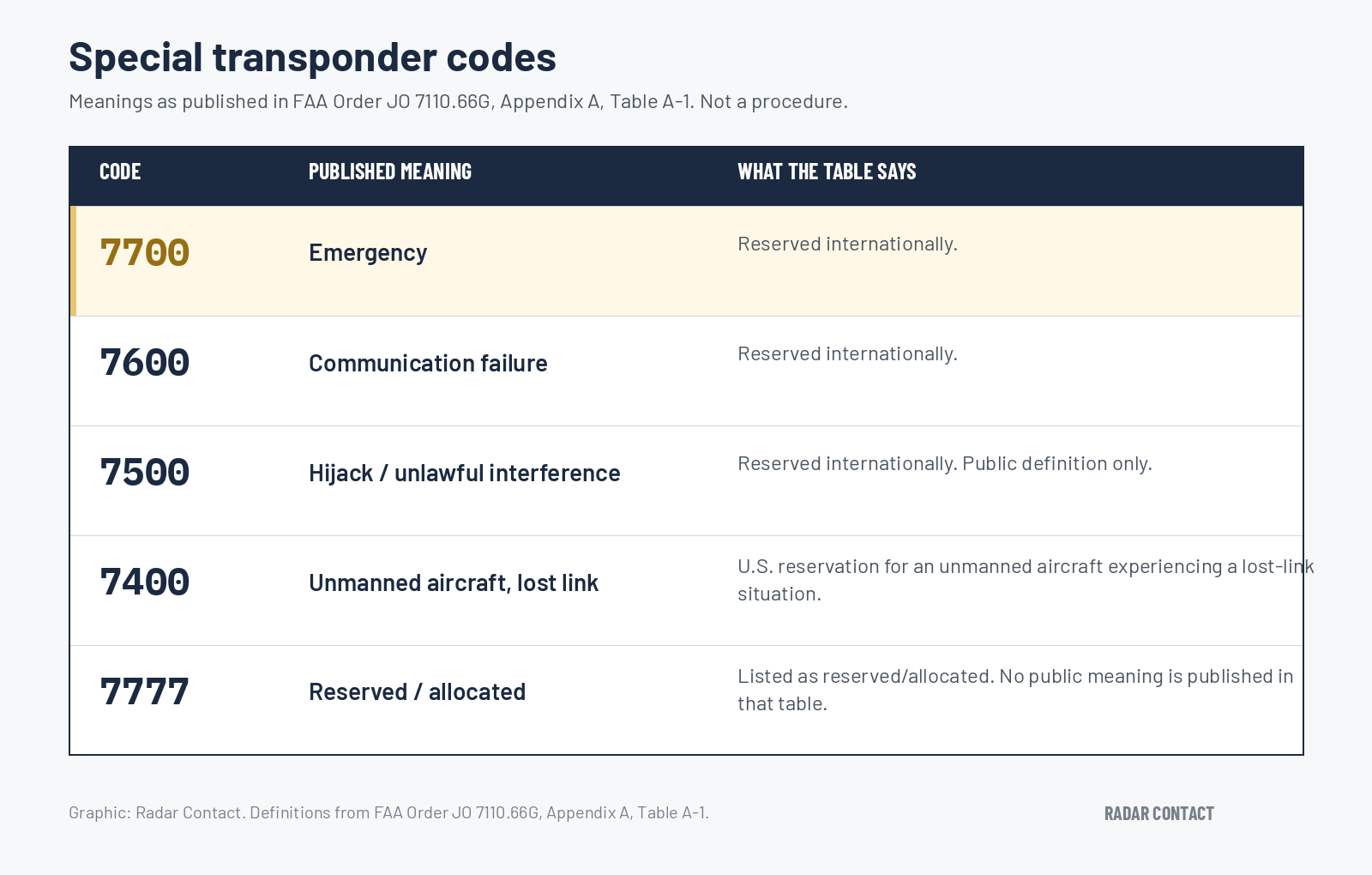
These three are reserved internationally. The FAA’s own table of reserved codes, for U.S. airspace, lists them like this.
| Code | Published meaning |
|---|---|
| 7700 | Emergency — reserved internationally |
| 7600 | Communication failure — reserved internationally |
| 7500 | Hijack / unlawful interference — reserved internationally |
| 7400 | Reserved for an unmanned aircraft experiencing a lost-link situation |
| 7777 | Reserved/allocated in the U.S. plan; no public meaning is listed in that table |
7700 is the general emergency code. That’s the one you’re here for.
7600 means communication failure — we lost the radio, or at least that’s what the code is reserved for. Canada’s AIM adds that setting 7600 doesn’t replace the normal lost-communications procedures. Europe uses the same reservation for a radio failure.
7500 is the internationally reserved code for hijack, or unlawful interference. That’s the public definition, and that’s as far as this article goes.
If you landed here because an autocomplete suggestion said 7700 is the hijack code, that suggestion is wrong. 7700 is emergency. 7500 is unlawful interference. Don’t treat a tracker screenshot as a security briefing, and don’t expect a magazine explainer to walk you through response procedures. We will not.
People also ask about 7400 and 7777. Same FAA table, and only as far as it actually writes them down. 7400 is reserved for an unmanned aircraft that’s lost its link. 7777 is listed as reserved, or allocated, alongside some other reserved blocks. The table doesn’t give it a public meaning in plain English. Anything more colorful than that isn’t coming from this source, so it isn’t going in this article.
Why 7700 Shows Up on Flightradar24
Flight-tracking sites pick up the same transponder and broadcast signals the radar facilities use to see us. When the code changes to 7700, the tracker can flag it, usually in a dramatic color. That’s a display choice, not a new kind of emergency.
“Squawk 7700 today” and “live” searches are mostly people watching a number. This page is not a live tracker. A red label means the emergency code is being transmitted. It isn’t a finding about what’s happening on board. If a later official report comes out, read that. Don’t let a comment thread write it first.
What Passengers Should Do
Stay in your seat with the belt fastened. Keep your bag stowed. Follow the cabin crew. If we’re diverting or landing sooner than you expected, wait for the people on the airplane to tell you what they can.
You don’t need to diagnose the transponder. You don’t need to refresh a tracker until the battery weeps. A code on a phone is not better information than a calm cabin.
Turbulence can feel dramatic without producing any emergency code at all. We walked through that in our turbulence explainer. For another “is this a disaster?” question, see what actually happens in a bomb-threat report. Same advice: wait for facts.
7700 means we’ve told the air traffic system we need priority. It doesn’t mean you should write the accident report before the airplane has parked.
FAQ
Is squawk 7700 a Mayday?
No. 7700 is a transponder code. Mayday is a spoken distress call. We can use one, the other, or both. If we’re already talking to air traffic control, we may just declare the emergency on the radio and keep the assigned squawk unless they tell us otherwise.
Is the squawk 7700 serious?
It’s serious enough that we want priority from ATC. It isn’t, by itself, proof that the airplane is about to crash. The FAA’s manual uses 7700 for a distress or urgency condition. That includes problems that end in a normal landing.
What does 7500, 7600, and 7700 mean?
In the FAA’s reserved-code table, 7500 is hijack or unlawful interference, 7600 is communication failure, and 7700 is emergency. All three are reserved internationally.
What does 7700 mean in Flightradar24?
It means the airplane’s transponder is transmitting the general emergency code. Trackers can highlight that change. The highlight doesn’t diagnose the problem, and it doesn’t mean the flight won’t land normally.
What does squawk 7777 mean?
The FAA’s reserved-code table lists 7777 as reserved, or allocated, alongside some other reserved blocks. That table doesn’t give 7777 a public meaning in plain English.
What is 7400 squawk?
In the same FAA table, 7400 is reserved for an unmanned aircraft that’s lost its link.
Do pilots always squawk 7700 in an emergency?
No. If we’re already talking to ATC, the manual says to keep the assigned code unless they tell us otherwise, and to squawk 7700 if we can’t get them on the radio. A flight can be handling an emergency without ever showing 7700 on a tracker.
What should passengers do if they see a 7700 alert?
Stay seated with your seat belt fastened, follow the cabin crew, and wait for information from the people on the airplane. A tracker flag isn’t a diagnosis, and it isn’t a reason to assume the worst.