Every pilot gets asked this at parties. "Doesn't turbulence scare you?" Honest answer: it annoys us. It spills coffee, wakes people up and makes the flight attendants' job harder. What it doesn't do is make us worry about the wings.
Here's why, and the one part of turbulence that does deserve your respect.
What Turbulence Actually Is
Turbulence is air that isn't moving smoothly. The FAA's passenger page calls it air movement you normally can't see, stirred up by jet streams, mountains, weather fronts and thunderstorms. It can happen in a perfectly clear sky.
Think of the airplane as a boat and the air as water. Most days the water's flat. Some days there's chop. The boat doesn't sink because of chop. It just gets bouncy.
The main kinds, in plain words:
- Clear-air turbulence. High up, often near the jet stream, with no clouds to warn anyone. Australia's safety investigators call it the main culprit in surprise turbulence, and it doesn't show up on weather radar.
- Thunderstorm turbulence. In and around storms. We go around these, not through them.
- Mountain wave. Wind pouring over a mountain range and tumbling down the far side.
- Wake turbulence. The swirling air another airplane leaves behind. We broke down one real case in our piece on United 1157 and the turbulence you can't see.
Can Turbulence Crash a Plane?
Realistically, no. Not a modern airliner in normal service.
Start with how they're built. The FAA's certification rules say an airliner's structure has to take at least 2.5g (two and a half times the normal pull of gravity) pressing down, and a full 1g the other way, without bending out of shape for good. Then the rules stack a 50% safety margin on top, and the structure has to hold that bigger load for at least three seconds without breaking. Separate rules cover gusts. Normal level flight is 1g.
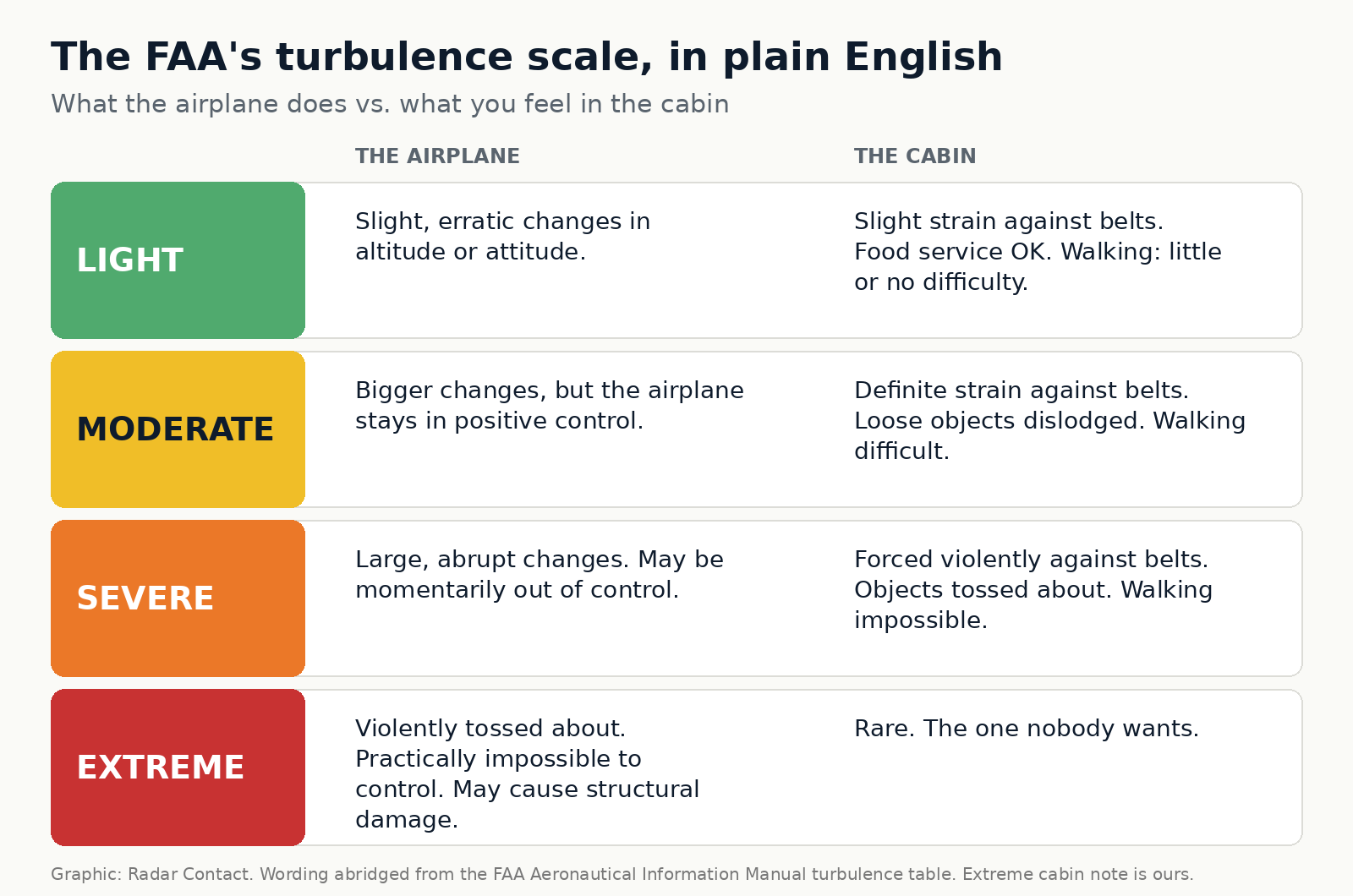
Then there's the scale we use to report bumps. The FAA's version tops out at "extreme," where the airplane is "violently tossed about," is "practically impossible to control" and "may cause structural damage." That's real, and it's rare. As one explainer in The Conversation put it, the turbulence needed to bend a wing spar is something even most pilots won't run into in a lifetime.
The record backs that up. The NTSB looked at ten years of US airline accidents, 2009 through 2018. Turbulence was the most common type, 111 of 295, more than a third. Every one of them seriously hurt somebody. Not one did substantial damage to the airplane. In 106, the airplane wasn't damaged at all. The other five broke cabin stuff like ceiling panels and overhead bins. The full write-up is in the NTSB's turbulence study, if you like that sort of thing. We do.
So where does the 1966 case fit? A Boeing 707 out of Tokyo left its planned route to fly near Mount Fuji in strong winds and broke up. Investigators found a gust load "considerably in excess of the design limit." That's mountain wave at its absolute worst. The Conversation's explainer notes modern airliners are built to higher standards and probably wouldn't be brought down by the same encounter today.
So What Actually Hurts People?
Not being strapped in.
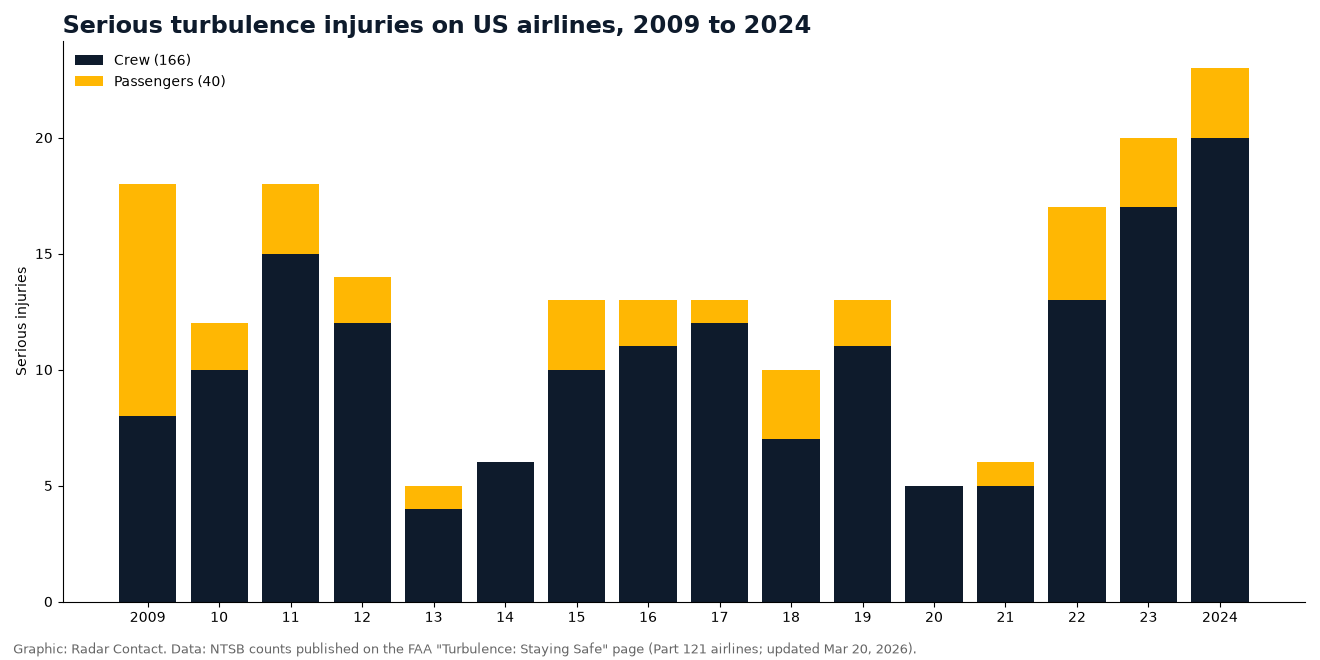
The FAA publishes the NTSB's count of serious turbulence injuries on US airlines. From 2009 through 2024, its table lists 166 crew members and 40 passengers. Forty passengers in sixteen years, on every US airline combined.
The NTSB's study found flight attendants made up 79% of the people seriously hurt. That tracks. They're the ones on their feet working, often while you're already belted in for landing.
Australia's safety bureau says in a typical turbulence incident, 99% of the people on board aren't hurt at all. Its fact sheet sums up the whole topic in one line: "While your aircraft is designed to take turbulence, your body is not."
Here's why unbelted people get hurt so fast. On the Singapore Airlines flight over Myanmar in 2024, investigators found the violent part lasted 4.6 seconds and moved the jet 178 feet. That's it. But in 0.6 seconds, the g-load swung from pressing people into their seats to lifting them out. Anyone not belted went airborne, then came back down. Reuters reported one passenger died of a suspected heart attack, and passengers and crew were injured. The bigger descent afterward, from 37,000 to 31,000 feet, was the crew's own normal, controlled descent 17 minutes later.
What We Do Up Front About It
A lot of our day is spent not finding turbulence.
- Before the flight. We look at turbulence forecasts along the route. The FAA says it also developed a "nowcast" that updates every 15 minutes so pilots and dispatchers can steer around the rough air.
- Ride reports. Pilots tell controllers and each other what the air's doing, and the FAA wants more of those reports, not fewer. Often the seatbelt sign comes on because an airplane ahead of us already told us what's coming.
- Storms. The FAA's manual says thunderstorms imply severe or worse turbulence, and to treat anything within 20 miles of one with great caution. We give them room. Radar shows us rain, not the bumps themselves, and the same manual warns the turbulence near a storm can be a lot worse than the rain suggests.
- In the bumps. We slow to the airplane's turbulence speed, turn the sign on, get the flight attendants seated and ask for a smoother altitude if there is one.
If somebody does get hurt, the crew can divert and have medical help meet the airplane, like the Singapore crew did. That's also when you might see an emergency code pop up on a tracking app. Our squawk 7700 explainer covers what that does and doesn't mean.
And yes, sometimes the sign comes on and nothing happens. We'd rather be wrong in that direction.
Is Turbulence Getting Worse?
Over the North Atlantic, at least, it looks that way. A 2023 study by University of Reading researchers found severe clear-air turbulence at a typical spot there went from 17.7 hours a year in 1979 to 27.4 in 2020, up 55%. The authors say it's consistent with the effects of climate change.
More bumps doesn't change the design math. It does make the seatbelt advice matter more.
How to Make Turbulence a Non-Event
- Belt on whenever you're seated. Not just when the sign's on. That's straight from the FAA.
- Kids under two in an approved child seat. The FAA says it's the safest place for them. A lap is not a seatbelt.
- Stow your bags properly. The FAA lists sticking to carry-on rules as an injury-prevention step. Its own scale says that in severe turbulence, loose objects get tossed about. Don't let one be yours.
- Listen to the crew. If the flight attendants are told to sit, it's a good time for you to stay put too.
- Time the bathroom run. Go when the sign's off and the cabin's calm. Don't hang out in the aisle.
FAQ
Can turbulence crash a plane?
Realistically, no. Airliners are certified to carry big loads with a 50% safety margin on top. The NTSB looked at 111 US airline turbulence accidents from 2009 to 2018. Every one seriously injured someone, and not one substantially damaged the airplane.
Has turbulence ever caused a plane crash?
Yes, but the cases people cite are old. The best known is a Boeing 707 that broke up near Mount Fuji in 1966 after flying close to the mountain in strong winds. An explainer in The Conversation says modern airliners are built to higher standards and probably wouldn't be brought down by the same encounter.
Can turbulence kill you?
It's extremely rare. On the Singapore Airlines flight in 2024, Reuters reported one passenger died of a suspected heart attack and others were hurt. The NTSB found 79% of the people seriously hurt in US airline turbulence accidents were flight attendants, and it calls sitting with your belt fastened the best protection.
Is turbulence normal?
Yes. The FAA says turbulence is normal and happens often. Pilots report it to each other routinely so the airplanes behind know what's coming. It's still worth keeping your belt on, because the bumps don't always come with a warning.
Is turbulence dangerous for small planes?
It's more of a factor for them. The FAA's moderate-turbulence advisories are aimed especially at visual-flight pilots and "operators of sensitive aircraft." Even so, the NTSB found turbulence was the defining event in only 0.6% of general aviation accidents from 2009 to 2018.
Is turbulence dangerous during takeoff and landing?
The NTSB found about half of US airline turbulence accidents happened during descent or approach, mostly below 20,000 feet. On the climb, it found none below 10,000 feet. Descent stands out partly because flight attendants are up preparing the cabin. If you're belted in, it's mostly just bumpy.
Is turbulence dangerous when pregnant?
The American College of Obstetricians and Gynecologists says occasional air travel is almost always safe in a healthy pregnancy. It says to wear your seat belt at all times, low on your hip bones and below your belly, because turbulence can happen without warning. Check with your own doctor first.
What's the difference between moderate and severe turbulence?
In moderate turbulence, the FAA says you feel definite strain against your belt and walking is difficult, but the airplane stays in control. In severe turbulence, you're forced violently against your belt, loose objects get tossed and the airplane may be momentarily out of control.
Where's the best seat to avoid turbulence?
Pilots and flight attendants told the NTSB the bumps are usually worst at the back. In its data, unbelted flight attendants in the rear of the cabin were seriously hurt far more often than ones up front or in the middle. Wherever you sit, the belt matters more than the seat.
Is turbulence getting worse?
Over the North Atlantic, yes. A 2023 study found severe clear-air turbulence there rose 55% from 1979 to 2020. The authors say that's consistent with climate change. It doesn't change how strong airplanes are. It does make the seatbelt matter more.
Sources
- FAA, Turbulence: Staying Safe (injury table updated March 20, 2026)
- NTSB, Preventing Turbulence-Related Injuries in Air Carrier Operations (2021)
- FAA, Aeronautical Information Manual, turbulence reporting table and thunderstorm guidance
- FAA certification rules for airliner structure (14 CFR Part 25)
- Australian Transport Safety Bureau, turbulence fact sheet
- Singapore Transport Safety Investigation Bureau, SQ321 preliminary findings (May 29, 2024); Reuters
- Prosser et al., Geophysical Research Letters (2023)
- The Conversation, "How dangerous is turbulence... and can it bring down a plane?"
- American College of Obstetricians and Gynecologists, Travel During Pregnancy