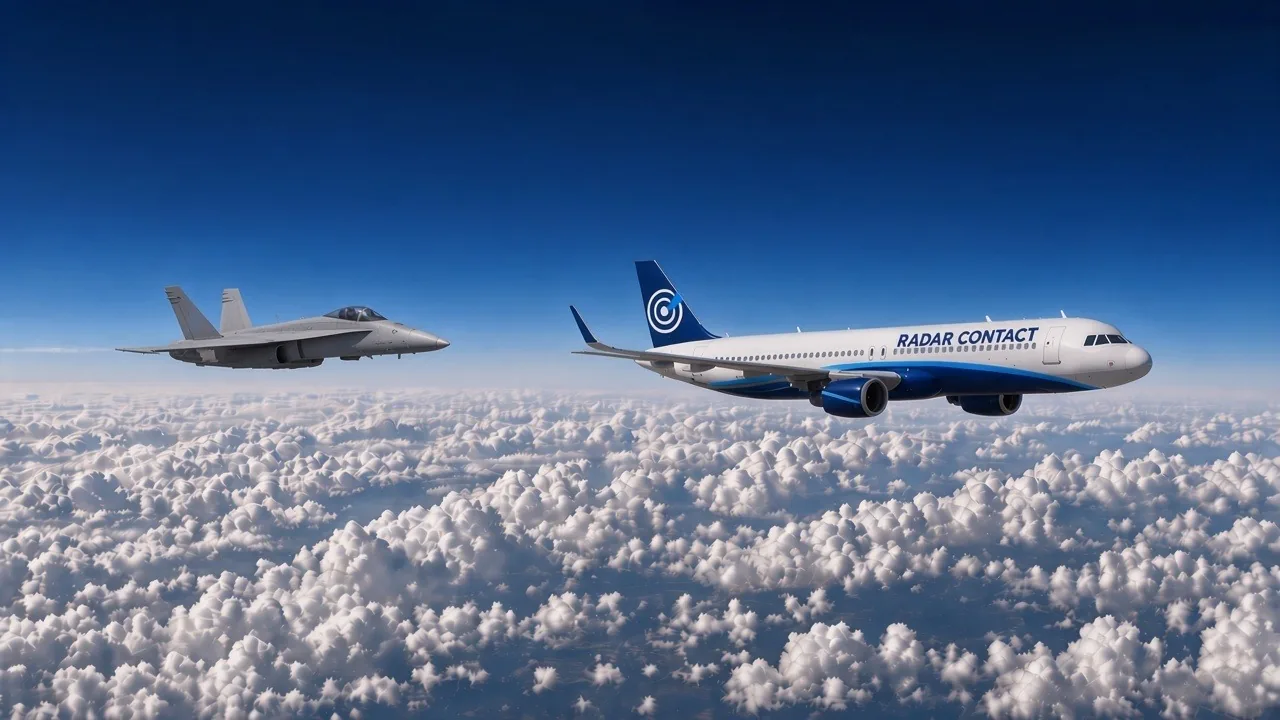
Tuesday was a long day for a lot of crews in Europe. At least seven airliners were searched after hoax bomb threats. At least one got an Italian Air Force escort into Rome. One was sent to a different Warsaw airport than the one on its tickets. Nobody was hurt, and no explosives were found on any of them.
So what actually happens up front during a plane bomb threat?
Short answer: less drama than the movies, more paperwork than you'd think, and a crew that treats it as real until somebody on the ground proves it isn't. Even when it's the fifth hoax of the morning.
What happened: the Nov. 3 wave of hoax bomb threats
Here's what's confirmed as of Tuesday afternoon in Europe. Seven flights, all declared false alarms (AP, BBC, The Guardian):
- LOT flight LO286, London Heathrow to Warsaw Chopin. The 737 MAX, with 181 people on board, diverted to Warsaw Modlin, which closed for about two hours. Passengers were bused to Chopin afterward (Irish Mirror, Aviation24.be).
- SAS flight SK751, Copenhagen to Warsaw Chopin. It landed as scheduled and was inspected. Chopin stayed open (Irish Times, BBC).
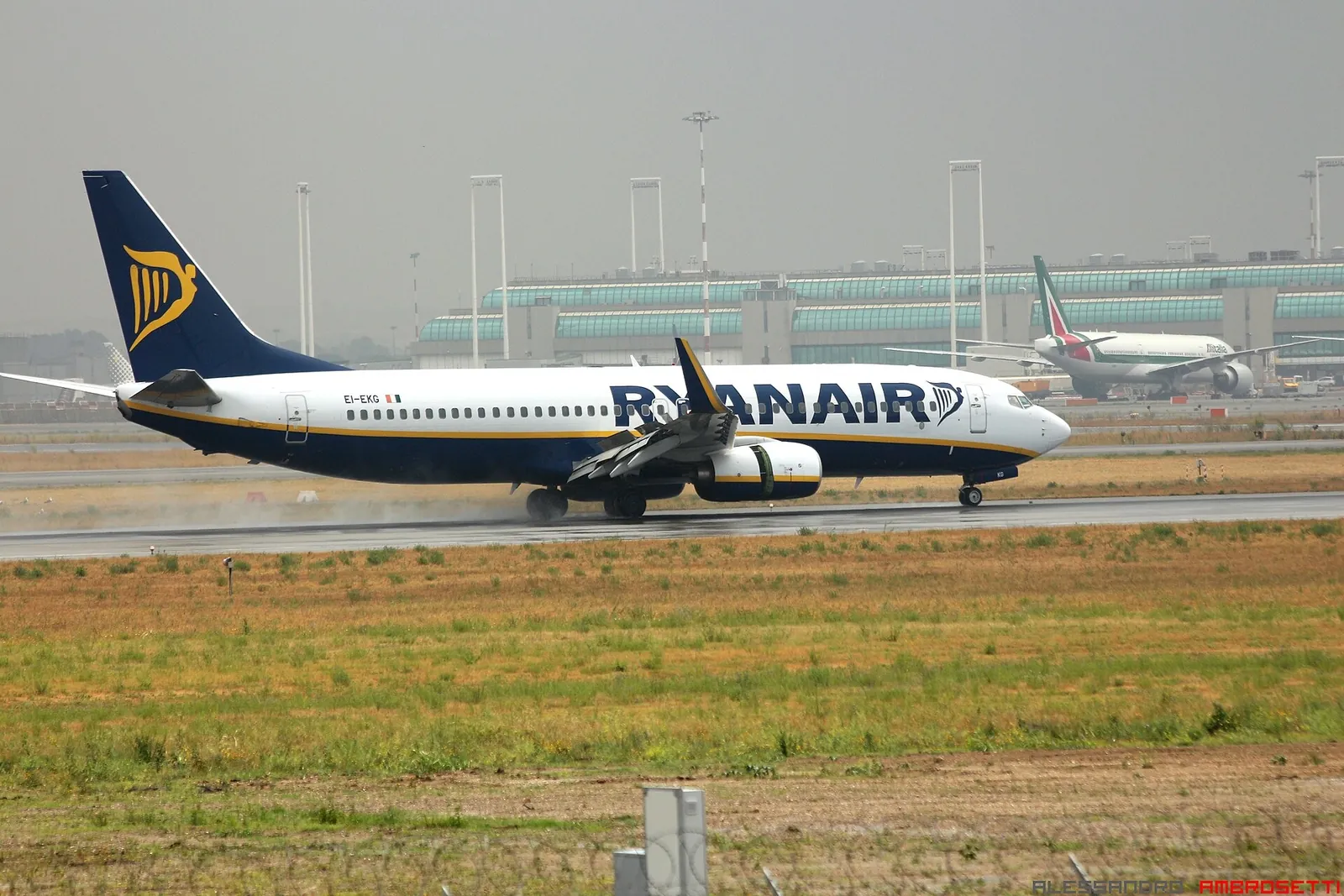
- Ryanair, Manchester to Murcia (reported as FR4116). 121 people on board. Spain's Civil Guard ruled out explosives, according to Spanish government delegate Francisco Lucas (BBC, Irish Mirror).
- Ryanair, Lisbon to Rome Fiumicino. It was searched after an emailed threat, and nothing was found (AP).
- Ryanair FR9611, Dublin to Rome Fiumicino. The Italian Air Force said it sent two Eurofighters, which escorted it until landing (ANSA). It was searched, and nothing was found (BBC, The Guardian).
- Wizz Air, Milan Bergamo to Sofia (176 passengers) and Ryanair, Dublin to Sofia (185 passengers). Both threats came in one email, Bulgarian police said. Neither flight diverted, and nothing was found (BBC, Irish Times).
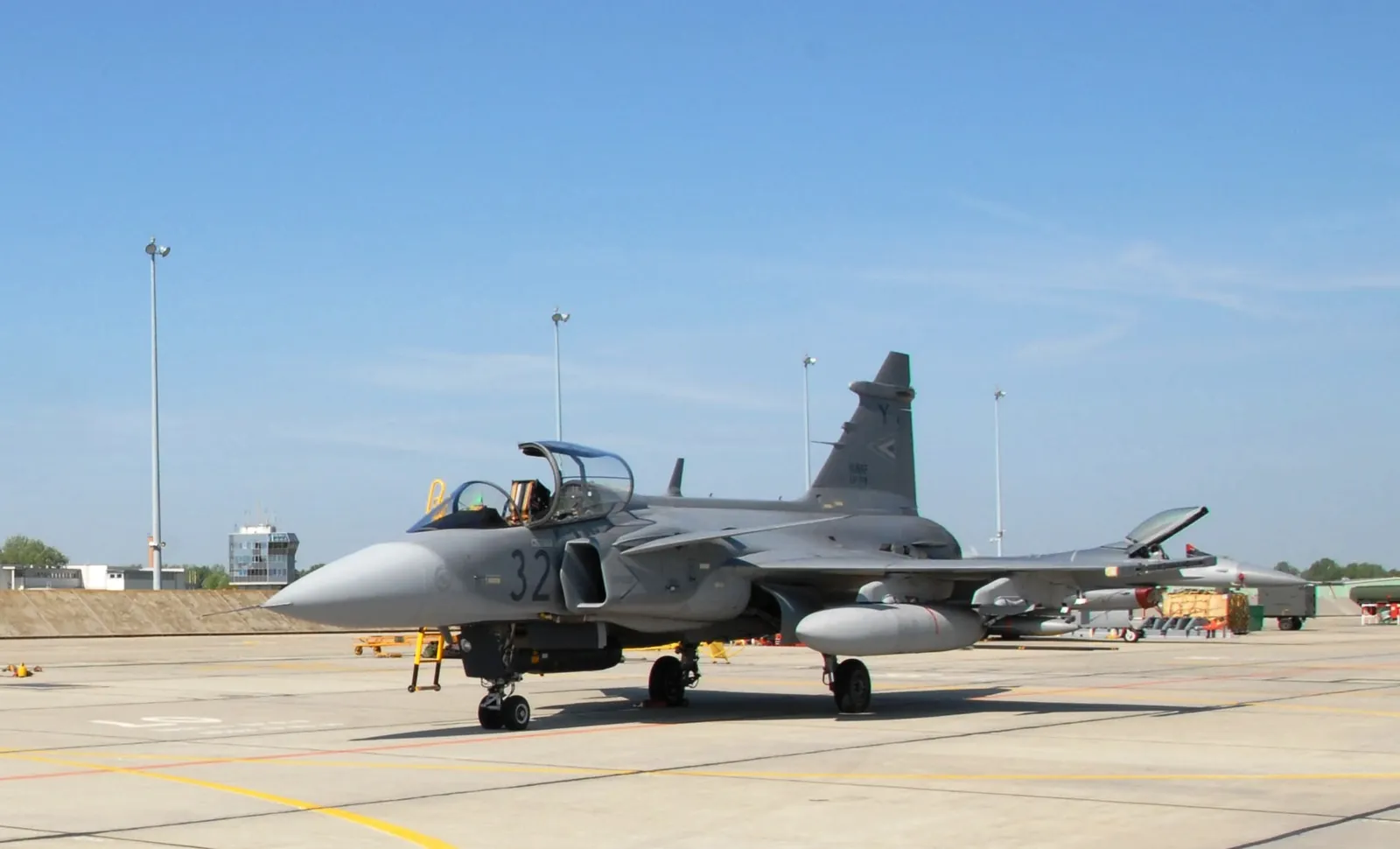
That came a day after Monday, Nov. 2, when a Wizz Air flight from London Luton to Sofia diverted to Budapest after a threat in flight. Hungary's defence minister said a Gripen fighter jet secured the landing. Wizz Air said the inspection was "completed and nothing was found" (BBC).
Who sent them, and are they linked? Nobody knows yet, and we're not guessing. As of Tuesday afternoon there was no claim of responsibility and no arrest, and officials weren't blaming anyone (Reuters via GMA News). Authorities are working together to find out whether it was coordinated, the BBC reports. In Italy, airport police and the postal and cyber police are investigating an anonymous email, and investigators said no link to the other European cases had emerged so far (ANSA). In Bulgaria, Interior Ministry Secretary General Lyubomir Nikolov said work to identify the sender of Monday's threat was continuing (BNR/BTA). The UK government called them "malicious hoax threats." For now, that's the official word.

How a bomb threat reaches the cockpit
Here's the part people don't expect. The threat almost never shows up in the cockpit first.
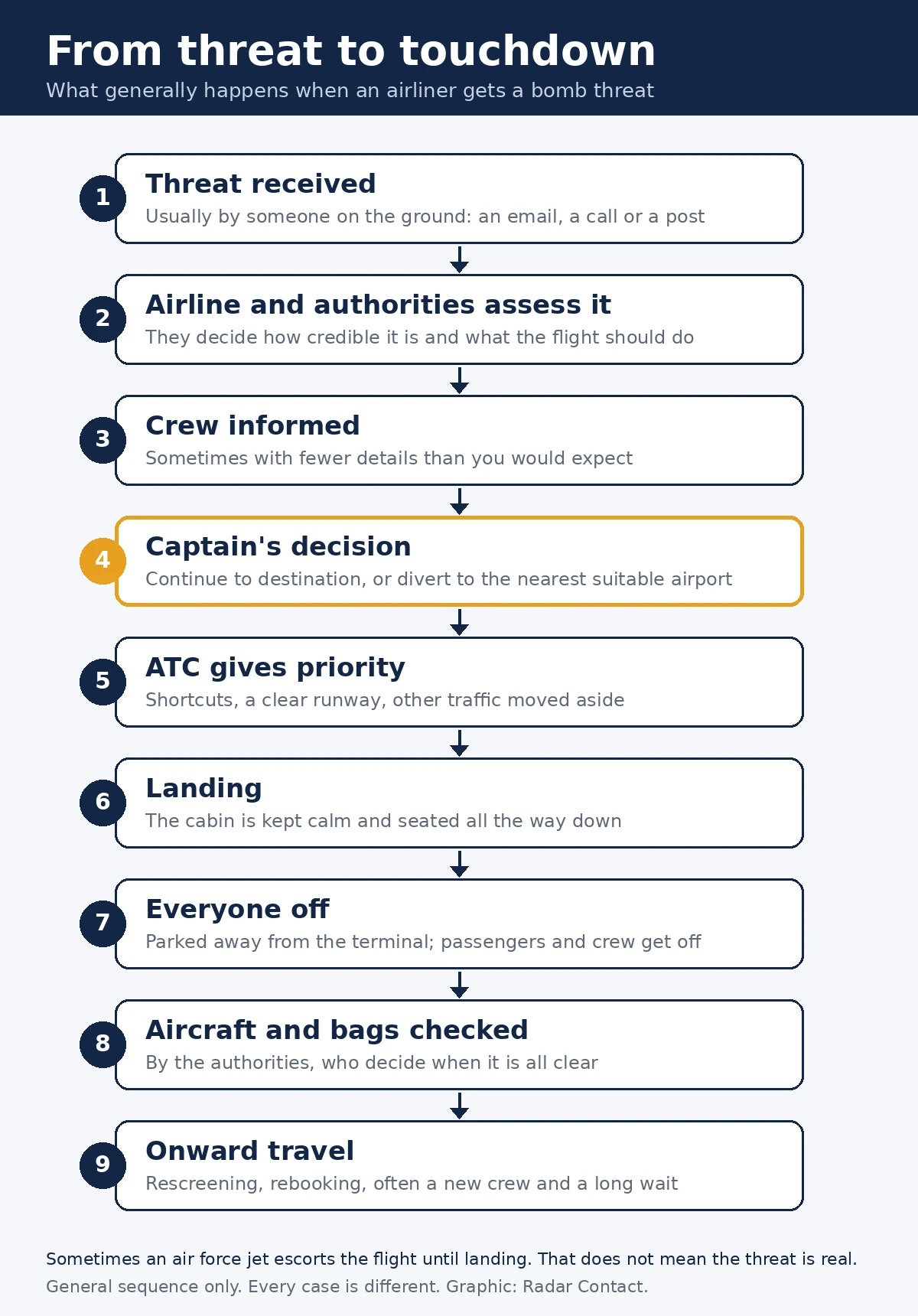
Most hoaxes go to someone on the ground: an airline, an airport, the police, a social media account. Tuesday's came by email, at least in Rome and Sofia. The airline's security people and the authorities then decide how credible it is and what the flight should do.
Then it gets to us, in plain and slightly too calm language. Sometimes the crew is told less than you'd assume. The BBC's transport correspondent noted that passengers, "and even the flight crew in some cases," won't necessarily be told everything. That isn't a cover-up. It's people on the ground handling the parts the crew doesn't need to fly the airplane.
The rarer case is a threat that starts on board: a note, a passenger saying something stupid, something written in a lavatory. Then the cabin crew know first, and it comes up front fast, clear and quiet.
Why every threat gets treated as real
Statistically, almost every bomb threat against an airliner is a hoax. Every pilot knows it. And it doesn't change a thing.
Marco Chan, a former airline pilot who now lectures in aviation operations at Kingston University, told the BBC a threat is considered "genuine until it is resolved, even though most turn out to be hoaxes." That's exactly right, and it's the only sane way to run it.
The maths is simple. If you treat a hoax as real, you lose a few hours, some fuel and a lot of goodwill on social media. If you treat a real one as a hoax, you lose everything. There isn't a pilot alive who'd take that bet with 180 people behind the door.
The hoaxers know this. That's the whole trick. It isn't clever. It just exploits the fact that we're responsible.
The diversion decision: nearest suitable, not nearest
When the decision is to get on the ground, the phrase you'll hear is "nearest suitable airport." The word that matters is suitable.
Suitable means a runway long enough for the airplane at its current weight, weather you can actually land in, proper rescue and firefighting cover, and an airport that can deal with the situation once you're stopped. Terry Tozer, a former airline pilot, told the BBC the captain weighs what facilities the diversion airport has and how the aircraft could carry on if it's a false alarm. That's the real-world calculation. The closest strip of concrete isn't always the right answer.
LOT 286 was headed for Warsaw Chopin and landed at Modlin, the city's other airport. Nobody has said why, and I won't invent a reason.
Landing heavy. On a long flight, an airplane that turns around early is carrying a lot of fuel it was supposed to burn. That can put it above its maximum landing weight. Some widebodies can dump fuel. Most narrowbodies, like the 737s and A320-family jets in this story, can't. So the crew either burns some off or lands overweight. Airliners can do that when they need to, followed by a maintenance inspection. On short European hops like most of Tuesday's flights, it's usually a non-issue. You were nearly there anyway. Meanwhile, the pilot monitoring is doing fuel maths the whole way down. Boring and vital, which is about half of this job.
Working with ATC
Once a crew tells air traffic control what's going on, the controllers are on your side, and they're very good at it. You get priority. You get shortcuts. You get the runway you want. Other traffic gets moved out of the way, and nobody complains about it on frequency.
ATC also becomes the switchboard to the airport and the authorities. That frees the crew to fly the airplane and land it well. Aviate, navigate, communicate. A bomb threat doesn't change the order.
The exact phrases and codes we're deliberately leaving out. There's no reason to hand them to the next person with a free email account and a grudge.
Why fighter jets show up
At least two flights got fighter escorts: Wizz Air into Budapest on Monday and Ryanair FR9611 into Rome on Tuesday. To passengers, that looks like things just got worse. It usually hasn't.
European air forces keep jets on quick reaction alert so they can launch quickly when something in the sky is unclear. A bomb threat counts as unclear. The fighters aren't there to shoot anyone. In practice they're there to see the airliner up close, confirm it's flying normally and under control, stay in contact, and stay with it until it's on the ground. If anything changes, the people making decisions on the ground have eyes right there.
What it looks like from the cockpit: honestly, often not much. Passengers at the windows often get a better view than the pilots do. You fly your approach, they peel off, and you land. The rest is the military's business.

What passengers experience
Mostly, confusion. And that's partly on purpose.
A crew dealing with a threat has two jobs in the cabin: keep things calm, and get everyone to the ground in their seats with their seatbelts on. Aviation security expert Paul Mason told the BBC that "maintaining a calm state in flight is absolutely essential." What you hear on the PA might be vague: a diversion "for operational reasons," a "security issue," or nothing at all.
One passenger on the Manchester to Murcia flight told BBC 5 Live: "We weren't told anything during the flight." After landing, she said, fire engines and the bomb squad arrived, and passengers were walked to the terminal and left their belongings on board. "We were only later told that it was an actual threat," she said.
Frustrating? Sure. But a cabin of scared people pulling bags down is its own hazard. You get the full story on the ground. (Same logic as why crews worry about power banks.)
After landing: away from the terminal, off the plane, a long wait
Once the airplane stops, the problem belongs to the authorities on the ground. The aircraft is generally parked away from the terminal, and passengers and crew get off. Specialists check the aircraft and bags, and nobody reboards until they're satisfied. On Tuesday that meant police, bomb-disposal teams and sniffer dogs, according to officials and the BBC. How they do it stays their business.
For passengers, expect:
- A long wait. Hours, not minutes. Sometimes in a terminal you didn't plan to be in. LOT's passengers were bused from Modlin to Chopin.
- Rescreening before you get your stuff back.
- A crew that may be out of duty time. After a diversion and a search, the crew who flew you there may legally be done for the day. That's often the real reason for the second delay.
- Rebooking. Under EU261 and UK261, a security threat is commonly treated as an extraordinary circumstance, so fixed compensation usually isn't owed. You're still owed care: food, and a hotel if it runs overnight. Keep your receipts.
What happens to the hoaxers
This is my favorite section to write, because the answer is "eventually, nothing good."
In the UK, communicating false information about a bomb is an offence under section 51 of the Criminal Law Act 1977. On indictment, the maximum is seven years in prison. In 2011, a passenger on an Etihad flight from Abu Dhabi to Heathrow told cabin crew another passenger had a gun and had threatened to blow himself up. RAF fighters were scrambled, and the flight diverted to Stansted. He got three years at Chelmsford Crown Court (The National).
In the US, giving false information about a threat to an aircraft carries up to five years under 49 U.S.C. 46507. Under 18 U.S.C. 1038, hoaxers can also be sued for the cost of the emergency response. In May 2025, a man who handed a flight attendant a bomb-threat note on a July 2023 Alaska Airlines flight from Atlanta to Seattle was sentenced to 22 months in federal prison. He was ordered to pay $79,449.47 to Alaska Airlines and Spokane International Airport, where the flight diverted (The Spokesman-Review).
India went through a much bigger version of this week in October 2024, when more than 500 domestic and international flights got hoax threats in about two weeks, most of them on social media (India Today). Police in Nagpur arrested a 35-year-old man they accused of sending about 30 of the threat emails. That's a charge, not a conviction.
Emailed threats feel anonymous. Investigators trace them anyway. It just takes longer than the hoaxer's afternoon of fun.
The pilot take
Here's how I'd sum up Tuesday from the crew room.
The system worked. Seven airplanes, plus Monday's, all on the ground safely. No injuries. Every one treated as real until it was proven otherwise. That's not overreaction. That's the job.
It also cost a lot: closed airports, fighters launched, crews timed out and thousands of people's days wrecked, all over some emails. If the senders are found, I hope the bill comes with the sentence.
And if your crew told you almost nothing until you landed? They were keeping the cabin calm and getting you down. Be annoyed with the hoaxer first.
Plane bomb threat: FAQ
What happens when a plane gets a bomb threat?
The airline and authorities assess it, and the crew either continues or diverts to the nearest suitable airport. After landing, everyone gets off, and the aircraft and bags are checked before anyone reboards.
Are bomb threats on planes usually hoaxes?
The vast majority are. Every one is still treated as genuine until it's resolved.
Why did fighter jets escort the planes?
To see the airliner up close, confirm it's flying normally and stay with it until landing. It doesn't mean the threat was real. Italy sent two Eurofighters with Ryanair FR9611 into Rome on Nov. 3, and Hungary sent a Gripen with a Wizz Air flight into Budapest on Nov. 2.
Which flights got bomb threats on Nov. 3, 2026?
LOT LO286 and SAS SK751 to Warsaw. Ryanair from Manchester to Murcia, and from Lisbon and Dublin to Rome. Wizz Air from Bergamo and Ryanair from Dublin to Sofia. All were false alarms.
Will passengers be told about a bomb threat during the flight?
Often not in detail. Crews prioritize keeping the cabin calm and seated.
Do you get compensation for a bomb threat diversion?
In the EU and UK, usually no fixed EU261/UK261 compensation, since a security threat is commonly treated as an extraordinary circumstance. The airline still owes you care and rebooking.
What is the penalty for a hoax bomb threat on a plane?
Up to seven years in the UK; up to five years in the US, plus liability for response costs. Real sentences include three years (UK, 2011) and 22 months plus $79,449.47 restitution (US, 2025).