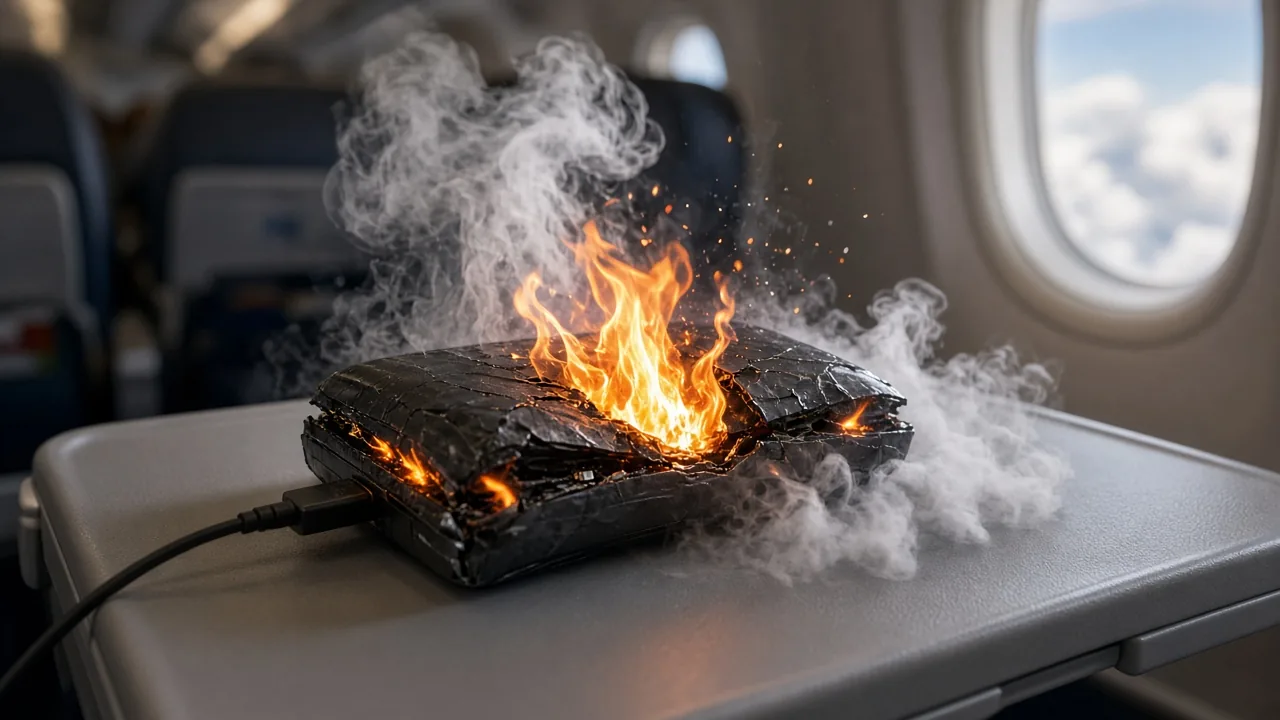
Here's the short answer, and it's the one the ramp agent won't have time to give you. Yes, you can bring a power bank on a plane. It goes in your carry-on, it has to be 100 watt-hours or less unless the airline signs off, and it never goes in a checked bag. These days, a lot of airlines also don't want to see it in the overhead bin or plugged into the seat.
That's the rule. Here's the pilot take. Of all the things passengers bring on board, that $25 brick of lithium cells is near the top of the list of things crews actually worry about. Not the guy with three carry-ons. Not the screaming toddler. The battery.
The IndiGo fire that put power banks back in the news
On October 11, 2026, IndiGo flight 6E 6115, an Airbus A321 flying from Delhi to Chennai, diverted to Hyderabad after a passenger's power bank caught fire in an overhead bin, according to The Hindu and The New Indian Express, both citing PTI. About 180 passengers and seven crew were on board. IndiGo said "smoke was detected from a customer's personal electronic device," that the cabin crew "responded promptly and the situation was brought under control," and that the pilots diverted "in line with established protocols." No one was hurt, and IndiGo sent another aircraft to take passengers on to Chennai.
Videos shared online appear to show flames inside the bin and passengers trying to smother them with cloth and bags. The Hindu reports it was at least the third power bank fire on an IndiGo aircraft in about a year.
The outcome was good. A cabin crew did its job, the pilots put the airplane on the ground at the nearest suitable airport, and everybody went home. That's what a good outcome looks like with a battery fire: an unplanned landing somewhere you didn't plan to be.
Can you bring a power bank on a plane? The rules in 2026
The basic rules haven't changed much in years. What changed in 2026 is the stuff layered on top.
The baseline (FAA, Transport Canada, ICAO):
- Carry-on only. Spare lithium batteries, including power banks and battery charging cases, must travel in the cabin. If your carry-on gets gate-checked, take the power bank out first. That's straight from the FAA's PackSafe guidance and Transport Canada.
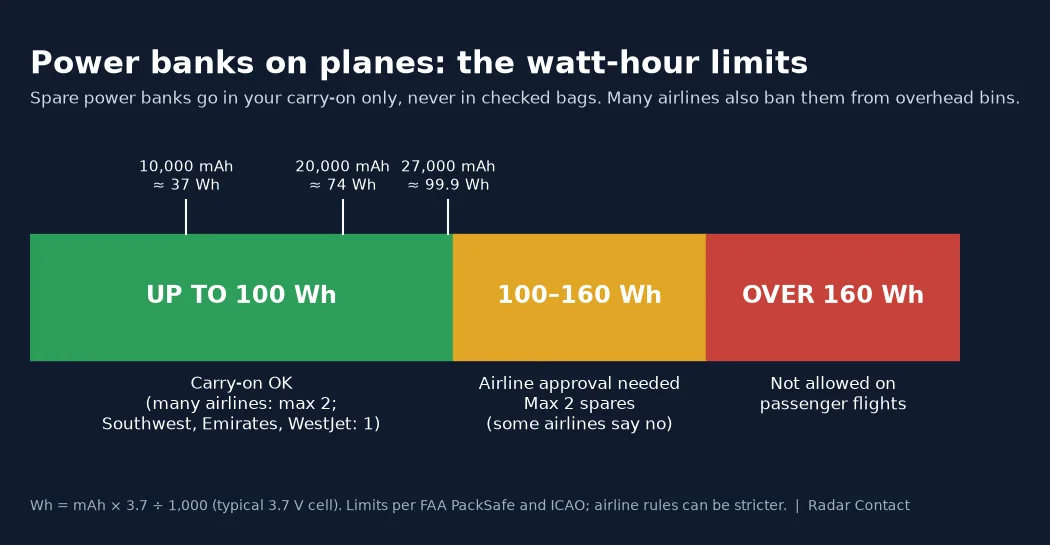
- Up to 100 Wh: fine. That covers nearly every phone-sized power bank.
- 101–160 Wh: airline approval required, and you're limited to two of these larger spares per person (FAA; CATSA in Canada).
- Over 160 Wh: not allowed on passenger aircraft. Delta and others say so outright. Those camping "solar generators" are out too. American names brands like EcoFlow and Jackery.
- Protect the terminals. Use the retail packaging, a pouch, or tape over the contacts.
- No damaged or recalled batteries, in either the cabin or the hold. Air Canada currently lists three recalled Anker models as prohibited.
What's new: ICAO, March 27, 2026. The UN aviation agency changed the international dangerous goods rules. Power banks are now limited to two per passenger, and recharging them during the flight is prohibited. The ICAO technical text also discourages using a power bank to charge other devices in flight, though it stops short of banning that outright. Airlines can, and do, go further.
What 100 Wh actually means. Most power banks list milliamp-hours (mAh), not watt-hours. For a typical 3.7-volt cell, Wh = mAh × 3.7 ÷ 1,000. American Airlines uses the same formula.
- 10,000 mAh ≈ 37 Wh
- 20,000 mAh ≈ 74 Wh
- 27,000 mAh ≈ 99.9 Wh, which is why that oddly specific capacity exists
Airline by airline: who bans what (as of Nov. 2, 2026)
This is where it gets messy. Every airline wrote its own version, and some have rewritten it twice.
| Airline | How many | Use on board? | Overhead bin? | Source |
|---|---|---|---|---|
| Southwest | One, max 100 Wh (since Apr. 20, 2026) | Allowed, but it must be visible while in use. No charging it from seat power | No | Southwest |
| United | Two | Can't recharge it from aircraft power | No | United |
| Delta | Two, max 100 Wh each, "no exceptions" | Can't recharge it on board, and can't use it to charge devices during taxi, takeoff or landing | No | Delta |
| American | Two, max 100 Wh each | Keep it within reach and visible while in use | No | American |
| WestJet | One | Can't charge it on board. Can't use it to charge a device when seat power is available | No | WestJet |
| Air Canada | Carry-on only. 100–160 Wh needs approval | No separate in-flight-use rule found on its baggage page | n/a | Air Canada |
| Emirates | One, under 100 Wh | No use at all (since Oct. 1, 2025), not even to charge your phone | No | Emirates |
| South Korean airlines (since Apr. 20, 2026) | Two, max 160 Wh each (over 100 Wh needs approval) | No use at all. Can't charge it, and can't charge devices from it | No | Korea's transport ministry, JoongAng Daily |
| IndiGo / flights in India | Two, max 160 Wh each | No use or charging in flight (DGCA rule) | Keep it within reach | The Hindu |
On a connection between two airlines, assume the stricter airline's rule applies to the whole trip. If one of them says one power bank, you're carrying one.
Why your crew is quietly terrified of them
On the ground, a lithium battery fire is a call to the fire department. At 37,000 feet, the fire department is a flight attendant with an extinguisher, a jug of water and a lot of training, and the nearest runway might be 40 minutes away. Over an ocean it can be a lot more than that.
The thing that makes these fires nasty is thermal runaway. The FAA describes it as a cell overheating in a way that feeds itself, and it "can occur without warning." The trigger can be damage, overcharging, heat, water or a plain manufacturing defect. Once one cell goes, it can heat up the cells next to it, so a fire that looks finished can flare up again. As Emirates put it, the result can include "fire, explosions, and the release of toxic gases." Not ideal in a sealed aluminum tube.
Air Busan 391: the one that burned on the ground
If you want to know what a battery fire can do to a whole airplane, look at Busan.
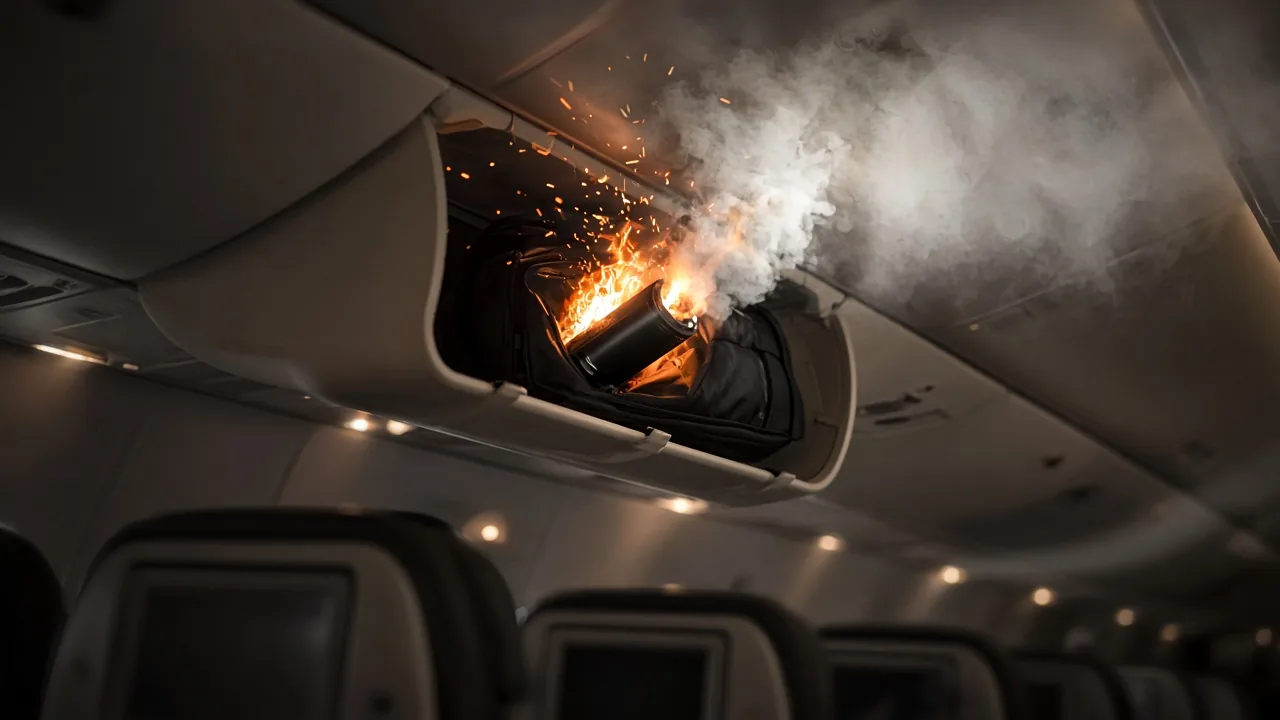
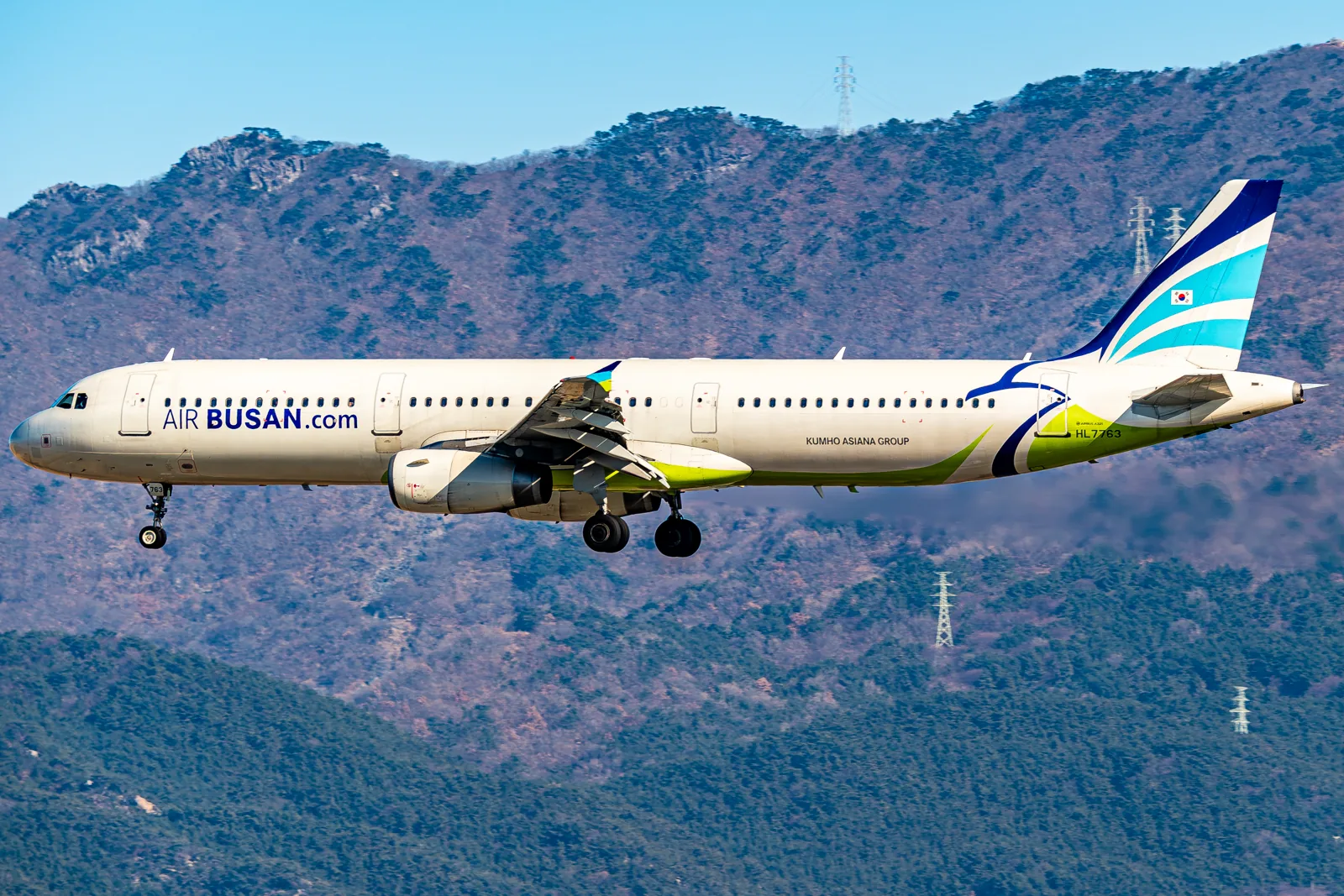
On the night of January 28, 2025, Air Busan flight BX391, an Airbus A321 registered HL7763, was at Gimhae International Airport in Busan, South Korea, getting ready to leave for Hong Kong. Boarding was done and the doors were closed for pushback when cabin crew found flames coming from an overhead bin near the back of the cabin, around seat 30L. The captain ordered an evacuation. That account comes from the Korean government's paper to ICAO.
All 176 people on board got out down the slides: 170 passengers (one of them a maintenance engineer) and six crew. According to that same paper, three people were seriously injured and 24 had minor injuries during the evacuation. Nobody died. The airplane didn't survive. The fire burned through the roof of the fuselage, and it took firefighters more than an hour to put it out completely, Yonhap reported. The Korean government says the aircraft was "completely destroyed." It was later cut up for scrap.

On March 14, 2025, Korea's Aviation and Railway Accident Investigation Board (ARAIB) released interim findings, based on National Forensic Service analysis. Investigators found multiple electrical melting marks on the remains of a power bank recovered near seat 31. They said the fire likely started when the battery's insulation broke down and caused an internal short circuit. They found nothing in the aircraft's own wiring or lighting linked to the ignition, and said a fire from the airplane's systems was "highly unlikely." The battery was too badly burned to show what caused the short (Reuters, KBS, Yonhap). Those are interim findings. ARAIB's site lists a preliminary report, and we couldn't find a final report as of Nov. 2, 2026.
Here's the pilot read. That fire happened at the gate, with the engines barely running, a fire station minutes away and slides right there. It still destroyed an A321. Now run the same thing at cruise, an hour from the nearest runway. That's the scenario every crew briefing on battery fires is built around, and it's why the airline rules went from "please be careful" to "not in the bin, not on the charger, and keep it where we can see it."
What changed afterward. Air Busan banned power banks from its overhead bins within days. On March 1, 2025, Korea's transport ministry made that the rule for all Korean airlines (Yonhap, Korea.net):
- power banks and e-cigarettes stay on you or in the seat pocket, not in the overhead bin
- the terminals are taped, or the device goes in a protective pouch or clear plastic bag
- no charging them on board
- up to five power banks of 100 Wh or less, or two of 100–160 Wh with airline approval
Korea tightened it again on April 20, 2026: two power banks per person, up to 160 Wh each, and no using them on board at all, not even to top up a phone (Korea's transport ministry). The ministry says ICAO's new international rule grew out of a Korean proposal.
Korea took the fight to ICAO. In 2025, airlines worldwide piled on with their own bin and in-flight-use bans, and Emirates' ban started Oct. 1, 2025. ICAO's two-per-passenger, no-recharging rule took effect on March 27, 2026, and ICAO's own guidance says the need for it was "heightened by an accident in January 2025" that "destroyed an aircraft" (ICAO). It doesn't name the airline. Busan is the only one that fits.
(If you're thinking of Japan: that was JAL flight 516 at Tokyo Haneda in January 2024, a runway collision with a Coast Guard aircraft. It wasn't a battery fire.)
How often does it happen?
More than you'd guess.
- The FAA logged 97 lithium battery incidents involving smoke, fire or extreme heat on passenger and cargo aircraft in 2025, up from 89 in 2024. That's according to Forbes, citing the FAA.
- Since the FAA started tracking in 2006, there have been 717 incidents through late April 2026, and 281 involved battery packs, the biggest single category (Forbes, citing the FAA).
- Insurance Business reported 58 verified FAA incidents on U.S. passenger aircraft in the first eight months of 2026.
- UL Standards & Engagement's industry program counted 2.36 thermal runaway incidents per week on passenger flights worldwide in 2025, with portable chargers the leading cause. About 12% of those flights ended in a diversion, a return to the gate, an evacuation or an unplanned deplaning (UL report).
The FAA notes that its incident list isn't complete, so treat those numbers as a floor.
Why the overhead bin is the problem. A battery in your hand or the seat pocket gets noticed when it starts smoking, swelling or smelling like a burnt circuit board. A battery inside a backpack, inside a closed bin, gets noticed when smoke starts coming out of the bin. Look at the IndiGo videos: that's exactly where it was. It's where the Air Busan fire started, too. Every airline rule about keeping it "within reach" or "visible" comes down to one thing: catching it in the first few seconds instead of the first few minutes.
What crews do, in general terms. Flight attendants are trained to deal with battery fires, and airlines carry equipment for it. In broad strokes, they put out the flames, cool the device to stop the runaway, and keep watching it. Up front, the pilots get the call and start planning a landing: weather, runway, fire trucks, the works. The FAA's PackSafe page has the passenger part. If your device is "overheating, expanding, smoking or burning," tell a crew member immediately.
From the flight deck, the pilot take is simple. "Smoke in the cabin" is one of the few chimes that gets everybody's full attention, mid-sandwich or not. You don't wait to see how it develops. You start looking for the nearest suitable runway. That's why one cheap power bank can cost an airline a diversion, a replacement aircraft, a crew that's now out of duty time, and a few hundred people their connections.
Practical tips: how to fly with a power bank without becoming the story
- Check the label before you pack. No Wh or mAh rating printed on it? Some airlines, Emirates included, won't accept it.
- Carry-on only. Always. If your bag gets gate-checked, take the power bank out.
- Know your airline's number. On Southwest, WestJet and Emirates, it's one. On many others, it's two.
- Keep it on you or under the seat, not in the overhead bin. Seat pocket is fine where the airline allows it.
- Don't charge the power bank from the seat outlet. United, Delta, Southwest and WestJet all ban this, and ICAO now prohibits it internationally.
- Charge before you fly. Top up your phone and the power bank at the gate, and use seat power for the phone if the airline allows it.
- Retire the swollen one. If it's puffy, cracked, dropped hard, or randomly gets hot, it's done. Recycle it. Don't bring it to the airport.
- Cheap and unbranded is a gamble. Check recall lists (CPSC in the U.S., Health Canada in Canada) for the one you own.
- If it starts getting hot or smoking: call a flight attendant immediately. Don't stuff it in a bag, don't pick it up bare-handed, and don't try to be a hero with a bottle of Diet Coke.
- Don't let it get crushed. Seat mechanisms are notorious for crushing phones that slide down beside the seat. If something slips into the seat track, ask the crew before you move the seat.
FAQ
Can you bring a power bank on a plane?
Yes, in your carry-on. Up to 100 Wh needs no approval. From 101 to 160 Wh, you need the airline's approval and can bring at most two. Over 160 Wh is prohibited. Several airlines now allow only one.
Can I put a power bank in my checked luggage?
No. Spare lithium batteries and power banks are banned from checked bags under FAA, Transport Canada and international rules, and that includes gate-checked bags.
How many mAh is allowed on a plane?
The rule uses Wh, not mAh. At 3.7 V, 100 Wh is about 27,000 mAh. A 20,000 mAh bank (about 74 Wh) is fine almost everywhere.
Can I use my power bank during the flight?
It depends on the airline. Recharging the power bank itself is now prohibited under ICAO rules and by most major airlines. Emirates, Korean airlines and all flights in India ban any use. Southwest and American allow use if it stays visible.
How many power banks can I bring?
ICAO's limit is two per passenger, and many airlines match it. Southwest, WestJet and Emirates allow one. Check every airline on your itinerary.
Has a power bank ever destroyed a plane?
Yes. In January 2025, Air Busan flight BX391, an A321, burned at the gate in Busan, South Korea, before departure. All 176 people on board got out, and the aircraft was destroyed. Korea's accident investigation board said in interim findings that a short circuit inside a power bank in an overhead bin was the likely cause.
Why can't power banks go in the overhead bin?
Crews can't see a fire that starts inside a closed bin, and a battery fire is easiest to handle in its first few seconds. That's why United, Delta, Southwest, WestJet, Emirates and Korean airlines all ban the overhead bin. Korea's rule came after the Air Busan fire.