
Commuting nights, crash pads and some training stays are different bills. One published agreement is not a worldwide free-room law.
A layover room is rest for the next duty period. It is not a personal holiday perk, and it is not automatically the same arrangement as every other night you spend away from home.
Who Pays for a Layover Hotel?
On a working trip, the ordinary model is simple: the company provides the room.
The publicly posted United Pilot Agreement 2023 is a concrete example, not a global rulebook. Section 4-C-2-a, printed page 61, defines a layover as the time between duty periods within the same trip. It then requires that pilots on a layover “shall be furnished suitable single occupancy lodging” under that section and the Hotel Guidelines. Source: United Pilot Agreement 2023.
The same agreement’s Hotel Guidelines section says mutually agreed hotel standards govern how layover hotels are sourced and selected. That is the contractual shape of “the airline has the hotel contract.” It is not an invitation to name properties, and we will not. Source: agreement, section 4-B.
Other airlines write their own terms. The passenger takeaway is still useful: working the same flight does not turn the overnight into your personal hotel invoice under that kind of provision.
Where the room sits is a separate question from who pays. Short rests are often near the airport; some agreements put longer layovers toward the city centre. In the United example, layovers of fourteen hours or more block-to-block are furnished in the core business district of the city served unless both sides agree otherwise — still company-furnished lodging, still no property names here. Source: agreement, section 4-C-2-d.
Working the same trip does not settle every crew question. See whether pilots fly the same plane.
Per Diem Is Not the Room Key
If the company is already furnishing the room, why does anyone talk about per diem?
Because per diem is not rent.


In the same United agreement, section 4-A-1 pays an hourly per diem while a pilot is on duty or on a flight assignment, from report until the assignment ends back at base. There are different rates for flights within the continental United States and for other flights, with dated escalators. That money is expense allowance during the assignment. It is not a line item that settles the layover hotel folio. Source: agreement, section 4-A-1.
Under that agreement, boarded meals can even reduce the per diem. That only reinforces the point: per diem tracks duty expenses, not whether you own the room. Source: agreement, section 4-A-2.
Different operators use different expense systems. Do not translate one carrier’s hourly rate into everybody’s meal budget.
When a Pilot Does Pay
This is where the internet gets confused. “Away from home” is not one category.
Commuting is the classic example. Living away from the assigned base can mean a hotel night before a trip starts or after it ends, outside the layover footprint. PSA’s public commuter explainer treats that travel and hotel planning as part of commuting, with limited assistance for registered commuters rather than a blank cheque. Piedmont’s public pilot FAQ likewise describes limited commuter hotel assistance by eligibility. Help can exist. It is still not the same entitlement as an assigned layover room. Sources: PSA, September 2026, Piedmont pilot FAQ.
Reserve commuting fits that same outside-the-trip pattern. If the pilot is not yet on an assignment, nights near base remain outside the layover model, even when limited commuter help applies.
Crash pads are another personal arrangement. The National Academies’ 2011 report on pilot commuting describes pilots arranging hotels, apartments or shared crash pads near base, including private bedrooms or shared bunks. That is background on the distinction, not a recommendation and not a claim about how many pilots do it today. Source: National Academies, 2011, chapter 2.
Personal preference can also put a pilot on their own bill: staying longer, choosing a different arrangement outside the company-provided room, or covering a night that was never part of the assignment. Those are personal decisions, not proof the layover model failed.
If a required layover room is missing, the United example does not leave the pilot with only a shrug. Section 4-C-3 says that when the company has not provided a required hotel room or the room is unavailable, the pilot may obtain alternate lodging and be reimbursed for reasonable actual lodging expenses. That is a provision in that agreement, not a worldwide self-booking instruction. Source: agreement, section 4-C-3, p.61.
So yes: pilots sometimes pay for hotels. The useful question is which night you mean.
Training Lodging Is a Separate Bill
Do not borrow the layover clause and declare every training night free.
The same United agreement handles training expenses in section 9-E. Section 9-E-1 provides suitable single lodging accommodations “when required,” with allowances, for the specified company-designated travel to and from a training assignment. Later provisions distinguish training at base, staying at home and other elections. Source: agreement, section 9-E, pp.155–156.
That supports a scoped training example. It does not support “all airline training comes with the same free private room.” Check the actual training terms.
Do Pilots Share Hotel Rooms?
Usually the layover question is about money. The roommate question still deserves a short, clean answer.
Single occupancy means who is assigned to the room, not how many beds the furniture catalogue shows. A room with two beds can still be one pilot’s room.
In the United layover provision above, the company furnishes single occupancy lodging. That is individual accommodation for covered layovers under that agreement, not a worldwide legal guarantee and not a claim about every airline’s cabin-crew hotel assignment. Same hotel is also not the same bedroom. Staying under one roof does not prove two people share a key.
For how trips fit into a working month, see our airline pilot schedule explainer. The schedule tells you when you are away. The agreement tells you who is supposed to pay for the bed.
Who Pays for What
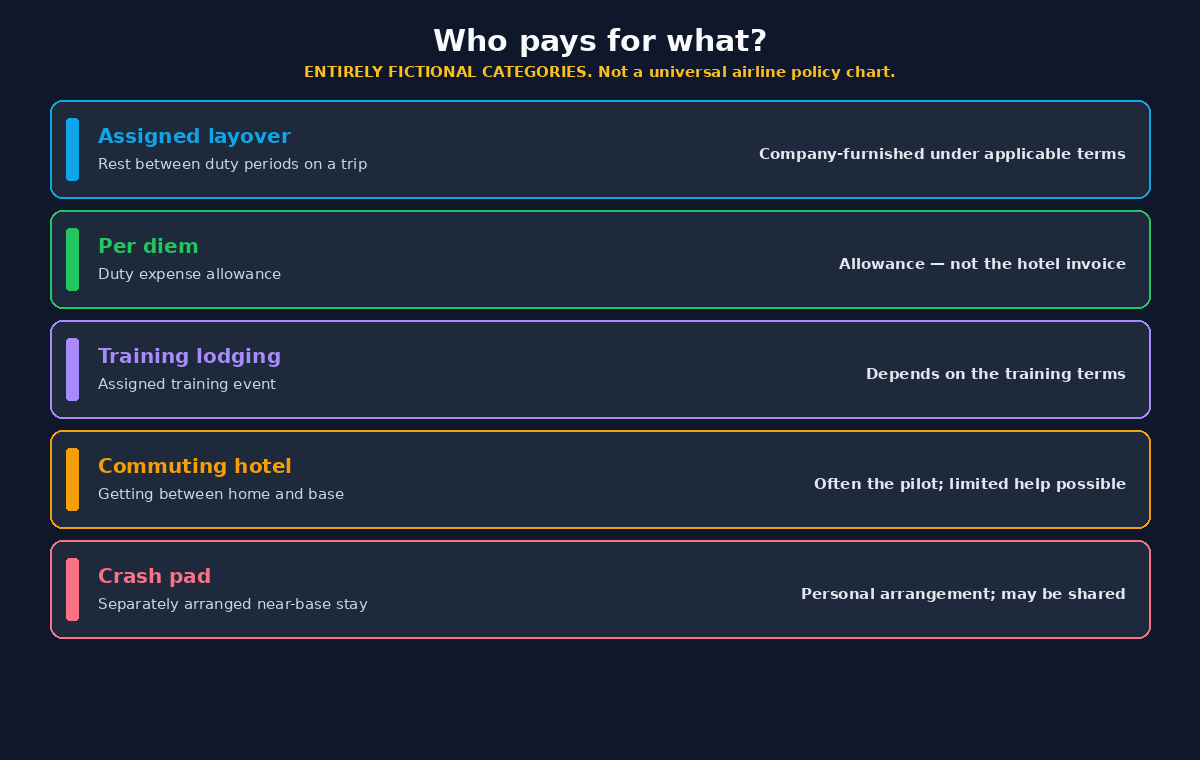
| Situation | What it is for | Who typically pays |
|---|---|---|
| Assigned layover | Rest between duty periods on a trip | Company-furnished lodging under the applicable agreement; United example requires single occupancy. |
| Per diem during the trip | Duty expense allowance | Paid as an allowance under the applicable rules; it is not the hotel invoice. |
| Training lodging | Attendance at an assigned training event | Depends on the training terms; United example provides single lodging when required for specified training travel. |
| Commuting hotel | Getting between home and base around a trip | Often the pilot; some operators offer limited assistance by eligibility. |
| Crash pad | Separately arranged near-base accommodation | Personal arrangement; may be private or shared. |
This table compares categories. It is not a promise that every operator matches the United example.
Frequently Asked Questions
Do pilots pay for layover hotels?
Under company-furnished layover provisions such as the published United Pilot Agreement 2023 clause, the airline provides the room for covered layovers. That is one agreement, not a worldwide guarantee. Commuting and crash pads are different.
What is per diem if the hotel is already covered?
In the United example, per diem is an hourly allowance while on duty or flight assignment. It is expense money during the assignment, not payment of the layover hotel bill.
Do commuting pilots pay for their own hotels?
Often they can, for nights outside the assigned trip. Some operators publish limited commuter hotel assistance or stipends for eligible registered commuters. That help is not the same as a layover room.
Is a crash pad paid by the airline?
Not as an assigned layover hotel. A crash pad is separately arranged accommodation used around commuting or base life and can involve shared housing. The airline layover model is a different arrangement.
Do pilots share hotel rooms on layovers?
Covered layovers under the published United agreement are single occupancy. Bed count does not decide occupancy. Other operators and assignments have their own terms.
What if the required hotel room is unavailable?
In the United agreement, if a required room has not been provided or is unavailable, the pilot may obtain alternate lodging and be reimbursed for reasonable actual lodging expenses. Follow the applicable agreement; do not assume every carrier matches that clause.
Does the airline pay for training hotels?
Only under the applicable training terms. The United example provides suitable single lodging when required for specified training-assignment travel, with separate rules for other training circumstances.
The Short Version
On the trip, the layover model puts the hotel on the company side of the ledger. Per diem feeds you; it does not rent the bed. Commuting and crash pads are where pilots more often open their own wallets. Ask which night you mean before you argue about the bill.
This is a dated reading of published sources, including the United Pilot Agreement 2023 effective September 29, 2023, with an amendable date listed through September 30, 2027. Other airlines differ. Later amendments can change entitlements. Sources: agreement sections 25-A and LOA 23-01, ALPA United contract status.