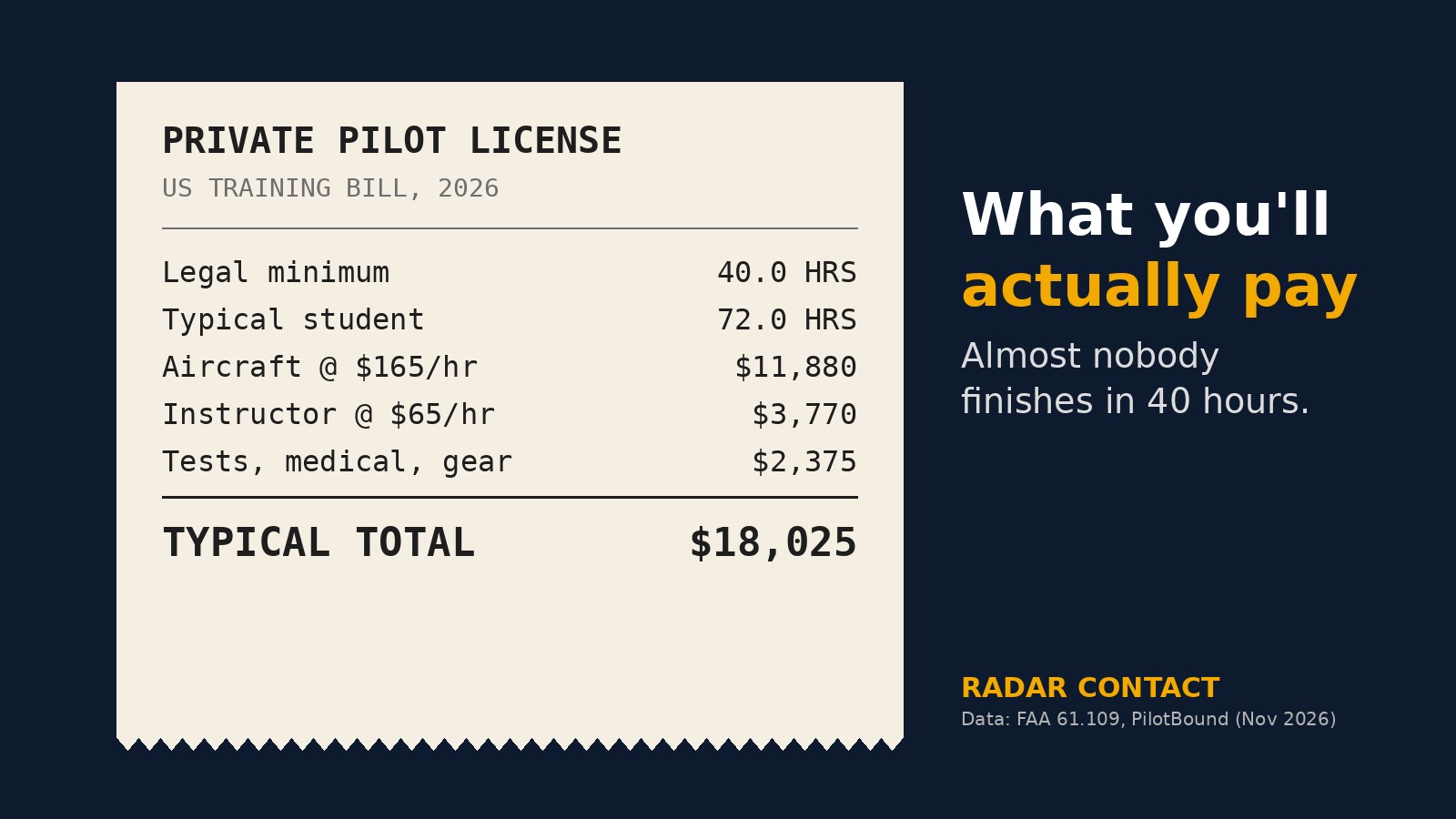
Ask a room full of airline pilots what their private license cost and you'll get two answers. The number they budgeted, and the number they paid. Those are rarely the same number.
So here's the honest version. The real bill, line by line, in four currencies.
Why 40 Hours Is the Number Nobody Pays
The FAA's rule is short. To get a private certificate for a single-engine airplane, you need at least 40 hours of flight time, with at least 20 hours flying with an instructor and 10 hours solo. That's 14 CFR 61.109, and it's a floor, not a forecast.
AOPA says there's no industrywide data on exactly how many hours people finish with, but it's most likely somewhere between 50 and 70. PilotBound, which bases its hours on checkride data compiled by an FAA examiner, models the typical US private at 72 hours.
That gap is where the money goes. Every extra hour is another hour on the Hobbs meter (the clock in the airplane that bills you), and usually another hour of instructor time on top.
Why does almost everyone go over? Weather cancels lessons. Life gets in the way. Two weeks off and you spend the first half of the next lesson remembering how to land. None of that is a character flaw. It's just how learning to fly works.
The other countries set slightly different floors:
- Canada: Transport Canada wants 45 hours, including at least 17 dual and 12 solo, plus 40 hours of ground school.
- UK: The CAA dropped the PPL(A) minimum to 40 hours, or 35 on an approved course, with 10 hours supervised solo. A lot of UK cost guides still say 45. The CAA's own page says 40.
- Australia: CASA asks for 40 hours, or 35 on an integrated course, with 10 hours solo.
Same story everywhere. Schools quote the minimum. Students fly more.
The Seven Lines on the Bill
Here's what you're actually paying for. US numbers first, because that's where the best current data is.
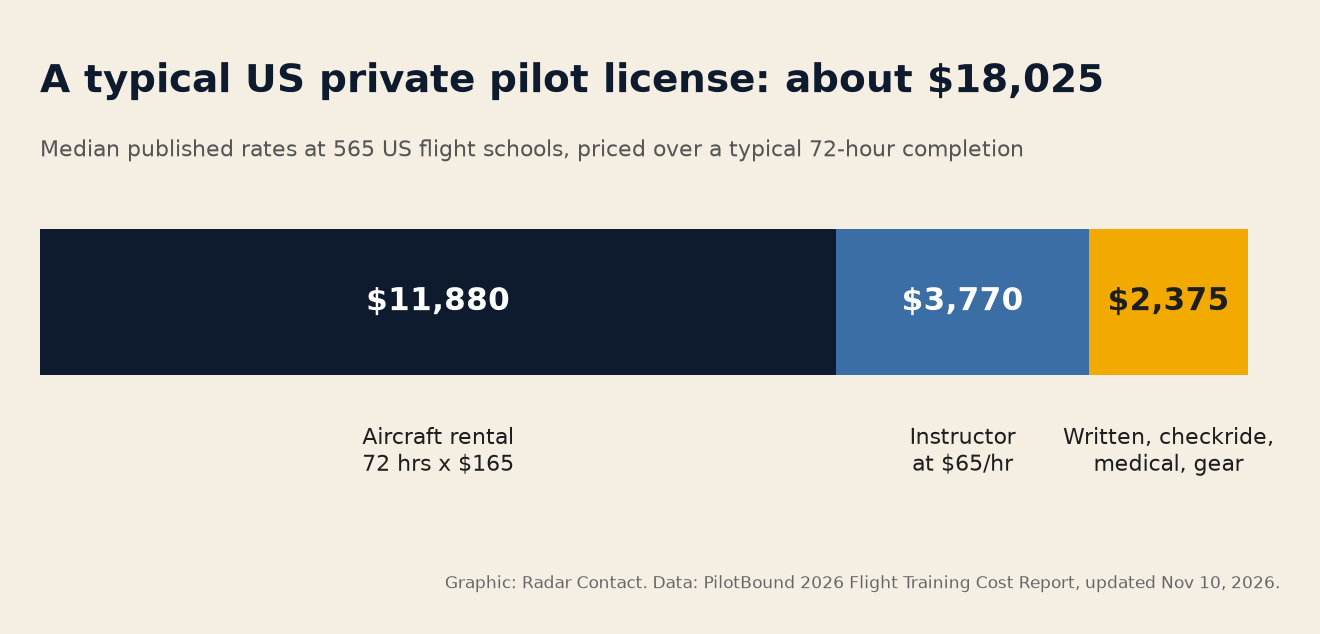
1. Aircraft rental. The big one. PilotBound's 2026 report, which checked published rates at 565 US flight schools, puts the median trainer at $165 an hour, with the middle half of schools charging $143 to $185. Most quote "wet," meaning fuel's included. Watch for the ones that don't say. At 72 hours, rental alone is about $11,900.
2. Instructor. Billed on top of the airplane for every dual hour. PilotBound's median is $65 an hour, with the middle half at $60 to $75. Solo hours are cheaper because nobody's sitting next to you.
3. Medical. In the US, a third-class medical from an FAA-designated doctor. Doctors set their own fees. PilotBound budgets about $150.
4. Written test. The FAA knowledge test costs $175 at PSI, the FAA's testing vendor. Fail it and you pay again.
5. Checkride. Your final exam, a practical test with an examiner (a DPE, a private individual the FAA authorizes to give the test). Examiners set their own fees. PilotBound uses $600 to $1,000, and Redbird's 2026 survey found about half of examiners charge $800 to $1,000. Bring a checkbook and a sense of humor.
6. Gear. A headset, charts or an app, a kneeboard, a logbook. PilotBound budgets about $1,000 combined. The headset is the big-ticket item, and it'll follow you to every rating after this one.
7. Ground school. This is the one line you can finish before the engine ever starts, and the cheapest hour of learning you'll ever buy. In the US, a good online ground school runs a few hundred dollars and prepares you for the FAA written. Outside the US, use a course built for your own country's exams. A US course won't teach you Canadian air law.
Add it up and PilotBound lands at about $18,025 for a typical 72-hour private, with a realistic range of $15,500 to $20,500. Redbird's separate industry survey, built from school, instructor, pilot and examiner responses, put the 2025 median at $16,500. Two different methods, same neighborhood.
What It Costs in the US, Canada, the UK and Australia
One warning before you compare. In Canada, the UK and Australia, the "dual" hourly rate usually already includes the instructor. In the US, it usually doesn't. So a C$312 hour in Canada and a $165 hour in Texas aren't the same thing. Compare totals, in your own currency.
United States: $15,500 to $20,500
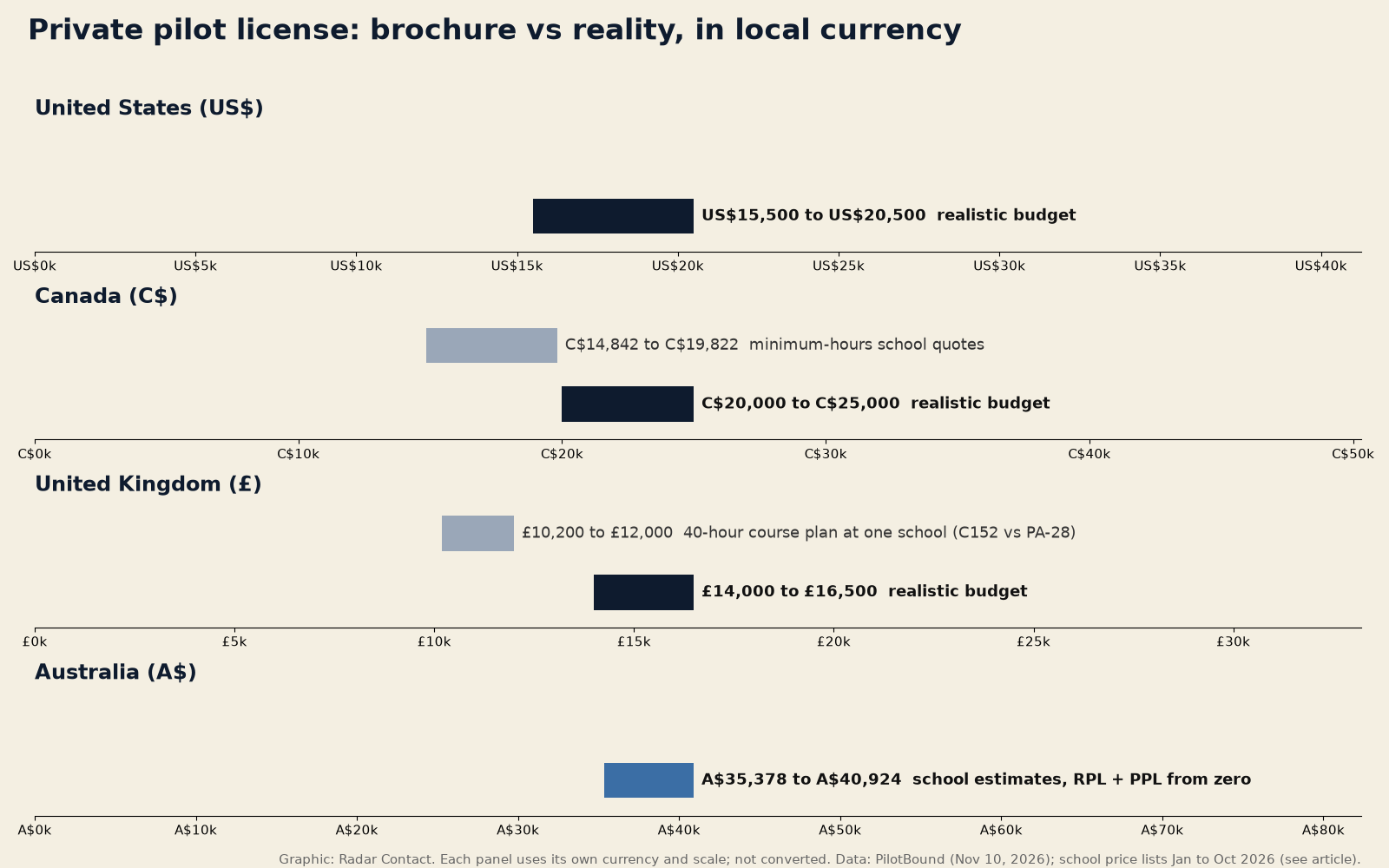
That's PilotBound's realistic range, about $18,025 typical, as of November 10, 2026. State matters. PilotBound's median trainer runs from $130 an hour in Wisconsin to $220 in Hawaii, among states with at least three schools in its sample.
Canada: about C$20,000 to C$25,000
Canadian schools love quoting Transport Canada minimums. Brampton Flight Centre's September 2026 sheet totals C$14,842.50 at the minimums. WWFC's August 2026 sheet says C$15,829. Adventure Aviation's February 2026 estimate is C$19,822.
Then read the fine print. Brampton says students average 60 to 80 hours. Victoria Flying Club says the national average is 65 to 75. Centennial's January 2026 outline says a realistic budget is 65 hours and C$24,865. Victoria quotes C$20,590 at 55 hours, before tax. Pacific Flying Club's February 2026 estimate is C$17,312.40 at 55 hours including the medical, fees and a headset, in a smaller Cessna 152.
There's no single published national figure. Line those realistic-hours school estimates up side by side, though, and most of them land around C$20,000 to C$25,000.
The fixed fees are modest by comparison. At the schools we checked, the flight test examiner runs C$450 to C$650, and the Transport Canada written about C$110 to C$150 at most of them (one lists C$315). Acadia College lists a Category 3 medical at C$175. Watch for billed ground briefings too. Centennial budgets 30 hours of them at C$95 an hour.
United Kingdom: £14,000 to £16,500
That's PPL Club's 2026 estimate for 55 to 60 hours of training. The flying is the bulk of it. PPL Club puts dual in a two-seat trainer at £210 to £240 an hour and a four-seater at £250 to £280. At The Pilot Centre at Denham, a Cessna 152 hour is £255 including VAT and the instructor, per its March 2026 price list. Its own 40-hour course plan works out to £10,200 in the 152 or £12,000 in a PA-28. That's the floor, before a single extra hour or fee.
Then the extras the package price skips. The CAA charges £263 to issue the PPL(A). The Pilot Centre lists its skill test examiner at £275, each of the nine theory exams at £40, and the radio practical test at £150. PPL Club puts a Class 2 medical at £200 to £250, landing fees at £10 to £25 a landing, and club membership at £150 to £250 a year. Circuit training gets expensive fast when every touchdown costs money.
Australia: about A$35,000 to A$41,000
Australian numbers look scary until you realize what they include. Most students do the recreational license (RPL) first and then the PPL, and schools price the whole thing from zero. Flight Training Perth's October 2026 estimate is A$35,378.45. Central Coast Aero Club quotes A$38,475 based on its average student, who finishes at around 65 to 70 hours. Air Gold Coast estimates A$40,924.
Dual rates there include the instructor and a lot of billed briefing time. Flight Training Perth charges A$665 an hour dual and A$770 for the testing officer. CASA's PPL theory exam is A$217.24, and its Class 2 medical processing fee is A$65, plus whatever your aviation doctor charges.
What Actually Moves Your Total
The minimum is fixed. Everything else is negotiable, sort of.
How often you fly. This is the big one. AOPA says flying once a week or twice a month will kill your progress, and to aim for three times a week if you can. The money goes out faster. The total comes out lower.
Weather. You can't fix it, but you can plan around it. Simple Flying's advice is to pick somewhere with reliable weather. Fewer scrubbed lessons means less relearning.
The airplane. A two-seat trainer is cheaper than a four-seater. PPL Club figures choosing a Cessna 152 over a PA-28 can save upward of £2,000 over a 50-hour course. In the US, PilotBound says its average rate gets pulled up by schools that only fly premium airplanes. Learning in a glass-cockpit rocket is fun. It's not cheap.
Part 61 vs Part 141. In the US, Part 141 schools follow an FAA-approved syllabus and can get you to the checkride legally in 35 hours instead of 40. That doesn't make them cheaper. PilotBound's model uses 78 hours for Part 141 against 72 for Part 61, and says Part 141 typically runs higher, not lower.
Simulator time. The FAA lets you credit up to 2.5 hours of approved sim time toward the 40, more at a certificated training center. Canada, the UK and Australia each allow up to 5 hours toward their minimums. More useful than the credit: practicing procedures somewhere that doesn't cost airplane money. AOPA says even a desktop sim can cut your air time.
Flying clubs. Simple Flying points out that clubs often rent their airplanes cheaper than schools do, at the cost of less scheduling freedom. You still need an instructor.
The checkride wait. Simple Flying reports examiner waits of two to three months in many regions. While you wait, you fly to stay sharp, and that's billable. Book early if your instructor says you're close.
Showing up prepared. AOPA's advice is to practice what you can on the ground, before the engine starts. Know the lesson before you get in. Chair-fly the radio calls. Every minute you spend figuring something out on the ground is a minute you're not paying two meters to figure it out in the air.
One more thing that isn't on any price list: you'll do go-arounds in training. Lots. A go-around is a normal, trained maneuver, not a failure, and it's one more reason the hours add up.
FAQ
How much does a private pilot license cost in 2026?
In the US, PilotBound's November 2026 report puts the typical private at about $18,025, with a realistic range of $15,500 to $20,500. In Canada, published realistic-hours estimates mostly land around C$20,000 to C$25,000. In the UK, PPL Club estimates £14,000 to £16,500. In Australia, schools quote about A$35,000 to A$41,000 from zero.
How long does it take to get a private pilot license?
Redbird's 2026 survey put the median at 24 weeks in 2025. PilotBound's estimator says about six months flying twice a week. Full-time versus part-time is the big swing. Australia's regulator, CASA, says about two months full-time, or just over a year flying an hour a week. Fly less often and it takes longer, and usually costs more.
Can you get a private pilot license in 40 hours?
It's legal in the US, and in the UK and Australia too. Canada's minimum is 45. Very few people finish there. AOPA says most likely 50 to 70 hours, and PilotBound models 72.
How much does a private pilot license cost in Canada?
Transport Canada minimum-hour quotes from schools run about C$14,800 to C$19,800 before tax. Schools say most students take 60 to 80 hours, and realistic estimates mostly land around C$20,000 to C$25,000.
How much does a private pilot licence cost in the UK?
PPL Club's 2026 estimate is £14,000 to £16,500 for 55 to 60 hours. The CAA's licence issue fee alone is £263.
How much does a private pilot licence cost in Australia?
From zero, including the recreational license first, school estimates run about A$35,000 to A$41,000. Central Coast Aero Club quotes A$38,475 for its average student.
Is Part 141 cheaper than Part 61?
Not usually. Part 141 allows a 35-hour minimum, but PilotBound models Part 141 at 78 hours against 72 for Part 61 and says it typically runs higher.
Can you make money with a private pilot license?
Not as a pilot for hire. Under FAA rules, outside a few narrow exceptions, a private pilot can't fly passengers or cargo for compensation, and can't pay less than an equal share of a flight's fuel, oil, airport fees or rental with passengers. If you want to get paid, that's the commercial license, and a much longer road. Here's what an airline pilot's schedule looks like at the end of it.
What's the cheapest way to get a private pilot license?
Fly often, so you're not paying to relearn last week's lesson. AOPA's advice is three times a week if you can. Train in a two-seater: PPL Club figures a Cessna 152 over a PA-28 saves upward of £2,000 over a 50-hour course. Look at a flying club, which Simple Flying says often rents cheaper than a school. And do your studying on the ground, where it's free. If you don't need full private privileges, a smaller license costs less. AOPA says a US sport pilot certificate comes faster and for less money, and PPL Club puts the UK's daylight, UK-only NPPL at about £8,000 to £9,500.
Can you pay for flight training as you go?
Yes, and most people do. Central Coast Aero Club says you pay for each flight or theory session at the end of the lesson, and Air Gold Coast bills the same way. Some schools want money on account before you fly. The Pilot Centre asks for £200. PPL Club recommends pay-as-you-go over a big upfront package, because your money's at risk if the school closes. It also says many UK schools take 5 to 10 percent off if you pay for 10 hours in advance. AOPA notes that if paying as you go is stretching your training out, some students finance it to speed things up.
Am I too old to get a private pilot license?
Probably not. The FAA, Transport Canada, the UK CAA and CASA all set a minimum age of 17 for the private license, and none of them sets a maximum. What matters is the medical. In the US, a third-class medical lasts 60 months if you're under 40 when you take it, and 24 months if you're 40 or older. So at 35, nothing changes. At 40, you just see the doctor more often. The airline retirement age is a separate rule and has nothing to do with flying for fun.
Is a private pilot license worth it?
If you want to fly, yes. It's the license that lets you take people up and go places, and it's the first step for anyone heading toward a commercial career. Just budget for the real number, not the minimum, and you'll enjoy it a lot more.
Sources
- FAA, 14 CFR 61.109 and 61.113 (eCFR)
- Transport Canada, Standard 421.26
- UK CAA, Private pilot licence for aeroplanes and licence fees
- CASA, Getting a private pilot licence
- PilotBound, 2026 Flight Training Cost Report (updated November 10, 2026)
- Redbird, The State of Flight Training 2026
- AOPA, How much does a pilot's license cost?
- School price lists named in the text, checked November 11, 2026