They are not smoke, and they are not a sign that something is wrong with the airplane. Whether you get a short puff, a long thin line, or a sky full of spreading trails depends on the temperature and the humidity at the airplane's altitude, not on how the day feels in your driveway.
What Contrails Are
Contrail is short for condensation trail. The FAA, EPA, and NOAA, in a joint fact sheet, describe them as line-shaped clouds produced by a jet's hot engine exhaust interacting with cold, humid air at cruise altitudes. They are made primarily of water, in the form of ice crystals.
The comparison official sources keep using is a good one. On a cold day you can see your breath. The water vapor you exhale hits cold air, condenses, and you get a little cloud. A contrail is that same idea, at a much larger scale, behind an engine that's pumping out hot, moist exhaust several miles above the ground.
They have been a normal part of jet flying since airplanes started spending time at those cold altitudes. If the sky over your house is scribbled with them, the EPA's plain explanation is that a lot of jets are flying overhead, in air that happens to be right for making a visible trail.
How Contrails Form
Jet fuel is mostly carbon and hydrogen. When it burns, the exhaust is mostly carbon dioxide and water vapor. The FAA fact sheet puts that split at about 71 percent carbon dioxide and 28 percent water vapor, with less than 1 percent other combustion products, including sulfur oxides, nitrogen oxides, and tiny particles of soot.
Right behind the engine, that hot, humid plume mixes with the much colder air outside. If the air is cold and humid enough, the water vapor condenses onto fine particles, from the exhaust or already in the atmosphere, and forms tiny droplets. Those droplets freeze quickly into ice crystals, and that trail of ice is the contrail you can see.
The air up there is very cold. The National Weather Service says temperatures at those altitudes are generally colder than -40 degrees Fahrenheit. The FAA fact sheet says they can be as cold as -70 degrees Fahrenheit. In air that cold, you don't need much humidity for condensation to get started.
The UK Met Office puts the usual height at above 20,000 feet, where the air around the airplane is well below freezing. That's why you rarely get a true exhaust contrail from a jet in the traffic pattern. Airliners spend most of a trip at those cold cruise altitudes, the same place we talk about when we explain how fast planes go.
Why Some Flights Leave White Lines and Others Don't
Contrails will not form if the air at the airplane's altitude is too warm or too dry. That's the FAA's rule of thumb, and it is why two jets on the same afternoon can look like they're doing something different when they are just flying through different air.
The humidity that matters is the humidity up there, not the humidity on the ground. The FAA and the EPA both point out that those two can be very different. It can be dry in your yard and still moist a few miles up, or the other way around. The air a few miles up can be a completely different day from the one you're standing in. That's true for humidity, and it's true for turbulence too.
The layers of air that make contrails are often wide, but shallow. The UK government, in its official contrails briefing, says a difference of 1,000 feet in altitude is enough for one airplane to leave a trail and another, which looks as if it's at the same height, to leave none. From the ground, that can look mysterious. It isn't. You're just not in a good position to judge a thousand feet of height.
The same idea explains broken or dashed trails. As an airplane flies in and out of regions the FAA calls ice supersaturation regions, the contrail can appear to start or stop abruptly. The fact sheet is explicit: that is entirely due to changes in the atmosphere, not to a change in the airplane's exhaust.
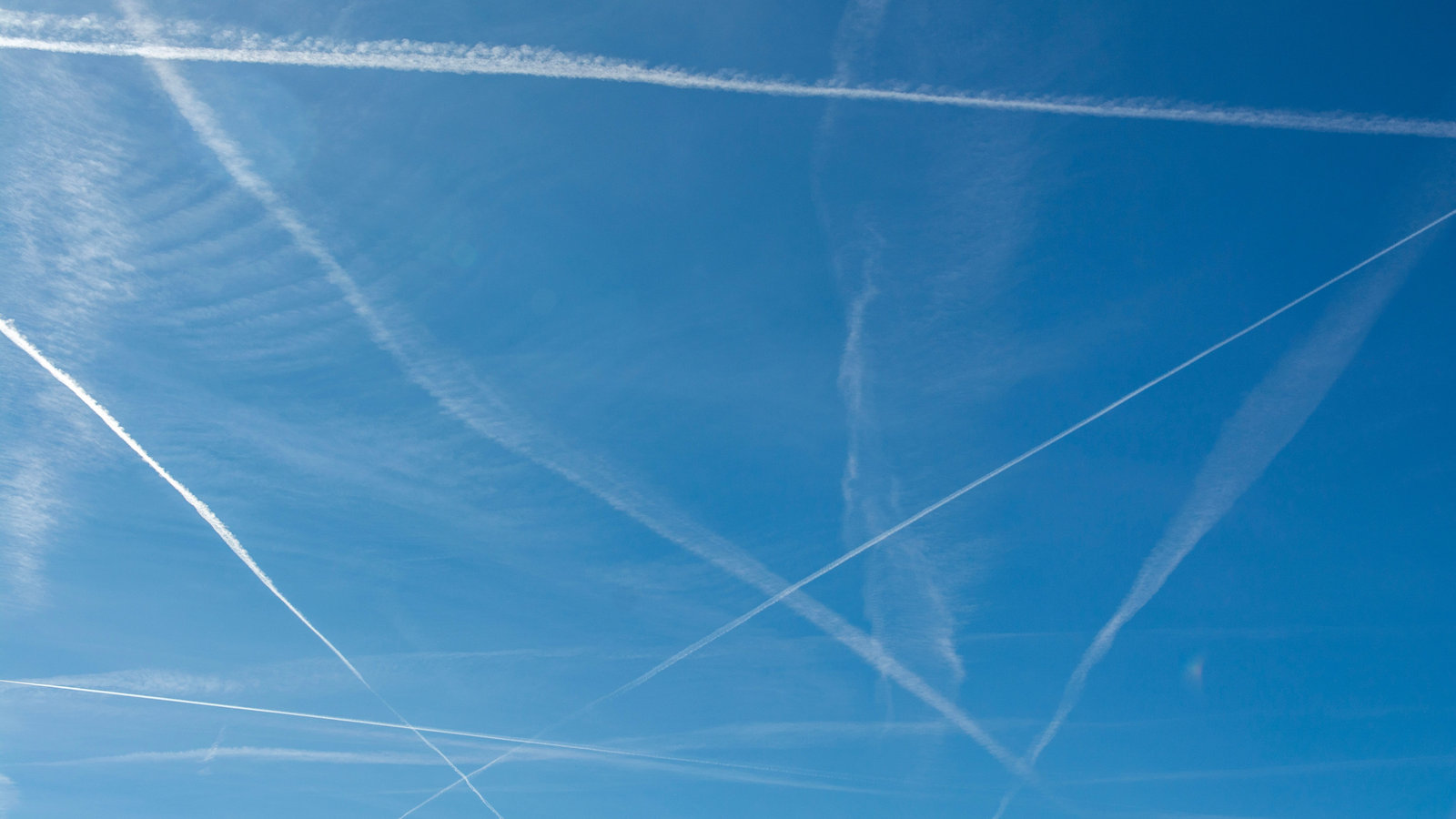
In the United States, contrails can form at any time of year. They are most likely to form and last when the upper air is cold and humid. Grid or crossing patterns are usually just traffic: airplanes often follow similar routes, separated by altitude, time, distance, and direction.
Engine type can play a part too. The UK briefing notes that more efficient engines, with cooler exhaust, can form contrails at lower altitudes than less efficient ones. The weather at the airplane's altitude is still the main switch.
Why Some Contrails Vanish and Others Spread
Once the ice is there, what happens next is almost entirely about humidity, and about the wind.
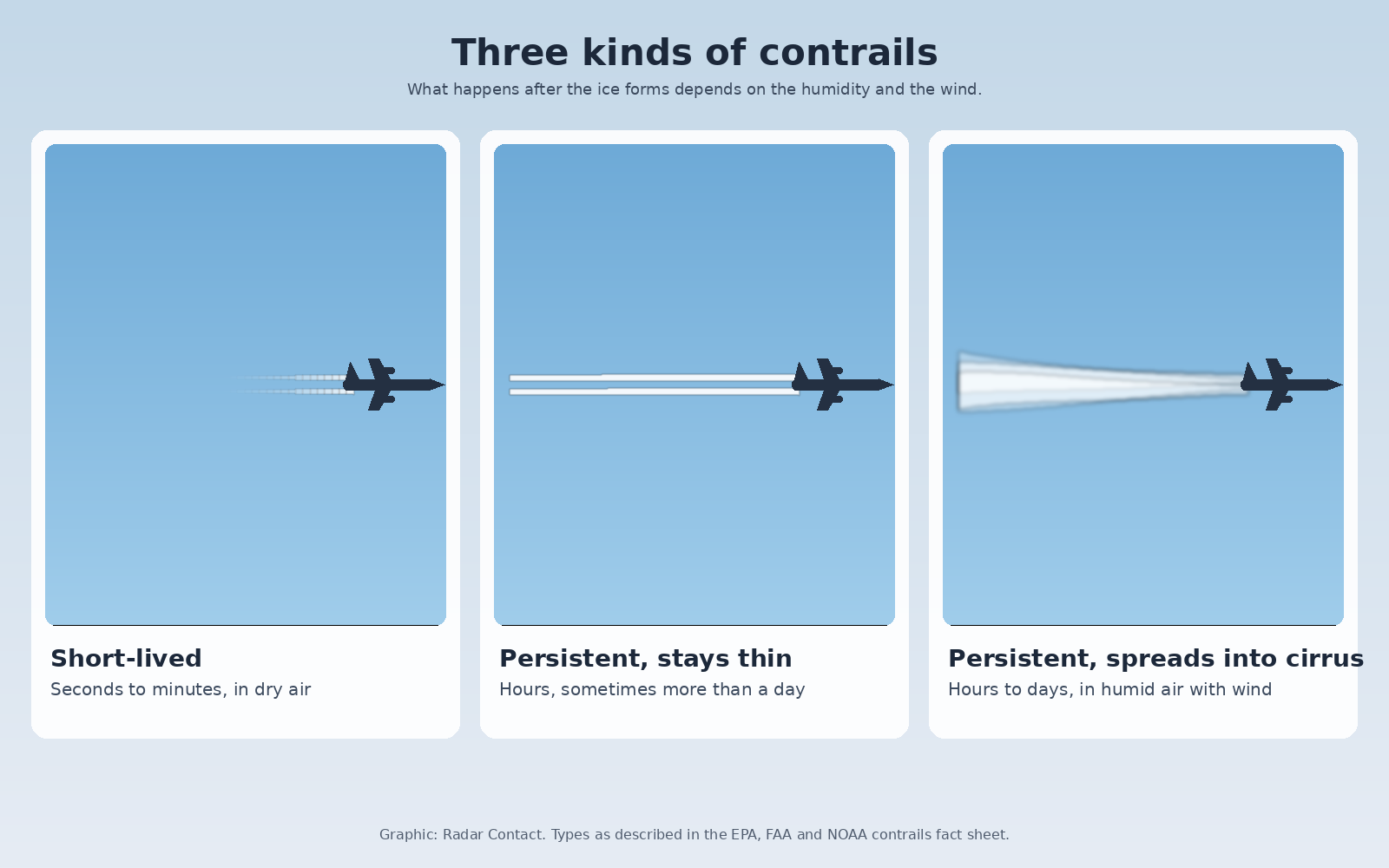
If the surrounding air is dry, the ice crystals go back to water vapor and disappear. The Met Office describes that as sublimation, a direct jump from solid to gas. The FAA calls these short-lived contrails. They can be gone in seconds to minutes, as the exhaust mixes out into drier air.
If the air is very humid, the ice stays, and the crystals can keep growing by taking water from the air around them. Those are persistent contrails. The FAA and the EPA say they can last from a few minutes to longer than a day. If the wind shear is low, a persistent trail can stay a thin line for many hours, long after the airplane is out of sight. If the wind shear is high, the trail can spread across the sky and blend into what scientists call contrail cirrus, a thin, wispy ice cloud a lot like natural cirrus.
The FAA groups them into three types: short-lived, persistent but not spreading, and persistent spreading contrail cirrus. After they have spread, they can be hard to tell from ordinary cirrus. The fact sheet notes the reverse as well: natural cirrus can be mistaken for contrails, especially when it happens to line up in parallel streaks.
Those Short Trails You See on Takeoff
If you've watched a jet rotate on a damp day and seen a wisp peeling off a wingtip or a flap, that is usually not an exhaust contrail. The Met Office describes it as condensation in a wingtip vortex: the pressure drop in the swirl off the wing can cool the air enough for a short line of droplets to appear. Those trails typically show up at low altitude, behind the wing rather than the engines, and they fade a few meters back. High-altitude contrails and low-altitude wing condensation can look related. They aren't the same process.
Do Contrails Change the Sky?
They don't make weather on the ground. The Met Office is direct about that. They are not large enough.
They do add cloud. Persistent contrails increase the cloudiness of the atmosphere, and if they last long enough they can become aviation-induced cirrus. The National Weather Service, and the FAA fact sheet citing it, say it has been estimated that in certain heavy air-traffic corridors, cloud cover has increased by as much as 20 percent. That is an estimate for some busy routes, not a single global number.
The FAA fact sheet says contrails are composed primarily of water in the form of ice crystals and do not pose direct health risks to people. The EPA says current models indicate that persistent contrail clouds could have a small net warming effect, and that more research is needed to quantify it. Scientists are interested in the ones that last, which is why you will see research into fuels, engines, and even routing around the most humid layers. The basic weather science of how the trails form is not in dispute.
FAQ
What are contrails?
Contrails, short for condensation trails, are line-shaped clouds of ice crystals that form when a jet's hot engine exhaust mixes with cold, humid air at cruise altitudes. They are made primarily of water, and they are a normal part of high-altitude jet flying.
What does "contrail" mean?
It means condensation trail. Official U.S. fact sheets use that expansion, and it is the same phenomenon people are asking about when they search for "contrails meaning": the white lines sometimes left in the sky behind an airplane.
Why do planes leave white lines in the sky?
A jet engine's exhaust is mostly carbon dioxide and water vapor. In very cold air, that water vapor can condense and freeze into a visible trail of ice crystals, the same way you can see your breath on a cold day. If the air at that altitude is too warm or too dry, no trail forms.
Why do some planes leave contrails and others don't?
The air at one airplane's altitude can be right for a contrail while the air a thousand feet above or below it is not. Official UK guidance says those humid layers are often wide but shallow, so a 1,000-foot difference in height is enough. From the ground, two airplanes can look as if they are at the same height when they aren't.
Why do some contrails disappear and others last for hours?
In dry air, the ice crystals turn back into water vapor and the trail can be gone in seconds to minutes. In very humid air, the ice can persist, sometimes for longer than a day, and winds can spread the trail into a thin cirrus-like cloud.
How high do planes have to be to leave contrails?
Exhaust contrails form in the cold air at cruise altitudes. The UK Met Office puts the usual height at above 20,000 feet. You can also see short wisps off a wing at low altitude on a damp day, but those are usually wingtip-vortex condensation, not the high-altitude exhaust trails this article is about.
Are contrails the same as chemtrails?
No. Contrails are ice-crystal clouds from routine jet exhaust. The EPA says "chemtrails" is a term some people use to inaccurately claim that those trails are an intentional release of dangerous chemicals. A joint EPA, FAA, and NOAA fact sheet says persistent contrails are composed primarily of water in the form of ice crystals, do not pose direct health risks, and do not indicate that an airplane has dispersed harmful chemicals. The EPA also says the federal government is not aware of a contrail ever being intentionally formed over the United States for geoengineering or weather modification.
Do contrails cause weather on the ground?
No. The UK Met Office says contrails are not large enough to cause any weather on the ground. They can, however, add high cloud, and persistent trails can spread into cirrus-like layers.