An official "accident" is a broader category, and most of those are not fatal. In 2025, the International Air Transport Association counted 51 accidents in 38.7 million flights, or one accident every 759,646 flights. Over the five years from 2021 through 2025, it counted one fatal accident every 5.6 million flights.

There Isn't One "Odds" Number
People type "what are the odds of a plane crash" and hope for a single fraction. The official numbers don't work that way, and they shouldn't. You have to know what is being counted, and what it's being divided by.
A death risk per boarding answers a simple question: if you have a boarding pass, what is the chance you don't survive the journey? MIT treats that journey as running from arrival at the departure airport to leaving the airport at the other end. A rate per flight, or per million departures, counts events, not people. A rate per billion passengers is deaths divided by people carried. Lifetime odds from the National Safety Council are something else again: the chance that a person in the U.S. population dies of a given cause over a lifetime. That also reflects how many people do that activity, not just the risk of one trip.
"Accident" and "crash" are not interchangeable either. Under the definition the NTSB uses, an accident is an event, from the time someone boards with the intention of flight until everyone has gotten off, in which anyone is killed or seriously injured, or the airplane takes substantial damage. A hard landing that hurts a flight attendant, or a wingtip ding on a taxiway, can show up in the same accident column as a wrecked hull. IATA's 2025 list of the most common accidents was tail strikes, landing gear events, runway excursions, and ground damage.
And airline flying is not the same as general aviation. The MIT, IATA and ICAO figures below are for commercial operations, mostly scheduled passenger and cargo flying in larger airplanes. The NTSB tracks U.S. airlines (Part 121) separately from general aviation, which is mostly noncommercial flying under Part 91. If you fly a small training airplane on the weekend, you are not in the airline statistics.
The Figure Behind "How Safe Is Flying"
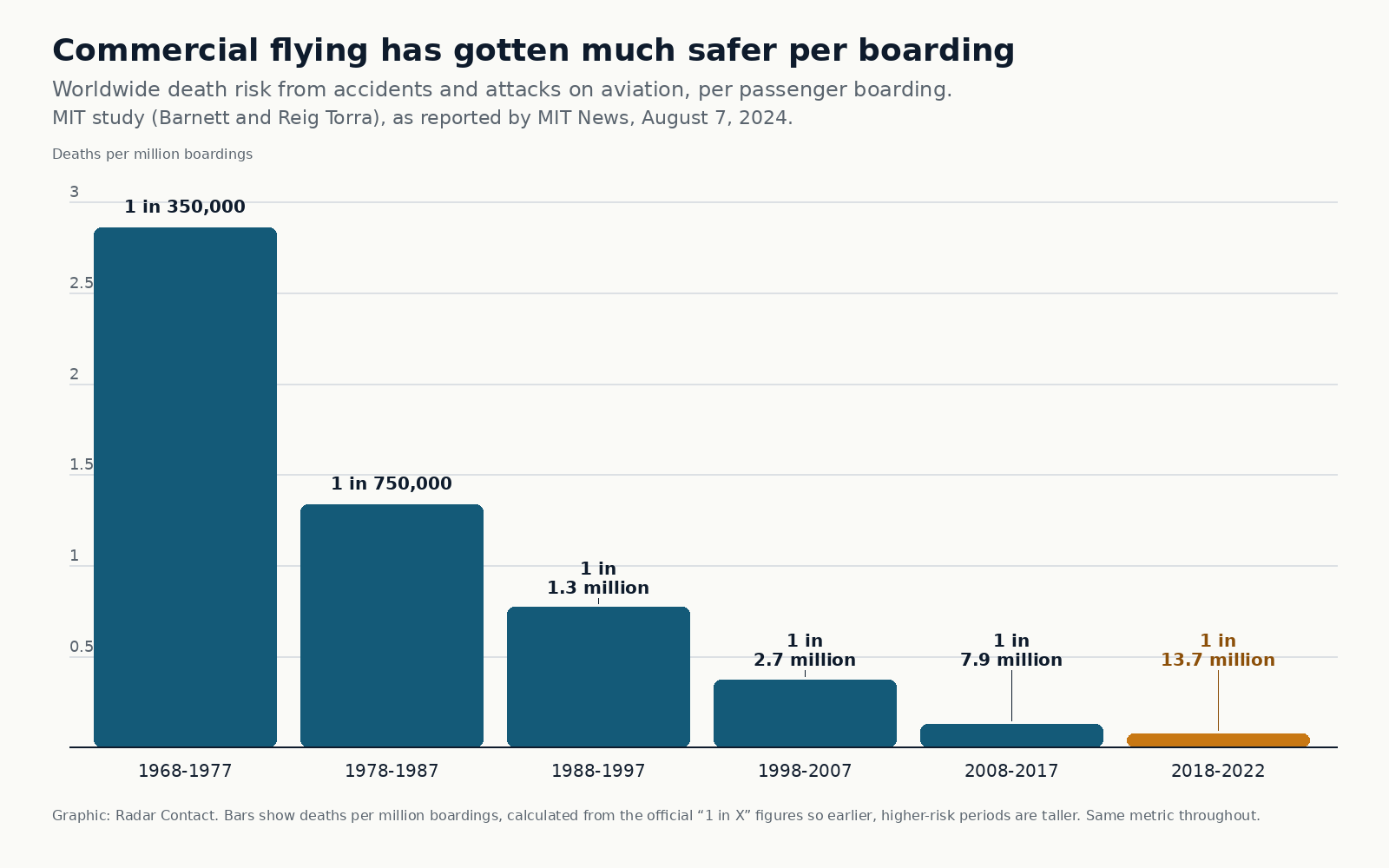
The MIT number comes from Arnold Barnett and Jan Reig Torra, in the Journal of Air Transport Management in August 2024, and MIT News summarized it on August 7, 2024. They counted passenger deaths from accidents and from deliberate attacks on aviation, then divided by passenger boardings worldwide.
For 2018 through 2022, that death risk was 1 in 13.7 million boardings. For 2008 through 2017, it was 1 in 7.9 million. Go back to 1968 through 1977 and it was 1 in 350,000. In per-boarding terms, passengers in that latest period were about 39 times safer than in the late 1960s and 1970s. Barnett's line is that the death risk has been falling by about 7 percent a year, or roughly half every decade. There is no promise that continues, but it is the long record.
The risk is not the same everywhere. In the United States, Europe, and a group of other countries with similarly strong records, MIT put the death risk at about 1 in 80 million boardings in 2018 through 2022. A third group of countries was much higher, about 36.5 times the top-tier rate, though that group was also improving.
The study treated COVID-19 transmission as a separate question, not as part of the accident-and-attack trend.
What the 2025 Accident Rates Actually Say
A single year is noisier than a decade, because one severe accident can move the fatality totals a lot. The accident rate and the fatality rate can even travel in different directions.
IATA released its 2025 safety report on March 9, 2026. Among commercial flights that meet IATA's criteria (an air operator's certificate, airplanes of at least 5,700 kilograms, and IATA's own damage and fatality rules), it counted:
- An all-accident rate of 1.32 accidents per million flights, or one accident every 759,646 flights. That was better than 1.42 in 2024, and a little above the 2021 through 2025 average of 1.27.
- 51 accidents among 38.7 million flights, down from 54 accidents among 37.9 million flights in 2024.
- 8 fatal accidents and 394 onboard fatalities, up from 7 fatal accidents and 244 fatalities in 2024.
- A fatality risk of 0.17 full-loss equivalents per million flights, up from 0.06 in 2024, with a five-year average of 0.12. A full-loss equivalent is 1 if everyone on board dies, 0.5 if half do, and 0 if a flight has no fatalities. It measures how complete the losses were, not your personal odds on a ticket.
The longer view is better than the one-year fatality jump. IATA said that a decade earlier, in 2012 through 2016, there was one fatal accident every 3.5 million flights. For 2021 through 2025, it was one every 5.6 million flights.
ICAO, the U.N. aviation agency, published its own 2025 figures in its 2026 Safety Report. It uses a different net: scheduled commercial flights in airplanes over 5,700 kilograms, with accidents validated under Annex 13. In 2025 it counted 85 accidents, 4 fatal accidents, and 387 fatalities, among 38.08 million flights and 4.950 billion passengers.
That works out to 2.23 accidents per million departures, down from 2.56 in 2024; 0.11 fatal accidents per million departures, down from 0.27; and 78 fatalities per billion passengers, up from 65. Fewer fatal accidents, more fatalities. ICAO's own explanation is the straightforward one: a small number of accidents accounted for a large share of the lives lost, and a single accident can involve hundreds of passengers.
Those IATA and ICAO counts will not match, and they are not supposed to. If someone quotes only one of them without the denominator and the definition, they are not giving you the odds. They are giving you a headline.
In the United States, the FAA tracks a different official rate: commercial air carrier fatalities per 100 million persons on board U.S. carriers. In fiscal year 2024, which ran from October 2023 through September 2024, the FAA's published result was 0.0, against a target of 4.7. The FY 2023 result was 0.1. The FY 2024 figure was still preliminary in the December 2024 summary, with final results expected in March 2025. It is a fiscal-year rate, not a calendar-year crash count, and it is not a per-flight odds number.
Airline Flying and Small-Plane Flying Are Different Jobs
The FAA keeps a separate target for general aviation, measured as fatal accidents per 100,000 flight hours, not as deaths per persons on board. In FY 2024, that preliminary rate was 0.72, against a target of 0.92. You cannot turn those two official rates into one comparison, because the units are different. What you can say is that the government does not treat a weekend in a small airplane as the same risk as a seat on a scheduled jet, and neither should you.
If the bumps are what got you worried, that's usually turbulence, and it is a much more common complaint than a crash. A go-around is not a crash either. It's a normal decision to climb away and come back to try the landing again.
What About the Drive to the Airport?
The National Safety Council publishes lifetime odds of dying from selected causes in the United States. In its 2024 figures, a motor-vehicle crash was 1 in 101 over a lifetime. For "passenger on an airplane," the Council said there were too few deaths in 2024 to calculate odds.
That is not the same as a per-flight or per-boarding risk, and it is not a claim that airplanes had zero risk. It is a population statistic: when very few people in the country die of a cause in a given year, the Council will not publish a stable lifetime figure. A lot more people spend a lot more time in cars than in airliners, which is one reason the lifetime motor-vehicle number looks the way it does.
If you want a number for the flight itself, use the per-boarding and per-flight figures above, with their years and their definitions attached.
FAQ
What are the odds of a plane crash?
There isn't one official "crash" rate. For commercial flying, IATA counted one accident of any kind every 759,646 flights in 2025, and one fatal accident every 5.6 million flights over 2021 through 2025. Most official accidents are not fatal, and the definitions include serious injuries and substantial damage, not only a wrecked airplane.
What are the chances of dying in a plane crash?
An MIT study put the worldwide death risk on a commercial flight at 1 in 13.7 million passenger boardings in 2018 through 2022, counting accidents and attacks on aviation. In the United States, Europe, and other countries with similarly strong records, it was about 1 in 80 million boardings in that period.
How safe is flying compared with driving?
They are measured differently, so be careful. The National Safety Council's 2024 lifetime odds for a motor-vehicle crash in the United States were 1 in 101. For "passenger on an airplane," it said there were too few deaths in 2024 to calculate odds. Those are population lifetime figures, not the risk of one trip. For a flight itself, use the per-boarding and per-flight rates above.
Is an official aviation accident the same as a crash?
No. The NTSB's definition includes any operation, from boarding with the intention of flight until everyone has gotten off, in which someone is killed or seriously injured, or the airplane takes substantial damage. IATA said its most common accidents in 2025 were tail strikes, landing gear events, runway excursions, and ground damage.
Are small planes as safe as airliners?
The headline commercial rates do not apply to general aviation. MIT, IATA and ICAO are counting airline-type commercial operations. The NTSB and FAA track general aviation separately, and the FAA's general aviation target is a fatal accident rate per 100,000 flight hours, not a death rate per passenger boarding.
Did flying get less safe in 2025?
It depends which official rate you mean. IATA's all-accident rate improved in 2025, to 1.32 accidents per million flights, but onboard fatalities rose to 394 from 244. ICAO counted fewer accidents and fewer fatal accidents, but more fatalities, at 78 per billion passengers, up from 65. Both agencies noted that a small number of severe accidents can move the fatality totals a lot in a single year.
What does 1 in 13.7 million boardings mean?
It is a death risk per passenger boarding, from the MIT study covering 2018 through 2022. If you had a boarding pass for a commercial flight in that period, that was the worldwide average chance of being killed in an accident or an attack on aviation during the journey. It is not a per-mile rate, and it is not a lifetime odds figure.
Why do IATA and ICAO publish different accident numbers?
They use different definitions and slightly different sets of flights. For 2025, IATA counted 51 accidents, 8 fatal accidents, and 394 onboard fatalities among 38.7 million flights. ICAO counted 85 accidents, 4 fatal accidents, and 387 fatalities among 38.08 million scheduled commercial flights. Compare them only with those definitions attached.
Sources
- MIT News, Study: Flying keeps getting safer (August 7, 2024)
- Barnett and Reig Torra, Airline safety: Still getting better?, Journal of Air Transport Management (August 2024)
- IATA, IATA Releases 2025 Safety Report (March 9, 2026)
- IATA, Safety fact sheet
- ICAO, Safety Report, 2026 Edition
- ICAO, analysis of 2025 air transport safety (July 23, 2026)
- NTSB, Statistical Reviews, glossary (updated April 21, 2026)
- 49 CFR 830.2, accident definition (eCFR)
- FAA, Fiscal Year 2024 Summary of Performance and Financial Information
- National Safety Council, Odds of Dying (2024 Data)
- Bureau of Transportation Statistics, U.S. Air Carrier Safety Data