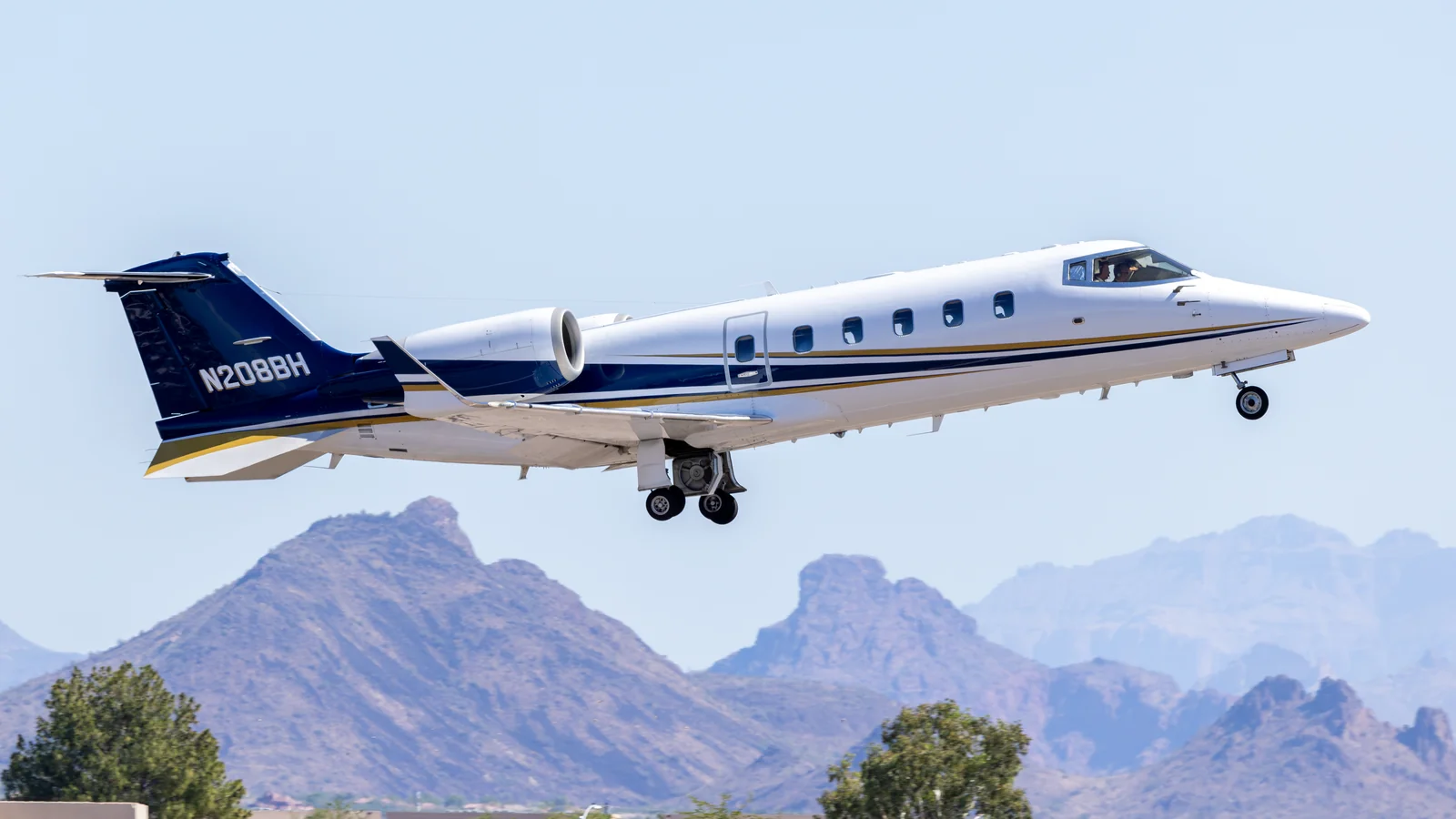

Nine people died on Sunday afternoon, November 1, 2026, when a Learjet 60 business jet crashed into a neighborhood in Palm Beach County, Florida. The jet was flying from Austin, Texas, to North Eleuthera in the Bahamas. It came down near Military Trail, between Cresthaven Boulevard and 10th Avenue North, in an unincorporated area near Greenacres and Palm Springs.
Our thoughts are with the families of the people on board and with everyone in the neighborhood where it happened.
Within an hour of the crash, dashcam video, descent numbers and theories about the cause were all over social media. This piece sorts out what has actually been confirmed and explains, from a working pilot's point of view, what the early data can and can't tell you. It also covers what investigators will do over the coming days and months. We won't guess at a cause. Nobody can know it yet, and anyone who claims to is getting ahead of the evidence.
Updates
- Nov. 1, 6:10 p.m. ET: The NTSB said on X that it is launching a go-team, with investigators arriving at the site Sunday and Monday morning, and that it will hold a media briefing in West Palm Beach on Monday (time and location to be announced). At a news conference with Gov. Ron DeSantis, officials said they had no reports of anyone on the ground being killed or injured, and county officials said about 600 residents of a nearby mobile home community are expected to be relocated while the investigation continues, WPTV reports.
- Nov. 1, 4:58 p.m. ET: First published. We checked official sources (the FAA, the NTSB, the Palm Beach County Sheriff's Office and Fire Rescue) at this time. The NTSB had not yet announced a briefing or posted a statement, and the Miami Herald reported that an NTSB spokesperson had not responded to requests for comment. No injuries or deaths on the ground had been confirmed. No one on board had been identified. The Palm Beach Post reports that the crash site is in an unincorporated area near Greenacres and Palm Springs.
What happened in the Palm Beach County Learjet crash: the confirmed facts
According to the Federal Aviation Administration (FAA), the Learjet 60 crashed in a residential area near Cresthaven at about 12:50 p.m. local time with nine people on board. It had departed Austin-Bergstrom International Airport and was headed to North Eleuthera Airport in the Bahamas.
Transportation Secretary Sean Duffy said on X, shortly before 4 p.m. ET, that all nine people on board were killed. The FAA said the National Transportation Safety Board (NTSB) will lead the investigation and provide all updates, with the FAA supporting it.
Public FAA registry records list the aircraft as N722BD, a Learjet 60 with serial number 271. It is registered to LR60271 LLC, a company at a Wilmington, Delaware, address. That address belongs to a registered-agent office used by many companies, so it tells you nothing about who flew the airplane or why.
Local agencies closed Military Trail in both directions. Palm Beach County Fire Rescue called it an "extended incident." The Palm Beach County Sheriff's Office is managing the scene. Video and photos from the area show fire, debris across the roadway and a crater near the road. As of 6:10 p.m. ET, officials said they had no reports of anyone on the ground being killed or injured (WPTV).
What's confirmed and what isn't
What the descent numbers and ADS-B data can and can't tell you
The figure getting the most attention is the reported descent: from about 35,000 feet to under 9,000 feet in roughly a minute. That's an average of around 350 feet per second, or more than 20,000 feet per minute. For scale, a normal airline descent toward an airport runs around 1,500 to 3,000 feet per minute. Even a deliberate emergency descent after a pressurization problem typically runs somewhere in the 4,000 to 6,000 feet per minute range.
So if the numbers hold up, the airplane was not in any kind of controlled descent. That much a pilot can say. What the numbers can't tell you is why. Here is what to keep in mind:
- ADS-B is not the flight data recorder. The tracking sites everyone screenshots use the airplane's own broadcast position and altitude, picked up by ground receivers. During extreme maneuvers, data can drop out, update slowly or show odd values. Investigators treat it as a starting point and check it against radar, air traffic control recordings and whatever data the wreckage gives up.
- Very different problems can produce the same descent profile. Structural, mechanical, environmental and human factors can all end up as "a steep descent from cruise." Picking one from a line on a chart is guessing.
- Weather reports describe the ground, not the cruise altitude. The Palm Beach Post reported overcast skies with rain and lightning in the area, and South Florida was under a flood watch on Sunday. That's worth recording, and NTSB weather specialists will study it. But surface conditions don't tell you what the jet met at 35,000 feet, and nobody official has linked the weather to the crash.
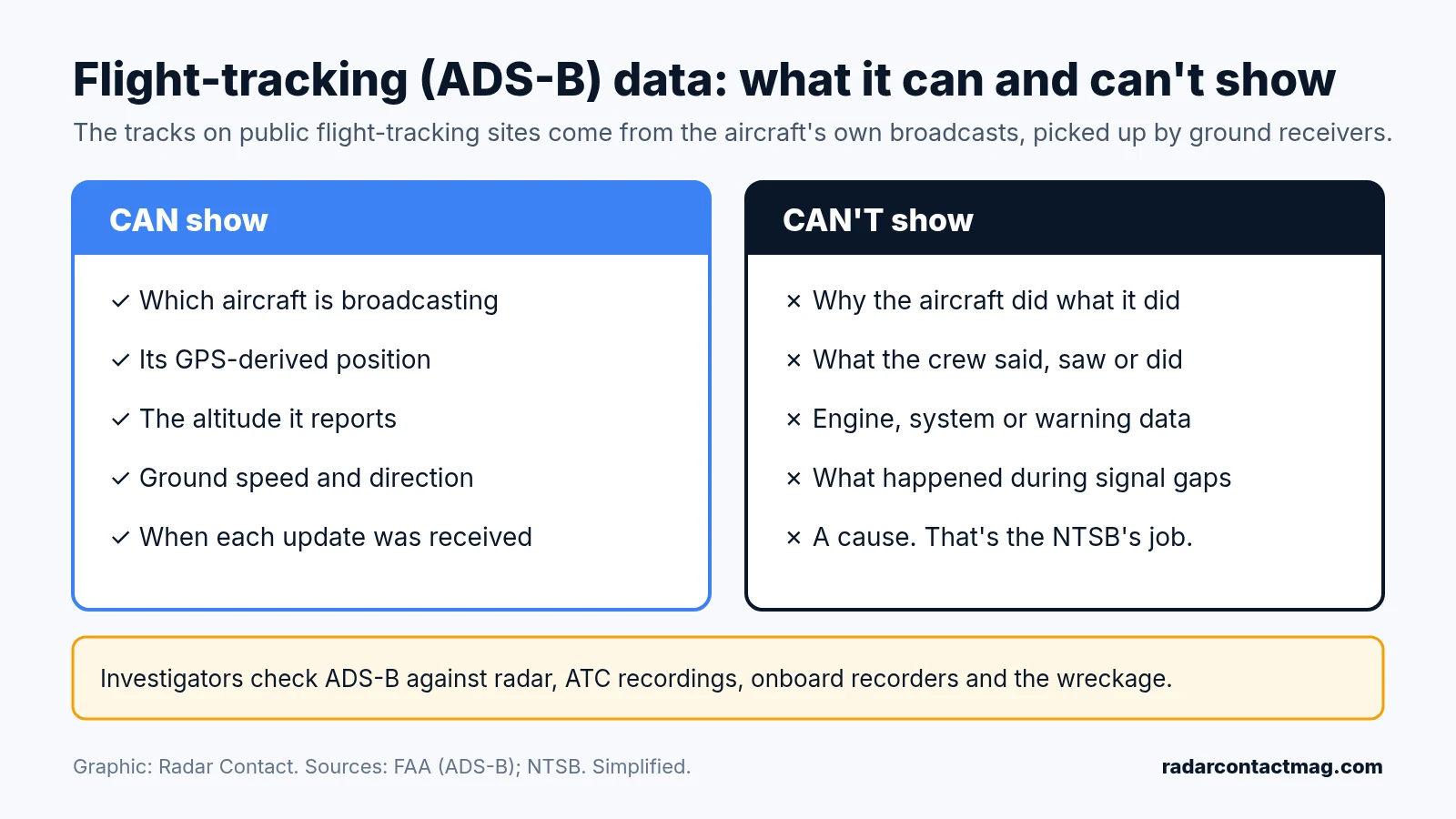
When you see a confident explanation on social media, ask what it is based on. Usually the answer is a tracking screenshot and a video clip, and the NTSB will spend months collecting much more than that.
A quick look at the Learjet 60
The Learjet 60 is a midsize business jet built in Wichita, Kansas. Production started in the 1990s, and the later 60XR version was built into the 2010s. It has two Pratt & Whitney Canada PW305-series engines and is designed for two pilots. It typically seats six to eight passengers, depending on the cabin layout. Bombardier, which owned the Learjet line, ended Learjet production in 2021, but hundreds of Learjet 60s are still flying with private owners, charter companies and air ambulance operators.
It's a fast, high-flying airplane that many pilots enjoy flying, and it holds the same kind of FAA type certificate as any other business jet. Its type and age alone tell you nothing about what happened on Sunday.
Private, charter or airline: why the rules matter
One of the first things investigators will establish is which set of rules the flight was operating under. That hasn't been confirmed for this flight. Here's why it matters.
- Part 91 (general aviation, including private flights). The owner or a company flies its own airplane for its own purposes. The FAA sets minimum standards, but there are fewer requirements for crew training, duty time, maintenance programs and operational oversight.
- Part 135 (on-demand charter and commuter). When the public pays for a flight, the operator generally needs an FAA Part 135 certificate. That comes with approved training programs, pilot duty and rest limits, maintenance requirements, stricter weather minimums and FAA oversight of the company.
- Part 121 (scheduled airlines). This is the world most line pilots live in (here's what a real airline pilot schedule looks like): dispatchers sharing legal responsibility for every flight, recurrent simulator training, safety-management systems, flight data monitoring programs and much more.
Part 121 has the strongest safety record of the three by a wide margin, and that's no accident. Every layer of rules exists because of an earlier accident. That doesn't mean business jets are unsafe. Many corporate flight departments and charter operators voluntarily meet standards close to airline levels. But the rulebook a flight operates under says a lot about the safety layers around it, and that's why investigators look at it early.
What the NTSB does now
The NTSB is an independent federal agency. Its job is to find out what happened and recommend changes so it doesn't happen again. It does not assign blame or decide legal liability. Here is how its process generally works:
- The first days on scene. Investigators document the wreckage and the impact area, measure and photograph everything, and recover anything that can hold data: recorders, avionics and engine components. On a major investigation, the NTSB usually holds a media briefing in the first days to share early factual information.
- Recorders. Many business jets the size of the Learjet 60 are required to carry a cockpit voice recorder. Whether this jet also had a flight data recorder depends on its equipment and how it was operated. The NTSB will confirm what was on board and what could be recovered. After a high-energy impact, getting usable data out of the recorders can take time.
- Parties to the investigation. The NTSB brings in organizations with technical expertise. That typically includes the FAA, the airframe and engine manufacturers and the operator. They help with the technical work, but the NTSB controls the investigation and its findings.
- The preliminary report. It usually comes out within about 30 days. It is factual only: the flight history, the wreckage and the weather. It doesn't analyze anything or name a cause.
- The final report and probable cause. This typically takes 12 to 24 months. The final report gives the probable cause and contributing factors, and often safety recommendations to the FAA, manufacturers or operators.
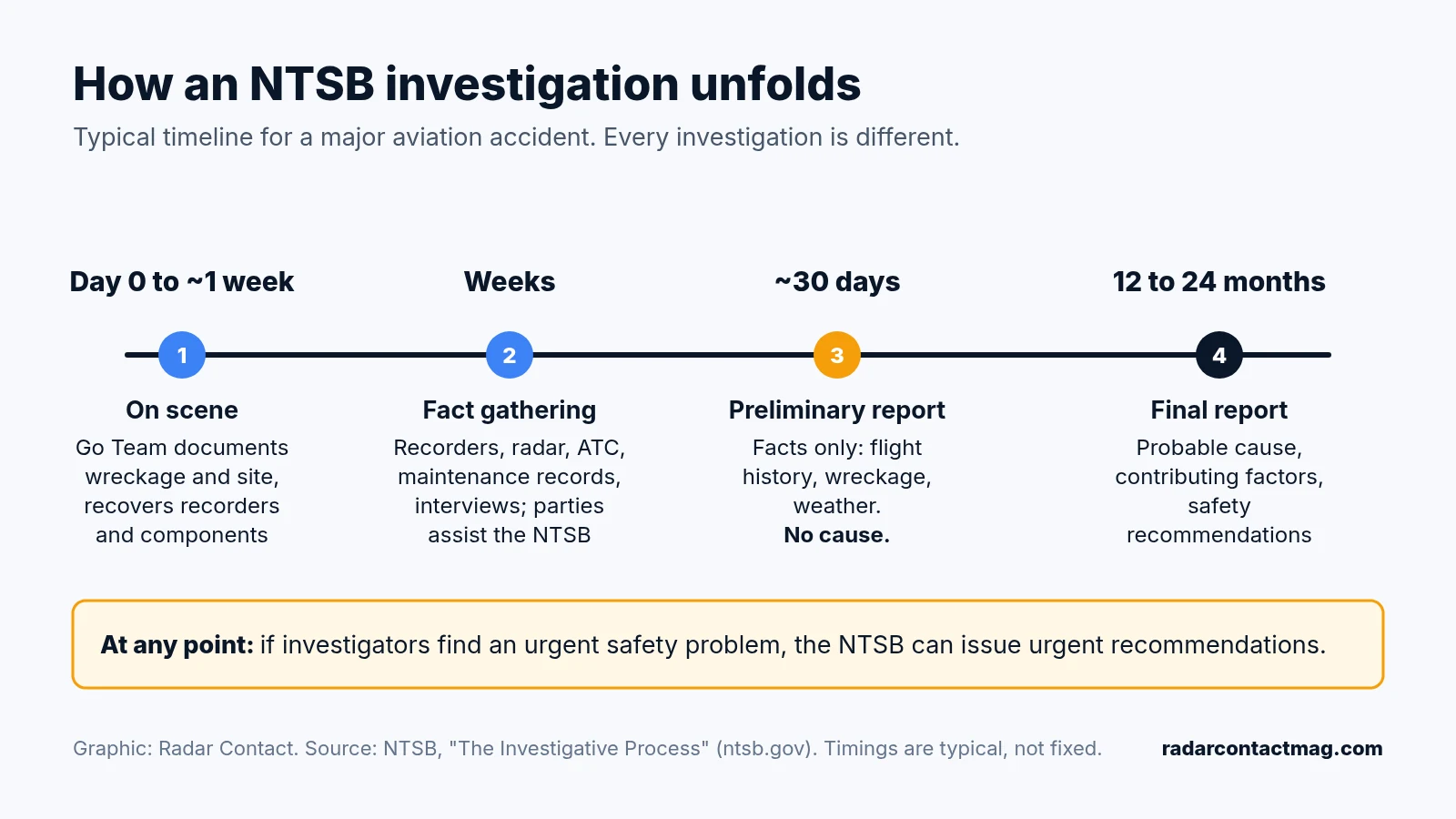
If investigators find an urgent safety problem along the way, such as a part or procedure that puts other aircraft at risk, they don't have to wait for the final report. They can issue urgent recommendations, and the FAA can act right away.
Why we're not naming a cause
Pilots are trained to work with facts and to keep a cool head. Experience also teaches us something about first reports after accidents: they're often wrong. Early reports have misidentified aircraft, miscounted the people on board and blamed the wrong thing entirely. The families of the nine people who died deserve accurate answers, not a guess from a stranger on the internet. We took the same facts-first approach in our explainer on the flydubai FZ1073 co-pilot attack and how cockpit security works.
We'll update this story as the FAA and NTSB release confirmed information. See the Updates section at the top for the latest.
Florida Learjet crash: FAQ
What type of plane crashed in Palm Beach County on Nov. 1, 2026?
A Learjet 60, a twin-engine midsize business jet, according to the FAA. FAA registry records list the jet widely reported as the accident aircraft as N722BD.
How many people died in the Florida Learjet crash?
U.S. Transportation Secretary Sean Duffy said all nine people on board were killed. As of 6:10 p.m. ET, there was no official confirmation of injuries or deaths on the ground.
Where was the plane going?
It departed Austin-Bergstrom International Airport in Texas and was headed to North Eleuthera Airport in the Bahamas, according to the FAA.
When will we know what caused the crash?
The NTSB's preliminary report usually comes out within about a month, but it won't name a cause. The final report with a probable cause typically takes 12 to 24 months.
Are private jets less safe than airlines?
Scheduled airline flying under Part 121 has the best safety record in aviation. Private and charter flights operate under different rules with fewer required safety layers. Safety varies a lot between operators, and many meet standards well above the legal minimum.